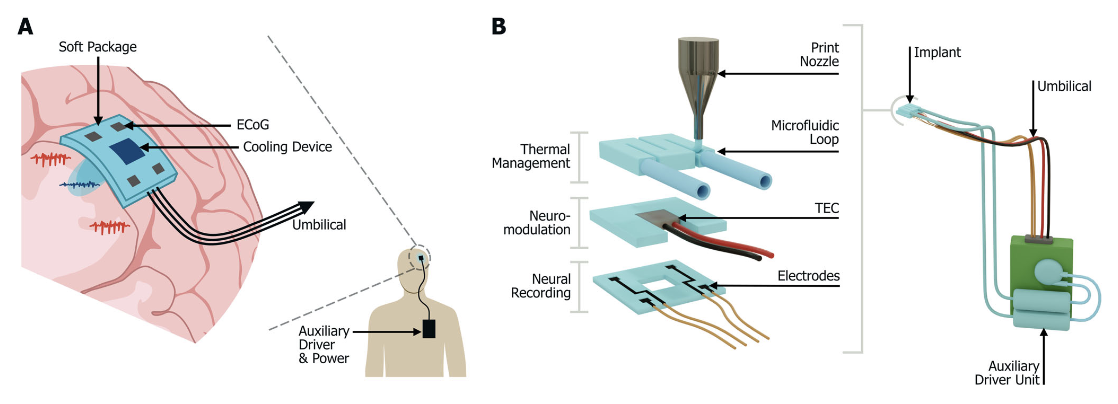
Researchers from the Leibniz Institute for Polymer Research Dresden, TUD Dresden University of Technology, the University of Sheffield, and the University of Limerick have developed a 3D printed silicone implant that cools a small area of the brain’s surface while recording its electrical activity. In rats, the device suppressed seizure-like activity, a result the team links to a possible alternative treatment for drug-resistant epilepsy.
Focal brain cooling temporarily lowers the temperature of a targeted region to quiet neural activity, offering a reversible way to dampen seizures. Its path to the clinic has been slowed by hardware: heat pulled from the brain must also be carried safely away, and earlier systems relied on bulky, rigid components poorly suited to soft tissue and the confined space of the skull.
Building the Implant with 3D Printing
The team fabricated the 10 x 10 x 3 mm implant with direct ink writing (DIW), extruding Dow’s DOWSIL SE1700 silicone on a RegenHU 3D Discovery printer. The researchers say the approach, which uses non-cleanroom tools and off-the-shelf components, could lower the cost of developing multi-function implants.
The device stacks three printed modules. The bottom layer holds four electrodes printed from a graphite and silicone composite. The middle layer houses a miniature thermoelectric cooler (TEC) that moves heat from one face to the other when current is applied. The top layer contains a water channel that carries heat away from the TEC’s warm side. Each silicone layer was printed as one continuous path to avoid seams that could weaken the structure, and a final cure fused the modules into a single piece.
Testing Cooling Performance
An external driver unit measuring 17 x 8 x 5 cm powers the implant, pumps water through it, and adjusts current to the TEC based on temperature readings. Surrounding brain tissue should not warm by more than 1°C. The team’s modeling showed that natural cerebrospinal fluid flow could not keep the TEC’s warm side within that limit, so the design uses forced water circulation.
In agar gel held at 37°C to mimic brain tissue, the system held its target temperature within ±0.25°C and reached 23°C in about 5 seconds. Heat from the warm side stayed inside the implant, while cooling reached 1 to 3 mm below the device. The system drew 2.6 W during steady cooling. The authors note that agar does not replicate blood flow and likely overstates how far cooling spreads.
Seizure Suppression in Rats
In nine anesthetized rats, the team triggered seizure-like activity with the drug 4-aminopyridine. The drug was delivered through a NeuroNexus depth probe that also recorded activity inside the cortex. The implant then applied 60-second cooling events at temperatures between 25°C and 15°C.
Cooling reduced average brain signal energy at every temperature tested, with signals weakening within seconds of activation. The 15°C setting was slightly less effective than milder ones. The researchers say this needs further study, since it differs from previous studies and rests on few trials.
The implant’s electrodes recorded the most consistent drops in the delta and beta brainwave bands. Delta-band signal energy fell 48 percent ± 35 percent at 18°C. Activity returned tens of seconds after cooling stopped, meaning the treatment dampened seizures without ending them.
Remaining Hurdles for Clinical Use
The 1 to 3 mm cooling depth is comparable to the thickness of the human neocortex, which the authors say makes the design attractive for seizures that start in that layer. Deeper or scattered seizure sources may require more cooling contacts or a new implant shape.
Long-term implantation would require shrinking the 680 cm³ driver unit toward the 10 to 20 cm³ of chest-implanted pacemakers. It would also need a reliable connector, an integrated power supply, a sealed titanium housing, and aging tests. The authors point to wireless power transfer as one route for powering the system. They also suggest signals recorded by the implant could eventually trigger cooling automatically, drawing on adaptive deep brain stimulation for Parkinson’s disease, which adjusts output based on beta-band activity. The work was funded in part by the European Research Council, with support from the Sheffield University Neuroscience Institute.
From Printed Electrodes to Multi-Function Brain Implants
According to the authors, previous 3D printed implantable electrode arrays have been limited to electrical stimulation and recording. Focal cooling systems, meanwhile, have used separate cooling and recording devices, bulky external hardware, and rigid metals.
Ivan R. Minev, an author of the new paper, also co-authored a 2020 study from the University of Sheffield, St Petersburg State University, and TUD Dresden University of Technology, which 3D printed soft implants that stimulated the spinal cords of injured rats and zebrafish. The brain cooling paper cites that work among prior printed implants confined to electrical functions.
The new implant extends that printing approach to temperature control, placing cooling, heat removal, and recording in one soft device on the brain’s surface.
Titled “Printing-Assisted Integration of Thermal, Fluidic and Electrical Components in Implants for Focal Brain Cooling,” the study was conducted by Spencer Ryan Moore, Naomi King, Aruã Clayton Da Silva, Clare Howarth, Jason Berwick, Thomas E. Paterson, and Ivan R. Minev.
To stay up to date with the latest 3D printing news, don’t forget to subscribe to the 3D Printing Industry newsletter or follow us on LinkedIn*.*
Explore the full Future of 3D Printing and Executive Survey series from 3D Printing Industry, featuring perspectives from CEOs, engineers, and industry leaders on the industrialization of additive manufacturing*,* 3D printing industry trends 2026*, qualification, supply chains, and* additive manufacturing industry analysis*.*
Featured image shows Design of the 3D printed brain cooling implant and its external driver unit. Image via Moore et al., Advanced Science.