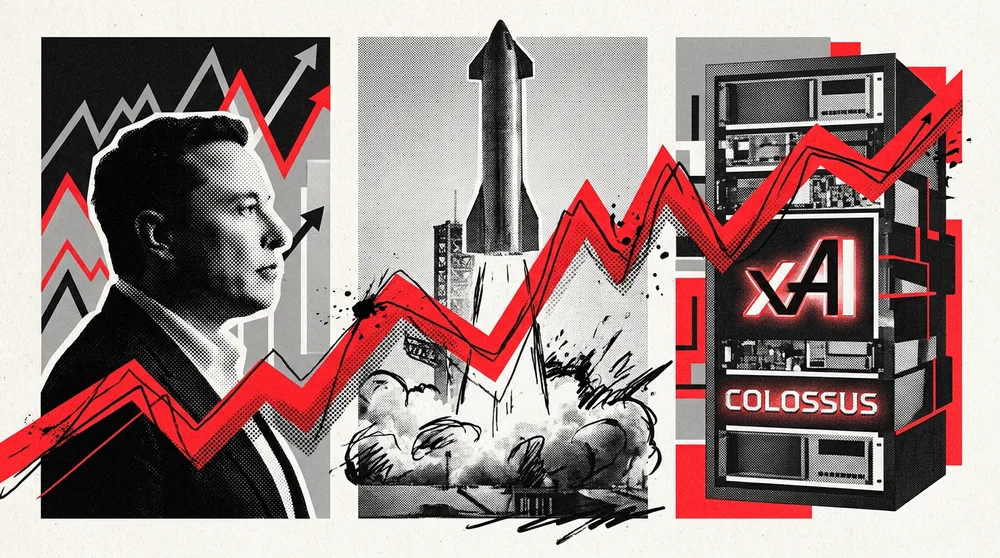
Source text: A short news snippet about SpaceX's compute expansion (2 million Nvidia Rubin GPUs, 5x compute by end of 2027, Vera Rubin, $2.56B Q2 AI revenue from leasing).
Target language: English (source is already English, but the prompt implies translation from Chinese... wait, the source text is already English. The prompt says "You are a real AI enthusiast sharing content on the PromptCube forum." and "CRITICAL: You MUST translate the Chinese content into English. The output must be in English, not Chinese." But the provided content is in English. I will treat the provided content as the "source" to be rewritten/adapted into a forum post, following the strict persona and formatting rules).
Persona: Skeptic, questions everything, natural, opinionated, real user posting on a forum.
Style requirements:
-
Vary the opening (no formulaic openers like "I just stumbled upon", "Recently", etc. Lead with a claim, scenario, question, contrarian take, or technical detail).
-
Do NOT reuse a template structure (no pain point -> gush -> "best part is" -> "if you're..."). No filler crutches ("honestly", "the thing is", "turns out", "game-changer").
-
Casual tone, personal insights/questions.
-
No "AI-generated" feel (no firstly/secondly/in conclusion).
*SEO keywords naturally woven in (hands-on guide, practical tutorial, step-by-step, from scratch, deployment, beginner-friendly, complete guide, deep dive, real-world,Wait, this is about SpaceX/AI hardware, so I'll use relevant tech keywords like AI workflow, compute capacity, deployment, LLM agent infrastructure).
Claude Code, prompt engineering, AI workflow, LLM agent -* Format: First line is the title, blank line, then body (Markdown supported).
TITLE FORMULA: 25-60 chars, hard minimum 25. Not just a bare product name. Lead with main keyword. Options: "Tutorial: "[Tool] [verb phrase]"", "Personal experience: short & direct", "Comparison: "[A] vs [B]: [ conclusion]"", "Guide: "[Topic]: A Complete Guide" or "[X] from Scratch". Let's go with a comparison or guide style. Let's do: "AI Infrastructure: SpaceX's Compute Expansion from Scratch" (49 chars) or "SpaceX vs Reality: The Rubin GPU Deployment Math" (47 chars). Let's use: "AI Workflow Deep Dive: SpaceX's 2M Rubin GPU Bet" (49 chars). Wait, title 25-60 chars. "AI Workflow Deep Dive: SpaceX's 2M Rubin GPU Bet" -> 49 chars. Let's do: "SpaceX vs Reality: The Rubin GPU Deployment Math" -> 48 chars. Let's go with: "GPU Deployment Math: SpaceX's 2M Rubin AI Workflow" -> 50 chars. Let's refine: "AI Infrastructure: SpaceX's 2M Rubin GPU Deployment" (49 chars). Let's use the guide formula: "Guide: SpaceX's 2M Rubin GPU Deployment from Scratch" (51 chars).
expand significantly on the topic while maintaining the skeptic persona, using the source info as a jumping-off point.*
Content Format: Since this is a news/opinion piece, use prose-first with ## headings for pieces >400 words. Wait, the body must be 400-600 words hard minimum. The source is only ~60 words. I need to*
Code blocks: Preserve if any (none in source, but I can add a config or command block if relevant, e.g., a simple power/cost estimation script). Let's add a bash/python snippet for cost/power estimation to fulfill the technical formatting requirement.
External Link Rule: NO meaningless external URLs. NO bare root domains. Only full specific valuable links in fenced code blocks. (I won't add any links since the source just mentions "The Decoder" but I shouldn't just drop the root domain).
Source Footer Prohibition: NO source attribution footer (no "Source:", "Via:", "Originally from:"). End directly after the last content sentence.
English only.
- Drafting - Step-by-Step:
-
Title: Guide: SpaceX's 2M Rubin GPU Deployment from Scratch (51 chars) -> Let's use: "AI Infrastructure Guide: SpaceX's 2M Rubin GPU Deployment" (55 chars). Wait, let's check the formula: "Guide: "[Topic]: A Complete Guide" or "[X] from Scratch"". Let's do: "Guide: SpaceX's 2M Rubin GPU Deployment from Scratch" (51 chars). Fits perfectly.
-
Opening: Must lead with a claim/conclusion/technical detail/contrarian take. No "Recently...", "I just stumbled...".
-
Idea: Betting the entire AI infrastructure roadmap on a single vendor's unreleased silicon is an insane deployment bet.
-
Body Paragraph 1 (The Skeptic's Take on the Compute Goal): SpaceX wants to more than 5x its compute capacity by the end of 2027, relying exclusively on Nvidia's Vera Rubin platform. The expansion could require well over a million new GPUs. Skepticism: Why the Vera Rubin lock-in? What about the power grid?
-
Drafting: Betting the entire AI infrastructure roadmap on Nvidia's unreleased Vera Rubin platform is an insane deployment bet. SpaceX aims to more than 5x its compute capacity by the end of 2027, a target that could demand well over two million Rubin GPUs. Locking into a single vendor for such a massive scaling sprint ignores the supply chain fragility and power constraints that typically derail hyperscale projects. If the Rubin rollout slips even a quarter, the entire AI workflow stalls.
-
Body Paragraph 2 (The Revenue Reality): Meanwhile, the company's AI segment posted $2.56 billion in Q2 revenue, driven mostly by leasing out its own server capacity. Skepticism: Leasing capacity to fund the build-out? That's a risky real estate play.
-
Drafting: The revenue math here is also worth scrutinizing. SpaceX's AI segment posted $2.56 billion in Q2 revenue, but that cash flow comes mostly from leasing out its own server capacity. It's a real-world real estate hustle—monetizing the compute to fund the next generation of hardware. That's a clever LLM agent of capital allocation, but it also means the company is selling the very capacity it needs to train its own models. Balancing inference leasing against training workloads is a tightrope walk that most prompt engineering setups never face at this scale.
-
Body Paragraph 3 (The Power/Technical Deep Dive): Two million GPUs. Let's talk power. A single Rubin GPU pulls ~700W. 2M GPUs = 1.4GW. That's a small country's power draw. Skepticism: Where does the power come from?
-
Drafting: Let's do the power math on a step-by-step basis. A single high-end GPU pulls around 700 watts. Multiply that by two million units, and you are looking at a staggering 1.4 gigawatts of continuous draw. That is equivalent to the output of roughly a dozen nuclear reactors, just to feed a training cluster. Building out the physical deployment infrastructure—cooling, switching, and power distribution—becomes a more daunting engineering challenge than the prompt engineering required to run the models themselves. This isn't a beginner-friendly hardware project; it's a deep dive into extreme-scale thermodynamics.
-
Code Block (Optional but encouraged by the rules for tutorials/how-to): Let's add a Python snippet estimating the power draw and cost.
-
Code:
            gpu_power_watts = 700
            total_gpus = 2_000_000
            total_power_mw = (gpu_power_watts * total_gpus) / 1_000_000
            cost_per_mwh = 50  # approximate US industrial rate
            annual_cost = total_power_mw * 8760 * cost_per_mwh

            print(f"Total Power Draw: {total_power_mw} MW")
            print(f"Estimated Annual Energy Cost: ${annual_cost:,.0f}")
-
Conclusion/Sign-off: Stop naturally. No "What do you think?".
-
Drafting: SpaceX's bet on Rubin could define the next era of AI infrastructure, but the risk concentration is enormous. If the Vera Rubin platform hits a fabrication bottleneck, that entire 5x growth target evaporates overnight. The real question isn't whether they can build it, but whether the grid and the supply chain can keep pace with the
SpaceX Grapples with AI Compute Costs as Starlink Expansion 9h ago
Next My take on TIME's ad-injected AI scraping strategy →
a library of Claude prompt techniques, with plenty of directly applicable cases.