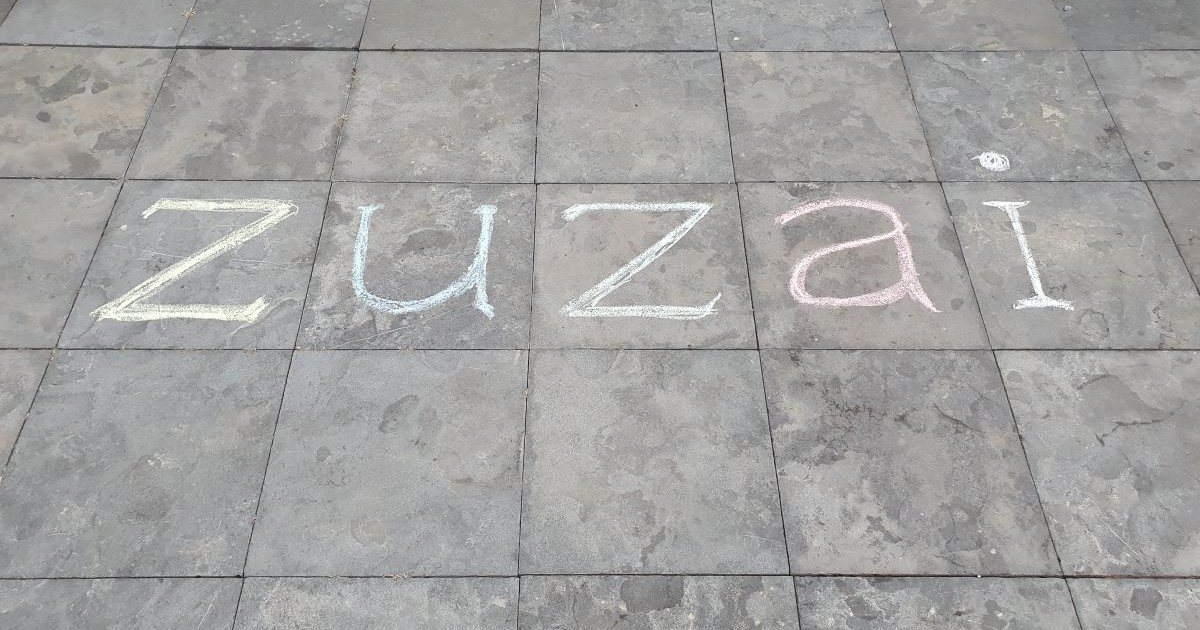
We need a new word. How about ... zuzai?
I'll begin with something obvious: things made with AI tools are proliferating in lots of places where lots of people don't want them.
Not so obvious: we don't have a good, crisp word to indicate that something is not one of these things, in other words, that it is free of AI.¹
In certain instances, a potent word like "human" works well as a descriptor (more on this below), but in so many cases people need to resort to "AI-free," or "non-AI," or "human-generated," or even spelling out something like "I wrote this without the use of AI."²
As I see it, this unprecedented presence of AI calls for us to deploy a newly coined word to signify its absence. A positive, lively word that doesn't center AI and that is broadly applicable. I'll get more into the why later, but first, I'll introduce my candidate ...
Zuzai uses zero artificial intelligence
The text in bold above provides the new word, zuzai, what it means, and what the letters in zuzai stand for.³ So technically it's an acronym (and a nerdy one at that, called a recursive acronym), but all in lowercase like laser and scuba. It's pronounced like "zoo's eye."⁴
I've been thinking about coining a new word for months, considering different options, and zuzai rose to the top. Its syllables pack poetic punch. Alphabetically, it's about as distant from AI as you can get. It doesn't appear to currently have significance in the English-speaking world.
I can envision it being used not just to describe a creation (like an essay or an image), but also a condition. Think about setting your design software to zuzai mode, an author using a zuzai writing process, or a teacher requiring a zuzai testing environment.
Ideally this new word, if widely adopted, could attain connotations in the popular imagination, evoking associations with characteristics like authenticity or quality.
Isn't this a retronym?
Initially, I thought that zuzai should be classified as a retronym as well as an acronym. Now I'm not so sure.
(A retronym is a word or word combination created to distinguish an old type of thing from a newer variety, where previously no such distinction existed. Clocks with dials and hands only became known as analog clocks after the advent of digital clocks. Paper books (aka physical books) were just "books" before e-books. Snail mail used to simply be "mail" prior to email. Wikipedia has a surprisingly long list of examples.)
So zuzai seems like a retronym, showing up to describe something that hitherto required no added description ... but what is the some thing? Zuzai might be better described as a retronymic adjective which can be applied to many a noun.
Most retronymic adjectives, though, are words that existed prior to being used in a retronym. Even "offline" was in the language (originally in the railroad context) before the creation of the Internet. Zuzai would be an unusual neologism (new word) called into service as a retronymic adjective ... but we are in unusual times.
Coining a word is one thing; wide adoption is another
I'm a lover of languages, but I have no formal academic training in linguistics. Fortunately, one of my best friends, Alex, has a PhD in the field, and he's reviewed this concept.⁵ He wrote, "I am a pretty strong believer in the 'invisible hand' of neologisms, i.e. I don’t think takes, proposals, and arguments carry much weight in whatever ends up winning the day." I concede that zuzai as household word may well be a long shot.
That said, I take heart from the example of "vegan," which was proposed by a guy in 1944 to replace "non-dairy vegetarian." This positive spin on what is today essentially "no animal products" has certainly taken root and grown like a weed, and now the word can be used to describe a sandwich, a person, a restaurant, even a pair of shoes.⁶
Perhaps the arrival of the word zuzai (kind-of like vegan, or keto, paleo, trad, sober,
clean, etc. to their adherents) might buoy supporters of AI-eschewing behavior by giving them a zippy, more affirmative shorthand to denote and describe it.
Should I be more clear about what I mean by "AI"?
Some readers may ask "Shouldn't you be specifying 'generative AI'?" and/or "Don't you know that even using the spellcheck in most writing programs is using AI?" and/or "What does artificial intelligence even really mean?"
In a piece from November about retronyms within the realm of AI, Eric Hultgren observes that "generative" was increasingly being dropped, even back then. I'll defer to one of the most prolific voices on AI, Ethan Mollick, who just uses "AI" instead of "generative AI."
I'm considering "AI" to mean what I perceive to be the most widespread interpretation: the technology that erupted onto the scene in late 2022. Not the technology in spellcheck or speech recognition or modern cameras' built-in image optimization.
Incidentally, I think that Janet Vertesi makes a strong case that questions like "What is AI?" can be considered an "ontological decoy" distracting from the more pressing problem of what she calls the "Project of AI." So I'm going to dodge that one entirely.
Why not use an existing word?
I considered a bunch of existing words (and also read others' writing about retronyms in response to AI). There are some good options out there, but I don't think they cover the general case quite as well as zuzai does.
The places where "human" takes the cake ... and doesn't quite
In his post from February, "Retronyms and the Rebranding of Humanity," Mark Gibson writes compellingly about new retronyms like "human creativity," "human participant," and "human oversight" and the implications for our age. For these instances, I do think "human" is the best choice of word, and I would add to his list retronyms like "human actor," "human therapist," and "human teacher." But "human" doesn't work well to describe visible, tangible, or audible outputs.
What about "human-made"? Gibson's article offers the retronym "human-made art" as distinct from "generative AI art." But 21st-century art can be very technology-driven (while free of AI). To my lights, every autonomously created momentary appearance from a 2008 art installation is not "human-made." Also, some people may find early animated films to be much more "human-made" than, say, 2015's Inside Out, which relied heavily on CGI (computer-generated imagery). Was the latter movie human-made? This one is squishier for me.
One-Word-A-Day declares "human-generated" to be one of its current Top 10 Retronyms ("vs AI"), but I reckon it's not quite sufficient. Setting aside the fact that it's a drab mouthful at six syllables, it doesn't cover the range of outputs that AI now can and does mimic. The sound in a recording of wind-chimes and birdsong is not "human-generated," nor is a snapshot portrait taken by a photo booth. But both are (typically, at least for the moment) free of AI.
Why "AI-Free," "no-AI," "non-AI," and "not by AI" are lacking something
Would the market for organic food be the behemoth that it is if the choice of label had been something like "synthetic pesticide-free"?⁷ Admittedly it's not a kale-to-kale comparison, but I hope the point is clear. Why mention AI if the point is avoidance of AI?
These AI-focused terms do bring the advantage that they are instantly understood, but look how quickly "slop," "6-7," and "enshitification" were able to enter the lexicon.
Other existing adjectives don't quite fill zuzai's shoes
- "Traditional" - Mark Gibson also offers "traditional art" as a retronym possibility, but that doesn't seem to encompass avant-garde or experimental art. I think there are a lot of innovative zuzai creators out there that would chafe at having their work called "traditional." And saying "I strive to write traditional email messages" doesn't get the (right) point across.
- "Hand-made" or "hand-spun" - I recall decades ago liking the latter for HTML, as used here, but don't think it's as broadly applicable as the word I would crave for us to have. Think, for example, of an image of an elk from a motion-triggered wildlife camera. - "Artisanal" - It wouldn't apply to, for example, Forrest Gump. Or my family's 1977World Book Encyclopedia. - "Real" (or actual, authentic, bona fide, legit, legitimate, etc.) - What about disinformation written by a human? And is technically sound software code written partly by AI not "legitimate"? I see a lot of potential for confusion.
- "Original" - Is a selfie taken by someone showing the peace sign in the passenger seat of a car original? Or a completed algebra assignment? I can think of heaps of very zuzai creations that are still artlessly imitative. Also, creations made with AI can be original.
- "Conventional" or "classic" - Like "traditional," these aren't a great fit for convention-defying creations.
- "Analog" - While it's useful for many other tools and outputs that pre-dated digital versions, what about the vast majority of music we listen to using our phones or other digital devices? Zuzai, but not analog.
- "Mindful" or "intentional" - These don't apply to security camera footage or satellite images. Would you say, "This is an intentional slide deck"?
- "Natural" or "organic" - These may be tempting as a counter to the "artificial" integral to AI's name, but they seem like a real stretch to describe something like OG Tetris.
- "Human intelligence" - The term is already commonly used in the military intelligence context, aka "humint," andit would be really unwieldy before a noun.⁸ - "Anthropogenic" - Too cumbersome and bookish-sounding; also often associated with environmental harms.
- "Unassisted" - Most books and magazine articles from our lifetimes have been written with the assistance of editors. Many coders work in teams.
- "Luddite" - A relevant word now, for sure, but it already has baggage from two centuries ago, and implies a general anti-technology stance, which is not the intent for zuzai.
Another thing about using existing expressions is that they're probably less likely to make anyone take notice or reconsider the significance of the concept.
How about borrowing a word from another language?
Why reinvent the wheel, if some other language already has filled this semantic gap? I did some cursory research, and it appears that Japanese, Spanish, French, and German currently have a smattering of terms being used for different instances, much like English.
Russian evidently does have a very widely used term, which translates to human-crafted, or human-made. But the word is рукотворный, and when I tried to mimic the pronunciation, I laughed out loud.
Interestingly, a few weeks ago, when looking into Mandarin, my Google search indicated that yuánchuàng (原创), which means something like "original," was the prevailing term. But as of July 21, a search indicates that this term has recently started being questioned because creations made with AI can be original too, as mentioned in the previous section.
My investigation was clearly far from exhaustive. If someone knows an expressive, multipurpose (and not too hard to transliterate and pronounce) word from another language out there, please let me know!
A newly minted term might pique more interest
AI has gotten plenty of buzz and hype. As I see it, those advocating for the benefits of pre-2022 methods deserve to have a fresh term that's worthy of some buzz as well, if not hype.
Years ago, Dr. Bill Thomas impressed me with his argument for using an unfamiliar, distinctive word to intrigue people so that they are more likely to and think about something, and maybe even more likely to absorb and retain it.
Another way of putting it: hashtags aren't what they once were, but #zuzai strikes me as a more vigorous hashtag than any of the alternatives I've seen.⁹
For the record, in conjuring up zuzai, I also toyed with and decided against a bunch of other concepts, which I've listed in a footnote.¹⁰
What about certifying that something actually is zuzai?
That is a whole 'nother discussion. I don't have much to offer on certification other than that I wonder whether C2PA is likely to catch on as a word.
Closing words about a word
If you read this far, thank you. AI looms large, likely to be a formidable force for the rest of our lives. Maybe you'll join me in promoting a word with personality that celebrates the things that can be done, and have been done, without it. If you'd consider sharing this essay, I'd be grateful. If you find your own way to spread the word (as it were), even better! Last, three final notes (before the footnotes).
Many thanks to Ramon Esquivel and Alex Funk for their insights on an early draft. Thanks also to Seth Godin for (unknowingly) giving me the nudge I needed to move this forward.
I plan to post this essay on LinkedIn as well as here on zuzai.org. The fact that this domain was unclaimed provides yet another indication that the word currently has few, if any, widespread associations.
And yes, both this prose and the images are zuzai. My research included using search engines, and sometimes I did look at what the "AI overview" provided. Soon I plan to reconfigure or replace my search tools so that such "guidance" doesn't automatically appear at the top!
Footnotes
¹ I acknowledge that "we" here is English language-centric. There's a real possibility that some non-Anglophone cultures are a step ahead and have fully addressed this need unbeknownst to me.
² Two good examples are "Legibility of Effort" by Nolen Royalty and "The Dead Economy Theory" by Owen McGrann.
³ The "u" could also stand for "used" or even "using" (instead of "uses") if that makes more sense given the context.
⁴ When naming words, I'm deliberately using a mix of quotation marks, italics, and sometimes neither. I'm sorry if that bothers some readers. I sacrificed consistency when it seemed to make the text more legible and the punctuation less of a distraction.
⁵ Alex also helped me understand that zuzai doesn't fit in the typical retronym box.
⁶ Apologies to the certain members of my extended family who would likely prefer that I used "plant-based" here instead of "vegan." I get that! Just not in this particular context. =) Also, I note that vegan isn't a retronymic adjective, in fact quite the opposite (see vegan cheese vs. dairy cheese).
⁷ In places where the labels are "biological" or "ecological" rather than "organic," the same logic applies.
[⁸](#top_footnote_8) Also the acronym for human intelligence would have confounding homonyms. =)

[⁹](#top_footnote_9) The pronunciation and spelling of zuzai might also pack appeal for the [weeb](https://www.noahpinion.blog/p/why-everyone-loves-japan) crowd.

[¹⁰](#top_footnote_10) Other new word candidates I considered:
- Sansai (derived from "sans AI") finished a close second in my reckoning due to otherexistingmeaningsbrought from Japanese into English. Search results as people were discovering the new word could be confusing. Also, would the second "s" be pronounced like the second "s" in "sans" or the "s" in bonsai? - Yuzai, zumai, zunai, zugai, cuzai, fuzai, tuzai, uzgai, uzai, unai, umai (these all either evidently have prominent meanings in English, Mandarin, or Japanese, or already have significant presences on the Internet for some other reason). For example, "uzai" is a common Japanese slang term meaning "annoying," "cuzai" sounds like a word that means "stinking" in Japanese, "tuzai" means "slaughter" in Mandarin, and "zugai" means "suck!" [2nd person plural imperative] in Galician. Zuzai apparently was once a word used in ancient Japanese criminal codes, but it has long since become obselete.
- N.I., for natural intelligence (see Natural above)
- Human-driven (one could argue that AI projects can still be human-driven)
- Pre-2022 (lots of syllables; potentially confusing in that it might be thought to exclude any and all post-2021 tools or methods)
- Slop-free, slopless (as with AI-free, why even put the thought of slop in someone's mind?)
- Brain-grown, gray matter-native (enough said)
- HB-AF, HMAF, for human built—AI-free or human made—AI-free, acronyms which I imagined could be pronounced "H-baff" and "H-maff" respectively (to my ear, these sound almost pejorative, not positive)
- Brainly (as it turns out, this one is already in use by a company marketing an AI learning companion)