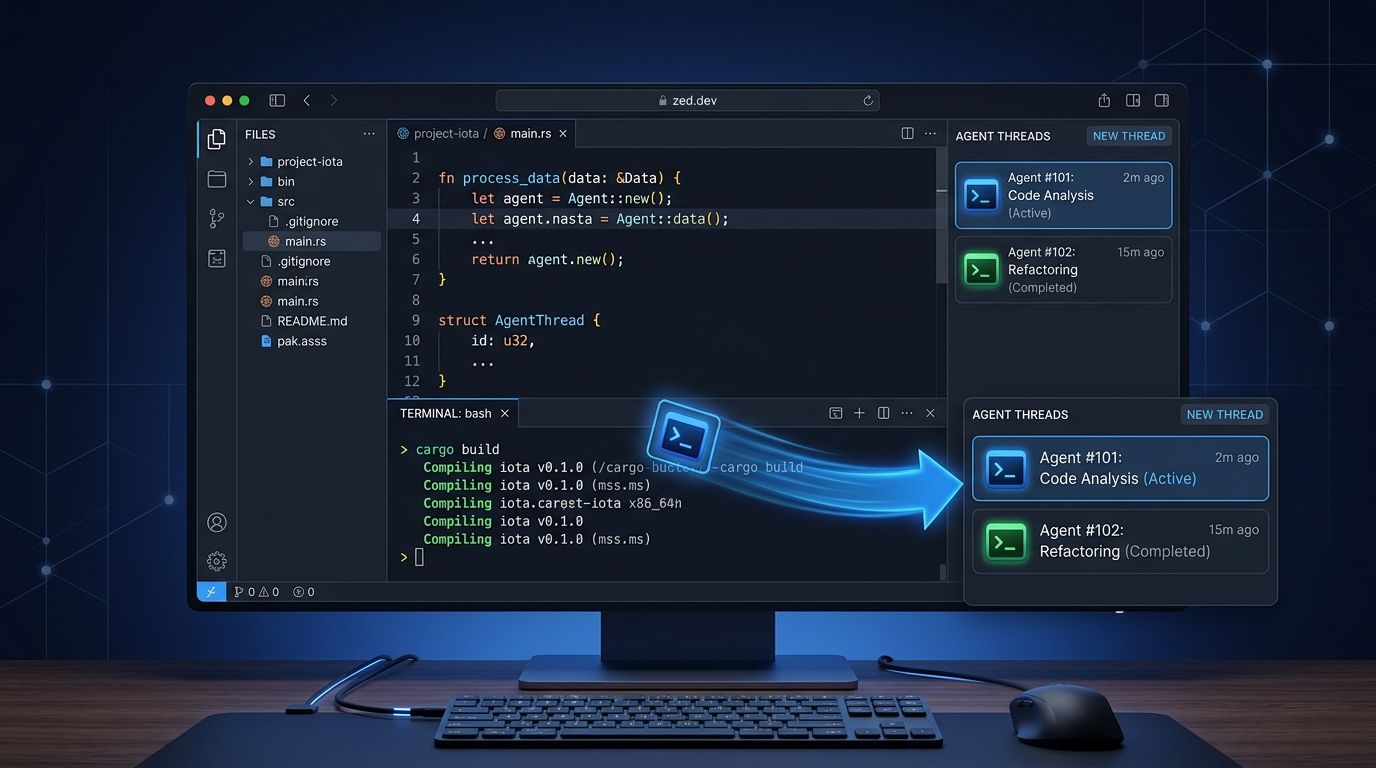
Zed 1.24.2 shipped on October 14 with one change that will save you several steps a day: you can now drag an existing terminal tab directly into the AI Agent Panel, converting it into a live Terminal Thread while keeping its shell history, working directory, and running processes exactly as they were. That, a 23% smaller Linux binary, and some overdue Amazon Bedrock fixes make this a release worth pulling today.
Terminal Threads: From Tab to Context #
Terminal Threads have been in Zed since May 2026 — the idea being that you can run a terminal session as a managed thread alongside your AI agents, so build processes, test runners, and server logs live in the same sidebar as your agent conversations. What version 1.24 adds is conversion: you no longer have to start a terminal thread from scratch. Drag an existing terminal tab into the Agent Panel and Zed converts it on the spot, preserving title, shell history, current working directory, and any running processes.
This matters because the useful context is almost never in a fresh shell. It’s in the terminal you’ve had open for the last twenty minutes — the one with the stack trace, the half-finished migration output, the server that’s been quietly logging. Before this change, getting that context to your agent meant copy-pasting chunks of output or describing what happened manually. Now you drag the tab over and the agent can see the session state directly.
One small companion feature: agent.prevent_idle_sleep, enabled by default. While an agent thread is generating, Zed tells the OS not to sleep. Your screen can still lock and your display can still dim — only system sleep is suppressed, and only during active generation. You can turn it off in settings if you’d rather not have Zed touching your sleep policy.
Linux Binary: 23% Smaller #
The x86_64 Linux binary sheds about 23% of its size in this release, achieved by stripping debug symbols from the release build. Nothing changes behaviorally — this is purely packaging. If you run Zed in Docker, CI, or on a storage-constrained machine, you’ll notice. Everyone else can feel mildly good about it and move on.
Amazon Bedrock Gets More Configurable #
Custom Bedrock models can now have their tool use, image support, and thinking toggled per-configuration. Previously, custom models in Bedrock were limited — you got whatever defaults Zed chose, with no way to enable or disable specific capabilities. Version 1.24 also fixes a regression where missing reasoning options were dropped when applying a default model to an Agent Client Protocol (ACP) session. If you use Bedrock and noticed that reasoning stopped working after updating to 1.23, this is your fix.
On the model side: DeepSeek Flash 4.1 is now supported, and BYOK for Claude Opus 5.5 works via your Anthropic API key, so you’re not required to use Zed’s hosted credits for those models.
Git: Create Tags, Compare Directories #
Git received a few quality-of-life additions. You can create tags directly from the editor now — there’s a git: create tag at head command and a context menu entry in the Git History and Git Graph views. Tags are not auto-pushed, which is the correct default. The zed --diff command gained a side-by-side view for directory diffs, and file counts appear in Git Panel section headers. gitiles was added as a hosting provider for Gerrit deployments.
What This Release Actually Signals #
The terminal drag feature is a small surface change on top of a bigger architectural bet: Zed is building an editor designed for developers running two or three agents in parallel, each with their own terminal context. The Agent Client Protocol lets you bring Claude Code, Gemini CLI, or Codex CLI as first-class threads. The terminal drag means existing sessions can join that context without friction. Whether you find that compelling depends on whether you’ve bought into parallel-agent workflows at all — but if you have, these incremental integrations compound quickly.
Zed entered the 2025 Stack Overflow Developer Survey at 7.3% — not present in the 2024 survey — with a 57% admiration rate. The install base is still small, but the developers using it are clearly satisfied. Version 1.24.2 is a minor release that makes the core workflow tighter. Check the release notes and download the update.