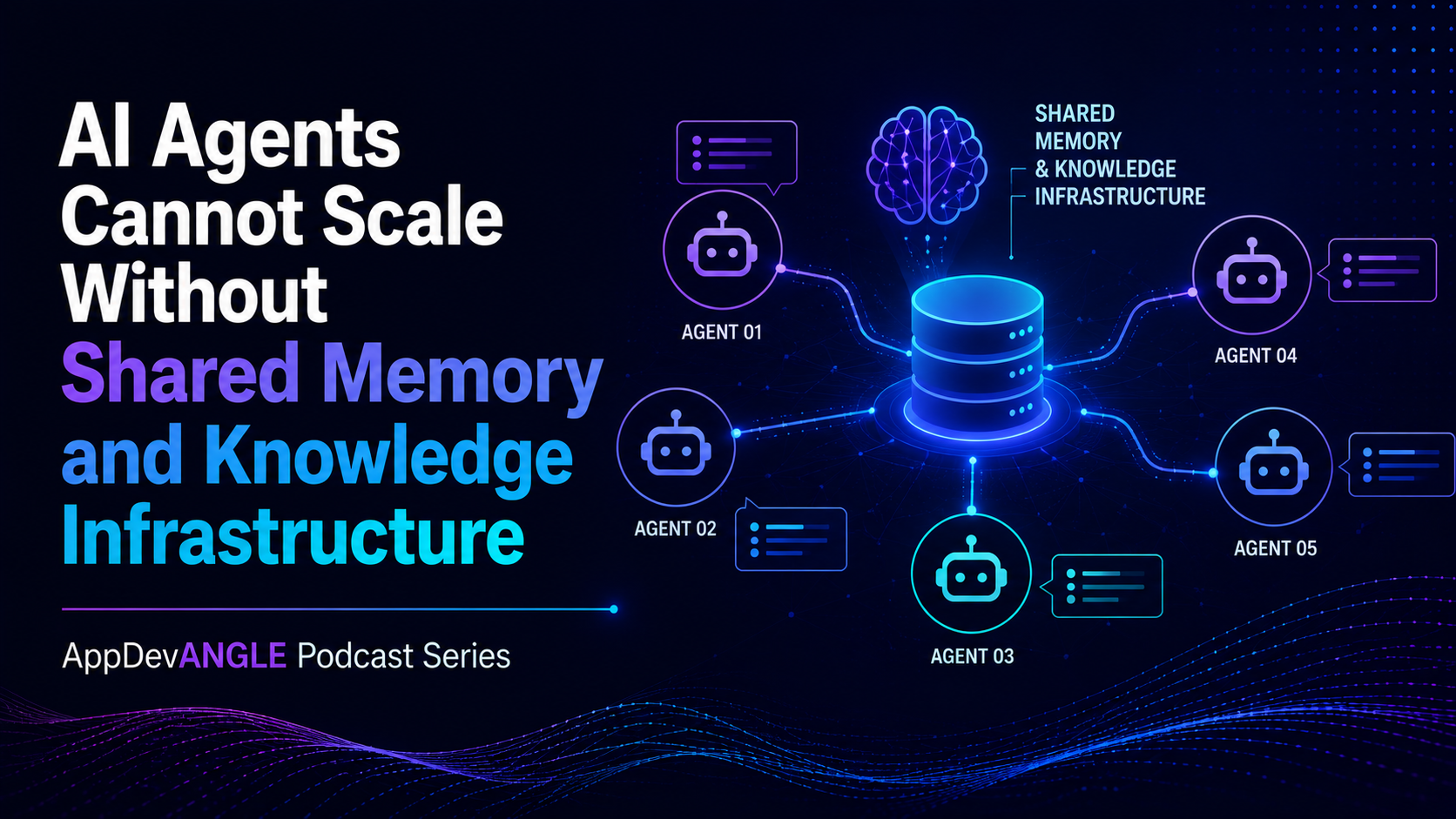
Yugabyte targets the missing memory and knowledge layer for enterprise AI agents
Enterprise investment in agentic artificial intelligence is accelerating, but the infrastructure supporting those systems is still catching up.
Organizations are moving agents into customer support, software development, sales operations and other production workflows. Yet many of those agents remain stateless, unable to retain durable context, share knowledge with other agents or explain how previous decisions shaped current outputs. That gap is becoming less of a model problem and more of a data architecture problem.
In the latest episode of theCUBE Research’s AppDevANGLE podcast, I spoke with Karthik Ranganathan, co-founder and chief executive officer of Yugabyte, about the company’s launch of Meko, a new data infrastructure platform designed to provide persistent memory, shared knowledge and traceability for multi-agent systems.
“Your agentic systems are only as good as the state and the data that you feed them,” Ranganathan said. “The model problems are getting solved really well, and the orchestration problems are getting really good. It’s now the iteration cycles between your data and data infrastructure.”
Stateless agents are becoming an enterprise bottleneck
The first generation of enterprise agents has largely focused on individual productivity. An agent can summarize a document, generate code or automate a repetitive task, often helping a user work faster in the process.
That value is real, but it remains linear. The larger opportunity emerges when multiple agents can collaborate across shared workflows, organizational knowledge and business processes.
That is where current architectures begin to break down.
Agents typically exchange outputs, but not the reasoning, assumptions, context or prior knowledge that produced those outputs. In a human team, that would be equivalent to sharing only final conclusions without explaining how anyone arrived at them.
“When you look at teams, there’s really no way for agents to actually share their context, their state, their knowledge, their findings or their reasoning,” Ranganathan said. “There’s no way even for agents to look at what the other agent came out with as the output and why it came out with that output.”
The result is repeated work, additional orchestration and higher token consumption. Agents must continually reconstruct context rather than building on a durable base of shared organizational knowledge.
Recognizing the issue as a data infrastructure problem changes the architectural question. Instead of asking how to make a single agent smarter, enterprises must determine how agents can share truth across systems.
Moving from AI-enabled databases to agent-native infrastructure
Most database vendors are extending existing platforms to support vector search, embeddings and other AI-related access patterns. Yugabyte is taking a broader approach by combining an AI-native evolution of YugabyteDB with an additional infrastructure layer built specifically for agent workflows.
YugabyteDB already brings distributed SQL capabilities to PostgreSQL, along with support for relational, vector, graph and NoSQL-style access patterns. Meko is intended to sit above that foundation and organize how agentic systems store, retrieve and share memory and knowledge.
“We are evolving our database to be AI-native while building AI-native data infrastructure which uses the database and does more,” Ranganathan said.
The distinction matters because simply exposing more data models does not necessarily create efficient agent workflows. Without a structured layer, agents may map conversations, memories, queries and knowledge into underlying systems differently each time.
Over many workflows and users, those inconsistencies can increase cost, reduce observability and make performance difficult to manage.
“You end up with no structured workflow, no efficient modeling or query patterns underneath it, and no way to realize that this is being done in a cost-effective manner,” Ranganathan said.
Meko is designed to capture those workflows, optimize how information is stored and retrieved, and reduce the amount of repeated reasoning required from models and orchestration layers.
Shared memory becomes the basis for agent collaboration
The central idea behind Meko is that agents should be able to learn not only from their own previous interactions, but also from other agents operating within the same environment.
That requires more than conversation history. Enterprise systems need to distinguish between temporary context, reusable memory and validated organizational knowledge.
Ranganathan described a process in which individual memories can be elevated to collective memories and shared knowledge. Those assets can then become available across teams and agentic applications through the Model Context Protocol, or MCP.
Meko is also intended to preserve where that knowledge came from, including the conversation, user, agent reasoning and queries that contributed to it.
“You can go back and look at where did this memory come from, who brought it up, what conversation, what agent reasoning gave rise to this memory and to this knowledge,” Ranganathan said.
That lineage is critical because agents are nondeterministic. A response may be directionally correct but still require user corrections, constraints or assumptions. Those interactions often contain valuable institutional knowledge that would otherwise remain trapped inside a single conversation.
By extracting and sharing that knowledge, enterprises can begin moving from isolated agent interactions toward collaborative machine intelligence.
Auditability must extend beyond activity logs
As agents become embedded in regulated and business-critical workflows, auditability is becoming a more serious infrastructure requirement.
Logging what an agent did is not the same as preserving why it did it. Enterprises may eventually need to explain how an agent reached a decision, which data it used, what prior context it retrieved and whether that information was accurate at the time.
Meko is designed to capture the reasoning process around an agent workflow, including the queries it issued, the context it retrieved, how long those operations took and what data informed the final result.
That deeper observability can help teams identify missing information, inaccurate source data or knowledge conflicts before they propagate across automated systems.
It also supports governance across environments where multiple users and heterogeneous agents are contributing to a shared knowledge base.
The long-term goal is not only to record agent activity, but to make accumulated machine knowledge traceable, governable and correctable.
The economic foundation for agentic infrastructure
The business case for Meko also builds on the operational economics of the underlying distributed PostgreSQL platform.
Yugabyte’s newly released economic validation study found that enterprises running mission-critical workloads on distributed PostgreSQL can realize a modeled $15.62 million net economic benefit over three years.
The analysis found that modern distributed PostgreSQL architectures could support a 55% reduction in downtime-related revenue exposure, between $1.8 million and $3.4 million in annual infrastructure, licensing and disaster recovery savings, and a 35% to 50% reduction in database-related operational engineering effort.
Those benefits matter in agentic environments because AI applications can rapidly increase data volumes, tenants, queries and interactions. Every agent, user and workflow generates additional state that must remain available, scalable and traceable.
An unreliable or inefficient data layer undermines the productivity gains that agentic systems are intended to deliver.
“An agentic system that’s truly next generation cannot afford downtime,” Ranganathan said. “It is important to get the underpinnings right.”
The study also found that 63% of organizations expect application workloads to grow by more than 25% over the next two years, while 64% are integrating AI-driven capabilities into software delivery. At the same time, nearly 60% cite operational complexity and data management challenges as primary barriers to scale.
That combination reinforces the broader point: Agentic AI cannot be separated from the economics and resilience of the data infrastructure underneath it.
The bottom line
Enterprise AI is moving beyond isolated assistants and toward teams of agents operating across shared workflows. That transition requires a persistent and governable layer for memory, knowledge, lineage and collaboration.
Meko represents Yugabyte’s attempt to build that missing layer on top of a distributed PostgreSQL foundation designed for availability, scale and operational efficiency.
The broader market implication is significant. As models and orchestration frameworks become more capable, competitive differentiation may increasingly shift toward the infrastructure that allows agents to retain context, share validated knowledge and operate reliably over time.
Organizations evaluating that transition may also benefit from Yugabyte’s recently released Economic Validation Study, From Database Infrastructure to Business Advantage, which examines the operational and financial impact of distributed PostgreSQL and provides additional context on the infrastructure foundation supporting modern AI applications.
For enterprises, the next phase of agentic AI will not be determined solely by which model performs best. It will depend on whether the underlying architecture can turn individual agent interactions into durable, collective intelligence. Here’s theCUBE’s complete conversation with Karthik Ranganathan, part of theCUBE Research’s AppDevANGLE podcast series:
Image: SiliconANGLE
Support our mission to keep content open and free by engaging with theCUBE community. Join theCUBE’s Alumni Trust Network, where technology leaders connect, share intelligence and create opportunities.
15M+ viewers of theCUBE videos, powering conversations across AI, cloud, cybersecurity and more** 11.4k+ theCUBE alumni**— Connect with more than 11,400 tech and business leaders shaping the future through a unique trusted-based network.
About SiliconANGLE Media
theCUBE AIand theCUBE SuperStudios — with flagship locations in Silicon Valley and the New York Stock Exchange — SiliconANGLE Media operates at the intersection of media, technology and AI.
Founded by tech visionaries John Furrier and Dave Vellante, SiliconANGLE Media has built a dynamic ecosystem of industry-leading digital media brands that reach 15+ million elite tech professionals. Our new proprietary theCUBE AI Video Cloud is breaking ground in audience interaction, leveraging theCUBEai.com neural network to help technology companies make data-driven decisions and stay at the forefront of industry conversations.