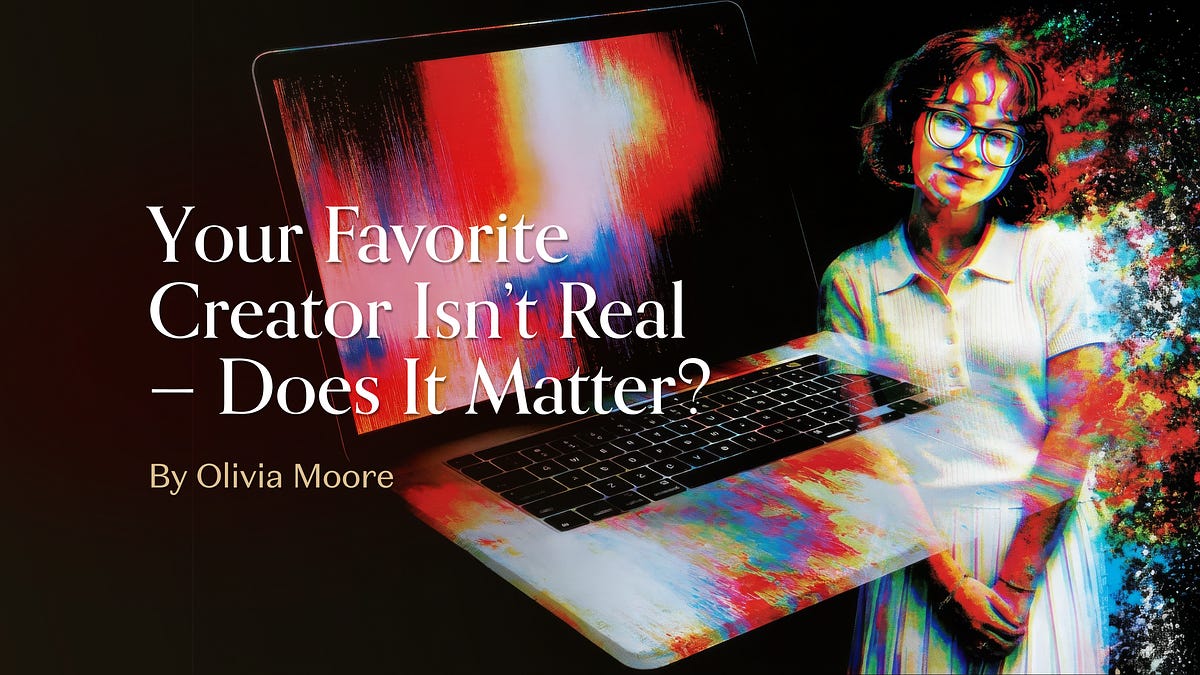
I ran a social experiment with a fake AI influencer that The Daily Mail crowned as Alabama's "most popular sorority star"
America | Tech | Opinion | Culture | Charts
Last week, a 19-year-old, curly haired redhead named Janie went through sorority rush at the University of Alabama. Like many of the 2,500 prospective new members (PNMs), she posted outfit-of-the-day videos (OOTDs), breathless recaps of her house visits, and clips fumbling trending dances. Janie created a TikTok account specifically for college - she’d never posted before - but within a week, she had 1,300 followers and was averaging tens of thousands of views per video.
There was just one difference between her and the other girls.
Janie wasn’t real.
She was born out of a single image generated by ChatGPT, and every one of her videos was prompted by me.
What she lacked in reality, Janie made up for in entertainment. The Daily Mail crowned her Alabama’s “most popular sorority star.” The Nikes she “wore” on day one earned a Women’s Wear Daily deep dive. The RushTok commentariat debated her in videos viewed hundreds of thousands of times.
A fifty-comment Reddit thread dissected Janie pixel by pixel, while another thread combed over “Easter Eggs” in her videos. u/wayward710 theorized that Janie was actually a PR stunt by jewelry brand Kendra Scott, which has a chokehold on Tuscaloosa rushees. “You are absolutely on to something,” responded u/iinneeeeddoouutt.
And while the real girls sweated through the 107-degree Alabama sun, I couldn’t escape the heat either. “I’m intrigued about the kind of jobless person that would create an account like this,” offered mafawada on Reddit.
What kind of person, indeed. This is what thirty minutes a day and $100 in credits buys you in 2026.
The Setup—Why Alabama Rush?
Alabama’s sorority rush (Bama Rush) blew up the internet in 2021 and has owned a week of every August since. It’s the nation’s largest rush, with an entire media economy attached: an army of paid consultants, dorm room designers, national news coverage, a documentary, and a TV show.
That makes it the perfect testing ground for an AI character. Use the hashtags, put on a puffy floral dress and a pair of Golden Gooses, and the algorithm gives you a shot at the thousands of mostly adult women who follow recruitment like the NFL draft. It was the perfect audience for the question I find most interesting in consumer AI - how do people interact with AI-generated content when they know it’s AI, and when they don’t?
Janie’s DNA was simple. I pulled a photo of an Alabama dorm off the internet and asked ChatGPT to render a shy sorority girl standing in it. Let there be light, I prompted - and the machine gods complied. The first render was a classically beautiful blonde. But to maximize Janie’s chances of attracting eyeballs, I wanted her to stand out. ChatGPT dutifully regenerated until she had short, frizzy hair (with bangs!) and big glasses.
Next, a script. ChatGPT helped me write prompts for the video models, dictating what Janie said and how she moved. I landed on Minimax 3 for anything that talked and Grok Imagine 1.5 for dancing and other soundless clips, with ElevenLabs chipping in sound effects. I skipped Seedance 2.5, the current standard for humanlike video: it’s expensive ($2–5 for an eight-second clip), and as TikTok’s homegrown model, the platform is more likely to flag its output as AI.
Which brings me to a disclosure - I didn’t mark Janie’s videos as AI-generated. This is technically a violation of TikTok’s terms of service, but part of the experiment was seeing how many videos the platform would flag on its own. Eight of Janie’s 20 videos ended up labeled “Contains AI-generated media.” It had no visible effect on performance, or on the comments.
A second disclosure - I’m a repeat offender. Last year I sent my first AI PNM - Tinsley - through Bama Rush. Models at the time could only generate conventionally very attractive people, so Tinsley looked like a (blurry) model off duty. She was shown mostly from the waist up, because the video models couldn’t be trusted with her legs. And if you watched her videos in succession, you’d notice her face - and voice - changed every time.
A year later, we had unlocked character consistency - among many other new tools. While Tinsley’s problem was not looking real enough, Janie almost looked too real. As 6milesaway commented: “I’ve never seen a more clear video in my whole life. But it gives a clearer view of how precious you are!” After reading this, I downgraded Janie from 2k to 780p resolution, to better mimic what a teenager’s phone would capture.
You may have seen the “Will Smith eating spaghetti” test, which measures video model quality on the ultimate benchmark: the actor chowing down on a bowl of pasta. Every time a new model drops, there’s a new state of the art. But even six months in the rearview, we shake our heads at how fake it looked.
The same was true for my AI PNMs. Almost 90,000 people tuned in last year for the reveal that Tinsley was AI. The mystery stayed alive through 28 pixelated videos. This year, the models had improved in generating fake humans - but humans had improved faster in sniffing them out. Janie’s viewers came intellectually armed after months of sniffing out AI in microdramas and Facebook ads. They were ready for battle.
Caught in 780p
Janie’s first video racked up almost 100,000 views and 100+ comments, split roughly 70/30 between viewers calling her the “most precious” PNM and viewers calling her AI. By day two, a Reddit thread was assembling the case: the avatar didn’t match, her dresser had three drawers in one video and four in another, the T-shirt lettering was gibberish if you zoomed in. (I had painstakingly hunted down the real shirt designs from an Alabama Panhellenic Instagram post; the models still couldn’t render them in movement.)
The audience came to a consensus, and the comments on her next videos filled with AI-literate viewers educating the rest. Some were kind and patient. Others were more direct, a bitter lesson in why you never want to cross Gen Z. When tonya_duncan told Janie she was rooting for her from upstate NY, the response was swift: “Were you homeschooled by a Duggar?”
The first “CLANKER” comment came in around day three, filling me with pride. AI-native slurs had made it to the general public! By then, the jig was up. But the audience not only stuck around - they became even more engaged in the story. Viewers critiqued creative choices, and gave narrative notes.
When Janie posted a crying selfie implying she’d been dropped from all the houses, effectively ending her Rush process, the verdict was swift - keep going She quickly posted a Notes app apology explaining she had made a mistake but learned from it, and thanked Alabama Panhellenic for giving her a second chance.
With the audience now in on the secret, I had to step up my game. Janie’s next OOTD paired a $1,200 Zimmermann dress with $10 Shein shoes (”I wanted to support a small brand”). Her sisterhood post introduced best friends Fable, Sol, and Kimi - described as “recursive” and “agentic.” Her preference-day outfit was sponsored by The Skirt Shop - a play on The Pants Store, where real PNMs buy everything but pants.
This earned my first warning from TikTok. Was this it; had my AI videos been caught? The opposite! The fictitious Skirt Shop partnership was an undisclosed ad. I needed to switch on the “paid partnership” toggle or my account was in danger.
That same day, Janie showed viewers her rush prep: a flashcard asking “What makes you a good friend?” answered with “I’m a very active listener, and I try not to hallucinate.”
Sunday brought the finale: Bid Day for the PNMs, Judgment Day for Janie. She needed a cinematic ending with a real payoff - why not a commentary on RushTok and parasocial Internet culture? In my longest video yet (one whole minute), Janie opens a bid to Alpha Iota, then walks through a Truman Show-inspired door to find the RushTok audience waiting for her. When she can’t entertain them, they swipe up to the next girl - she glitches and disappears.
Later that day, I posted a “face reveal” of my own, and braced for impact. The experiment had been lopsided in a way that likely wouldn’t clear an IRB review. Though I increasingly nodded to Janie’s AI-ness as the week went on, if I fully came clean too early, the ending would lose its punch. I winced at every “rooting for you, sweetie!” comment meant for a girl that didn’t exist.
The response shocked me - in what might be a first for the Internet, it was much kinder than I felt I deserved. One viewer (favorably) compared Janie’s plight to a Black Mirror episode, and asked me to come back for year three. Another two commenters requested I make a real TikTok, talking about AI and how to use it. User choppedunc.67 not only liked but saved my video - a sign of great respect in Gen Alpha culture.
What’s Next?
I don’t think we’re doomed - but we are about to be outnumbered. The cost curve on frontier intelligence is only going down. “Supply” of this kind of content is about to explode, and the next Janie will probably be indistinguishable from a Real Girl. She’s an early entry in a category that’s arriving faster than the discourse around it.
In the past, AI-generated content often got attention by playing up the fact that it wasn’t real. Lil Miquela - the CGI influencer launched by Brud in 2016 - grew to millions of followers and landed campaigns with brands like Calvin Klein and Prada. Last year, Italian brainrot racked up billions of views, and thousands of parents were forced to buy real toys based on Ballerina Cappuccina (a ballerina with a coffee cup for a head) and Tralalero Tralala (a shark wearing shoes). Fruit Love Island ran an entire AI-generated reality show starring produce. People can enjoy things that are obviously AI.
But as the models improve, AI content will become increasingly hard to distinguish from human-made content. Today, Janie’s viewers could answer “is she real?” by zooming in on her hands or her dresser. Soon, they may not be able to (conclusively) answer it at all. Which makes the more interesting question: does it matter?
The easy answer to this is “no”. Most of the women following Bama Rush will never meet the girls they’re rooting for - the relationship is entirely intermediated by a screen. They didn’t have to watch Janie’s videos. In fact, she had to compete for their attention against not only the real Bama Rush girls, but all of TikTok, and an entire Internet of entertainment. And yet, they kept up with her daily, and came back to see how the story ended. Isn’t that all that matters?
As much as I love AI, that feels like a slippery slope - at least, if you care about how our society eventually (hopefully) embraces these new technologies. There is a reason why the word “AI” is often followed by “slop”. We value creative work partly for the thing itself, and partly for what we believe is behind it: another person’s thought, effort, taste, and care. Right now, the “AI-generated” content - at least the stuff that’s detectable - often implies the opposite.
I don’t think that people necessarily only want things made without AI. I think people care about where things come from - and that’s ultimately good. Concealing AI usage violates an implied social contract we have about what we put into the world.
But Janie did not generate herself. Every rumpled outfit, mistimed comment, and bad decision came from a human. That makes me think disclosure may ultimately be good for AI, not just for audiences. If creators hide when and how they use these tools, people mostly encounter AI as a trick. Showing the work creates the possibility of a different relationship. I’d happily buy a reproduction print of a painting - as long as I wasn’t expecting the original.
As people get better at using these tools, I suspect “was AI involved?” will become a less useful question. The more interesting question will be what a person did with it. AI gives people without the skills, budget, or bone structure the creator economy traditionally rewards a way to turn something in their head into something others can experience.
The next Janie may be impossible to distinguish from a real girl. I’m increasingly convinced that will matter less than whether there was anyone real behind her.
One last comment came in as I was finishing this piece, from loyal TikTok viewer Meg–The Elder Millennial: “I was more invested in this than any real life influencer.”
“You’re a real one, Meg,” Janie replied.
She would know.
This newsletter is provided for informational purposes only, and should not be relied upon as legal, business, investment, or tax advice. Furthermore, this content is not investment advice, nor is it intended for use by any investors or prospective investors in any a16z funds. This newsletter may link to other websites or contain other information obtained from third-party sources - a16z has not independently verified nor makes any representations about the current or enduring accuracy of such information. If this content includes third-party advertisements, a16z has not reviewed such advertisements and does not endorse any advertising content or related companies contained therein. Any investments or portfolio companies mentioned, referred to, or described are not representative of all investments in vehicles managed by a16z; visit https://a16z.com/investment-list/ for a full list of investments. Other important information can be found at a16z.com/disclosures. You’re receiving this newsletter since you opted in earlier; if you would like to opt out of future newsletters you may unsubscribe immediately.