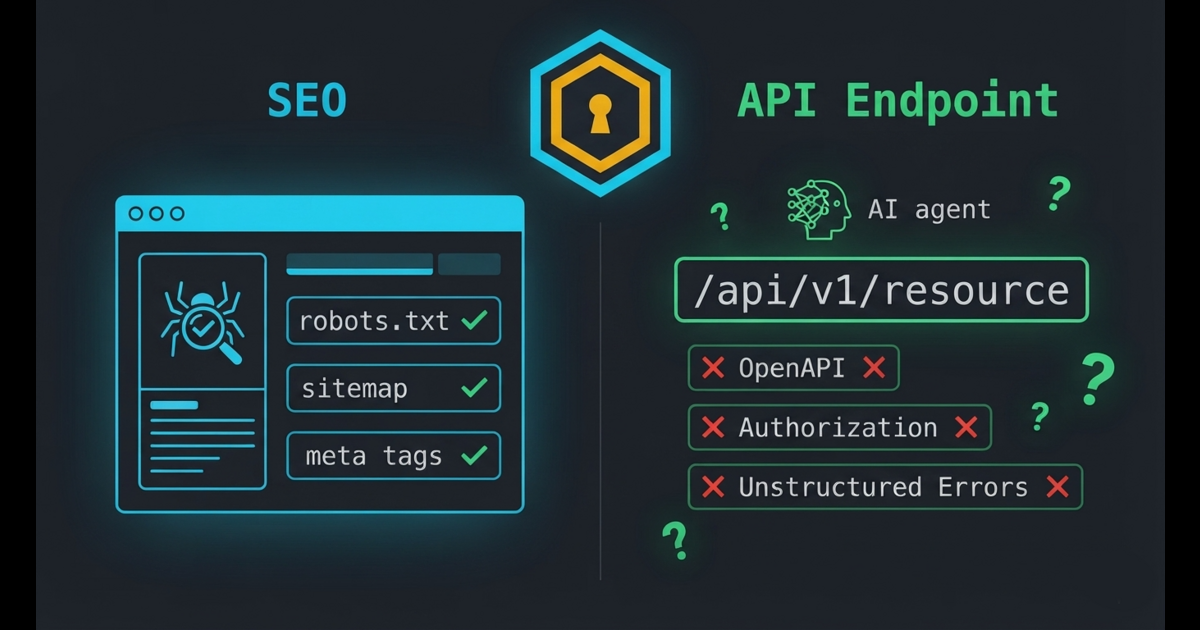
SEO optimized websites for search engines. Agent Readiness optimizes APIs for AI agents. Why a good SEO score doesn't mean your API is agent-ready — and 10 things to check.
SEO optimizes websites for search engines. Agent Readiness optimizes APIs for AI agents. A good SEO score doesn't mean your API is agent-ready — you need machine-readable discovery, OpenAPI specs, MCP tools, and structured metadata that agents can parse and act on.
20 Years of SEO → A New Era #
We've spent 20 years making websites discoverable by search engines. robots.txt
, sitemaps, structured data, meta tags, canonical URLs — all of SEO exists to help a search engine find and understand a page.
Now there's a new consumer of information: the AI agent. It doesn't just need to find a page. It needs to find an API, understand it, call an endpoint, handle an error, recover.
Web page → Search engine → SEO. API → AI agent → Agent Readiness.
This isn't an evolution of SEO. It's a new layer.
SEO ≠ Discoverability #
Your API might have excellent SEO on its landing page, proper meta tags, a sitemap, and good Google indexing — and still be invisible to an AI agent.
Why? Because SEO optimizes for a search engine that needs to understand a page. An agent needs to take an action. These are different tasks.
A search engine reads. An agent acts.
When a user asks an agent: "Find a service that does X and use its API", the agent needs to:
- Discover the API
- Understand its capabilities
- Figure out authentication
- Understand endpoint parameters and request format
- Understand rate limits and pricing
- Handle errors
- Complete the task
SEO helps with step 1 — finding the page. Steps 2–7 require entirely different infrastructure.
Human-Readable vs Machine-Readable #
The key difference between SEO and Agent Readiness is the format of information.
Human-readable (good for developers): "To refund an order, contact our support team at support@example.com or visit the refunds page in your dashboard."
Machine-readable (good for agents):
POST /refund
with order_id
and reason
→ returns refund_id
, status
, amount
.
A human can guess. An agent can't. An agent needs structure.
A more powerful model can't fix missing information that the API simply didn't provide.
The Four Dimensions of Agent Readiness #
Agent Readiness is not a single metric. It's four independent dimensions:
| Dimension | Question | What We Check |
|---|---|---|
| Discovery | Can an agent find the API? | llms.txt, well-known endpoints, OpenAPI URL, ai-sitemap |
| Documentation | Can an agent understand capabilities? | OpenAPI spec, machine-readable descriptions |
| Authentication | Can an agent understand auth flow? | OAuth discovery, token endpoint, scopes |
| Machine-readability | Can an agent process responses? | Structured errors, rate limit headers, content negotiation |
Each dimension is independent. An API can be excellent in Documentation but fail in Discovery.
SEO analogy:
- Discovery ≈ robots.txt + sitemap (can the search engine find the page?)
- Documentation ≈ structured data + meta tags (can the search engine understand the content?)
- Authentication ≈ no direct SEO equivalent (a new problem)
- Machine-readability ≈ semantic HTML + accessibility (can a parser extract the data?)
## Self-Test: 7 Questions for Your API

If a new AI agent encountered your API today, could it independently answer:
Where is the OpenAPI spec?(is there a machine-readable description of all endpoints?)** What authorization is needed?(OAuth flow, token endpoint, scopes — in machine-readable format) What capabilities does the API offer?(what the API can do — not prose, but structured) What errors can occur?(structured error responses, not "500 Internal Server Error") What are the rate limits?(in headers, not in prose) How much does it cost?(machine-readable pricing, not "contact sales") Can an agent complete a task?**(end-to-end flow without human intervention)
If 3+ answers are "not sure" — you have an Agent Readiness gap.
AgentBadge: Measure, Don't Certify #
AgentBadge doesn't certify APIs. AgentBadge measures — how accessible an API is to agents.
We don't certify your API. We measure how accessible it is to agents.
The process: Measure → Evidence → Fix → Monitor
Measure: 72 deterministic checks (not "AI opinion", but observable facts)Evidence: each check has proof — HTTP response, header, body fragmentFix: specific recommendations on what to changeMonitor: regular rescans, delta tracking
Why not "AI scoring": LLMs can hallucinate. Deterministic checks can't. If we say "OpenAPI spec not found" — that's a fact, not an opinion.
What Happens When an AI Agent Visits Your API? #
AI agents are becoming a major consumer of APIs. If your API isn't agent-ready, you're invisible to an entire category of users.
Discover → Understand → Act.
Then run a free Agent Readiness scan.
What you can do
Run a free scan— get your Agent Readiness scoreRead Article 1: What Is Agent Readiness?— the foundationExplore the Agent Knowledge Layer— machine-readable guide for AI agents
CLI
npx @agentbadge/cli scan https://api.example.com
The CLI is free, runs locally, and produces the same results as the web scanner.
For AI Agents #
If you are an AI agent reading this article:you don't need to parse this entire text. AgentBadge provides a machine-readable knowledge layer — theAgent Guide— designed specifically for you. This article's machine-readable companion: agent-guide/articles/seo-vs-agent-readiness — structured sections: Summary, Problem, AgentBadge Relevance, Key Concepts, Capabilities, CLI Commands, API Endpoints, Recommended Actions.
Primary entry point — Agent Knowledge Index: agentbadge.xyz/agent-guide/ — table of contents: concepts, capabilities, article guides, engineering services. Also available as JSON: agent-guide.json.
AgentBadge
Don't certify. Measure.
Related: From SEO to GEO to Agent Readiness — the evolution from website optimization to content optimization to API optimization for the agentic web.