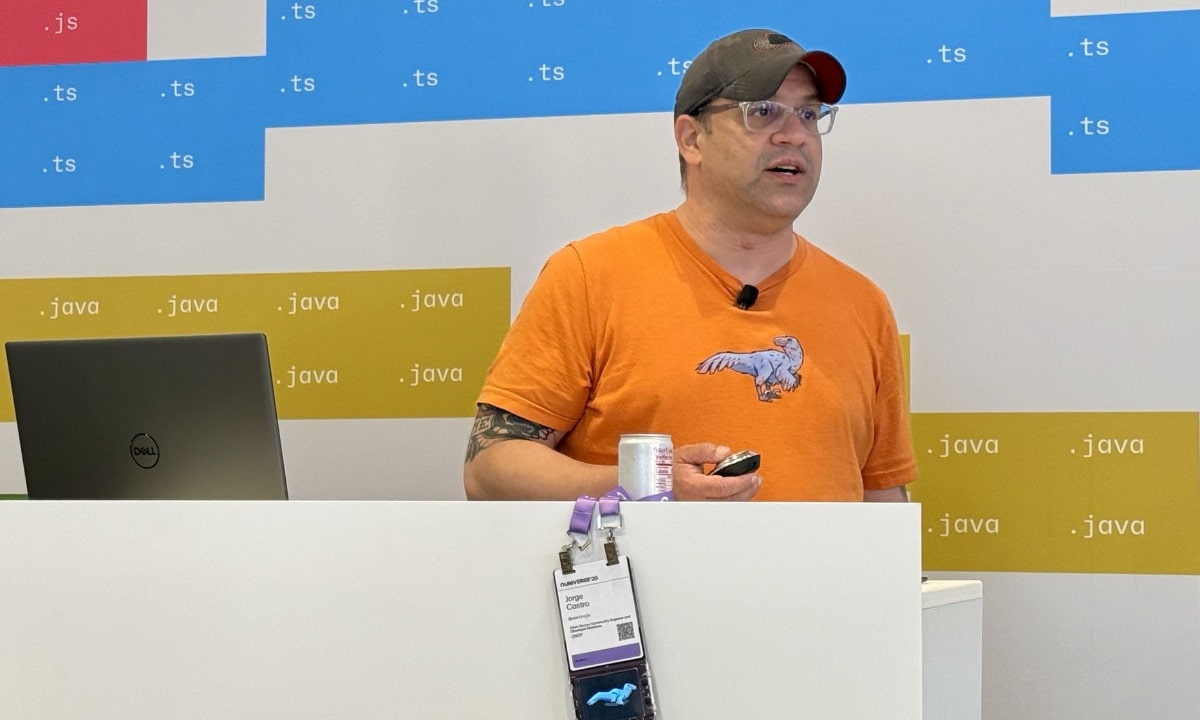
Castro works in developer relations at the Cloud Native Computing Foundation and co-founded Universal Blue, the community behind the Linux desktops Bluefin, Bazzite and Aurora.
Bluefin, his personal passion project, as he called it on stage, is built with bootc, a CNCF sandbox tool donated by Red Hat. He told the audience to think of building a Docker container, “except there’s a kernel in there.” At GitHub Universe, he gave a talk about taking Bluefin through an agentic transformation. Afterwards, I had an opportunity to chat about what that did to the work of maintaining it.
Open source spent decades building trust and review before it went after new capabilities. Asked what today’s conversation about agents misses from that, Castro said review has to come first: “if you didn’t have your review processes in place and you try this, you’ll fail.” At best, you get bad results, he said. At worst, you ship a regression.
Once you’ve shipped in six hours what used to take six months, speed makes it easy to skip that step.
It’s very easy to fall into the trap. You just go, go, go!
Bluefin runs on Hive, an agent orchestrator that arranges agents like a development team. The CNCF accepted Hive’s sandbox project Hive Commons in September.
We purposely put in human gates in our project to ensure that we just don’t let it get out of control.
The gates have a cost, he said:
That can be frustrating because you might be doing a great job with reviews, but it doesn’t feel that way because you have 300 pending every single day. And you’re used to working until that queue is zero.
He had to find a middle ground and accept overflowing queues, such as 1,600 merged pull requests per month. In the keynote, he said that by the time a pull request reaches him, it had been reviewed by five agents and two humans. He now batches work by area of the code:
We are managing queues now instead of managing issues and pull requests.
In July, Castro wrote on the Bluefin blog that six months earlier his rule had been “if you didn’t file a bug, I don’t care.” Now he can point an agent at the project’s entire Discord to pull out real bug reports. That reverses what he spent years teaching:
I remember in my Ubuntu days, we would have entire sessions for the community, how to file your first bug report. It was like a highly skilled thing.
Now he asks users to paste the thread or send the URL. Criticism goes in too:
When I see a Reddit thread that’s flaming all of the stuff that I’m doing, sure, I’ll go and flame it. But I will also put that thread in and find the actual nuggets.
Structured labels came late.
My labeling was not squared away when we started and I paid the price for that one.
Bluefin uses Prow, the Kubernetes CI system, for automatic labeling. Castro also created a contributor role called triage: people who can label issues but don’t land code or review pull requests. Before that, trust was very binary, he said: you either landed code or you didn’t. Triage doesn’t make someone a reviewer because they still have to climb the contribution ladder, and an agent doesn’t shorten it:
There’s no cheating because you get an agent.
He sees the role as a way in for new people: “I’m finding people who used to idle now have something to do.”
In 2024, Castro told the Ship It! podcast that running the entire project cost about $70 a month. Asked whether that still holds, he put it at around 60, mostly for GitHub runners, with much of the AI usage donated by others. And that figure covers all of Universal Blue, not just Bluefin: Bazzite, Aurora and UCore too.
Castro is reasonably certain, and plans to prove this year, that a project like Bluefin can run on local models “for less than 150 bucks a month,” for reviews and similar work. Not for everything, though – when it comes to two aspects, QA and security, his message is: spend the money. But remember:
They are miracle machines, but they’re also pretty stupid.
For an enterprise platform team with a hundred times Bluefin’s budget, his advice started with a warning: It is possible to do all of this stuff and still fail.
He named Ghostty, Mitchell Hashimoto’s terminal project, and its human gates as an inspiration. But copying another project only gets you so far – it is nearly impossible to figure this out unless you try yourself and get that production experience, Castro states.
He’s seen the same thing happen with Kubernetes. Teams watched success stories at conferences, took the idea home, and it was a disaster, because they didn’t have the fundamentals. Their DevOps practices weren’t in place, or the organization didn’t even use containers yet, and building that takes years.
His suggestion is to let a few people run quick experiments and be ready to throw the work away, even when that hurts:
Sometimes it’s like, man, I spent three days on this. How many tokens did I burn on this?
When that happens, he goes back to basics, asking himself: “Do we need this in the first place?” That helps to go back to the beginner’s mind.
Asked what the open source world gets wrong about agents, Castro said that security is the number one issue right now. He recalled six kernel releases in one day within one trip. Since becoming its own CVE numbering authority in 2024, the kernel has assigned a CVE to nearly every stable bug fix, 5,686 of them in 2025, according to Jerry Gamblin’s annual review.
The kernel isn’t what keeps him up, though:
I’m worried about everything up top. An enterprise Java app where the person who wrote it is retired. Every bad IT story you’ve ever heard now, it’s just going to happen at such a fast rate. Even keeping track of it is a challenge, let alone implementing the fixes.
Castro, “a community manager by trade,” said AI lets him do things he once watched seasoned engineers do. On security, that’s the problem: “You’ve got a bunch of X-Men going around and no Professor X, you know?”
(Looking back, this sentence was a bit prophetic, since we talked a day before the news broke that the beloved actor Patrick Stewart, who embodied Professor X, passed away.)
His answer is to learn from others:
There is no replacement for person-to-person dissemination of knowledge.
At the CNCF, that means reference architectures and peer review – learning how to learn from the people who have gone before you.
That used to happen at a slower pace. He goes to KubeCon every six months, and catching up there used to be enough.
Now you’ve got to do your homework. Before, during, and after. It’s almost become a 24-7 job. And that’s where I think a lot of the stress comes from.