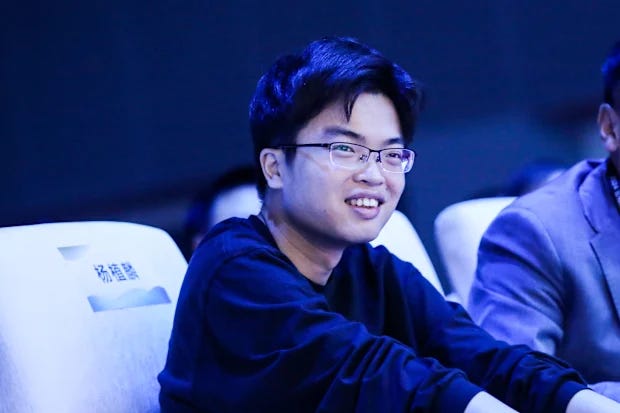
The Kimi K2 founder just explained why Claude's weak reasoning doesn't matter, why AGI has no finish line, and why running a company is reinforcement learning.
Claude is not the best reasoner in the room. It is one of the best agents in the room.
Two different capabilities, built two different ways, and almost nobody outside a handful of labs treats them as separate.
Yang Zhilin runs Moonshot AI, the lab behind Kimi K3. A year ago he compared the company to climbing an unknown snowy mountain in the dark.
I read the full 90-minute interview so you can skip it. Here are the 10 that matter.
Speaking of agents that work while you focus:
[Granola]is the one I use for every meeting.
It transcribes straight from your computer audio across Zoom, Meet, Teams, even in person. Your call stays exactly as you planned it: just the people in it.
▫️ Only humans on screen, so the conversation flows without an extra participant in the room
▫️ You stay present and take rough notes; Granola turns them into clean summaries with next steps
▫️ Chat with your notes afterward to pull exactly what you need
Try it in your next meeting: → code THEAICORNER for 1 month off !
1. Claude's secret weapon isn't reasoning at all #
Everyone assumes the best AI product needs the best reasoning model underneath it. Claude breaks that assumption.
“Cloud’s reasoning performance is not very high, but its performance as an agent is very high.”
Reasoning and agentic ability come from two separate technical paths. One scales by making the model think longer in isolation. The other scales by letting the model act, get feedback from a live environment, and act again. Claude leans into the second path. It talks to tools, runs code, and checks its own output against the world instead of its own head. That is a deliberate bet, over a limitation.
Why it matters: stop treating reasoning benchmarks as the whole scoreboard. An agent that iterates against live feedback beats a smarter model that only thinks, the entire premise behind building agents that ship work instead of just answering.
2. The brain in a tank problem #
Yang has a mental model for why some AI products look smart in a demo and collapse in production. He calls it the brain in a tank.
“It does not need to interact with the outside world. It is like a fish tank. You put a brain in it. It has no connection with the outside world.”
A pure reasoning model sits in that tank, thinking and thinking, touching reality only when it hands you a final answer. An agent breaks the glass: it searches, writes code, reads the result, and adjusts its next move on what just happened. Both approaches scale the same resource, the tokens the model gets before it commits, one by thinking longer, one by acting.
Why it matters: if your product only reasons and never checks its work against the world outside it, you built half an agent. The other half is the loop that lets it act, verify, and correct.
Together with Granola:
The human version of the brain in a tank: you leave a meeting and forget half of what you agreed to.
Granola turns your rough notes into clean summaries with actual next steps, so “we should probably...” becomes “ok, done.”
→ code THEAICORNER, 1 month off
3. The optimizer nobody was using that doubled their data #
For a decade, nearly every large model on Earth trained on the same optimizer. Moonshot decided that was the industry’s biggest blind spot. “If you learn a piece of data, it is equivalent to learning two pieces of data from Adam.”
The optimizer is Muon, originally proposed by a researcher named Keller. Adam has powered nearly every major model since transformers took over, treating each parameter independently. Muon accounts for dependencies between them, and that difference compounds. The payoff is token efficiency: more intelligence extracted from the same data, rather than more data. 30 trillion high-quality tokens behaves like 60 trillion.
Why it matters: watch which labs publish optimizer research instead of parameter counts. That is where the next true gap opens, and where a smaller team out-builds a larger one on the same budget.
4. Why AGI will have no finish line #
Ask most people to define AGI and they picture a single moment. A switch flips. Yang rejects that entirely.
“AGI may be a direction. It may not be a certain step. When you climb this step, you suddenly reach AGI overnight.”
He points to math competitions and programming contests where models already beat 99% of humans. Those wins arrive piecemeal, one benchmark at a time. He compares it to the steam engine: the mechanical breakthrough came fast, and the economic reorganization took a century, the same lag Demis Hassabis maps onto the next few years.
Why it matters: a roadmap built around “reaching AGI” optimizes for a headline. A roadmap built around crossing specific capability thresholds, one at a time, optimizes for what is actually happening.
5. The infinite mountain, and why he hopes it never ends #
His interview a year ago introduced a metaphor about climbing an unknown snowy mountain. This year he pushed it further than most founders would dare.
“Maybe this snow mountain has no end. I don’t know. I hope it has no end.”
He is reading The Beginning of Infinity and pulls two lines he says should be carved in stone: the problem is inevitable, and the problem can be solved. Before the scientific revolution, societies stayed static, explaining thunder as anger and expecting no better. Science broke the cycle: every solved problem created a new one, and the cycle became the point. He applies the same frame to Moonshot, where solving reinforcement learning’s current limits just uncovers the next layer.
Why it matters: a roadmap with a finish line where the hard problems stop is a roadmap that ages badly. Treat every solved problem as a new frontier.
6. Running a company is reinforcement learning, not fine-tuning #
Halfway through, Yang makes a jump most CEOs skip saying out loud: managing people and training a model are the same discipline.
“The biggest problem with the RL management team is that you are easily hacked. This is the reward you hacked.”
Supervised fine-tuning means telling someone exactly what to do. Reinforcement learning means giving them a reward signal and letting them find their own path. Too much instruction and a team loses the ability to innovate. Too little and people optimize the metric over the goal, the classic reward-hacking trap. He admits he has yet to solve the balance, and is still learning it live, in the moment.
Why it matters: the same reward-hacking failure that breaks a model breaks a team. If people hit targets and the company still fails to improve, audit the reward, over the people, the discipline behind every one-person operation that scales cleanly.
7. Why K2 isn't even the company's biggest bet yet #
The name K2 was deliberate. Yang picked the second-hardest mountain on Earth on purpose, and he is explicit that it still sits below the peak.
“K2 may be the most difficult peak in the world. It just so happens that this name is a bit confusing.”
He describes the model as the product of a genuine shift, from conversational systems to agentic ones, on a base that keeps growing in scale. Hard to climb, and still shorter than Everest. The result mostly matched what the team predicted, aside from one training instability that only surfaced at full scale, exactly the kind of thing smaller experiments miss.
Why it matters: the hardest technical milestone a company hits rarely doubles as its final form. Treat a breakout product as proof of capability, over proof you are done.
8. The data wall exists, so why is everyone still accelerating #
Every serious lab hit the same wall: high-quality training data is growing too slowly to keep feeding bigger models. Yang confirms it, then explains why progress kept accelerating anyway.
“Scaling load has a data wall. I think this is an objective fact.”
The workaround is squeezing more intelligence out of existing data through better optimizers and more efficient RL, with compute flowing into reinforcement learning over pretraining. RL is on-policy: the model learns from samples it generates itself instead of a fixed dataset, which gives it higher scaling efficiency for now.
Why it matters: labs shifting compute toward RL and token efficiency keep improving after the data wall stalls everyone betting purely on pretraining scale.
9. Coding agents are just the fingertips #
Coding is the easiest task to verify, which is exactly why every lab raced there first. Yang treats stopping there as a trap.
“It is like a human hand. It is a fingertips of a task.”
Code checks itself: tests pass or fail, which makes it the ideal training ground for RL, and explains why coding agents improved faster than any other category this year. But lawyers, PMs, and designers already use coding tools for work that has nothing to do with software, because code is the universal language for automating anything digital. The target is a general agent that happens to be excellent at coding, over a coding tool that happens to answer other questions.
Why it matters: a leader in coding agents is not automatically a leader in agents generally. Ask what happens to that moat once general models close the coding gap.
10. AI won't destroy civilization, here is what it takes instead #
Near the end, the interviewer raises the existential question every AI founder faces. Yang’s answer is sharper than the usual hedge.
“I don’t think so. First of all, you can’t say that there is no risk. But we can do a lot of things.”
He frames AI as a magnifier for human civilization, over a replacement. Learning a subject from scratch takes a person twenty or thirty years; AI compresses that, putting the next wave of scientific breakthroughs stacked on AI-assisted research. He splits human meaning into three: creation, experience, and love. He expects AI to absorb most creative work over time, and to leave the other two alone. The economic transition takes years, over months, and requires society to rebuild how people capture value.
Why it matters: the risk conversation usually splits into extinction versus nothing. Yang’s position is narrower and more useful: genuine risk, survivable risk, a multi-year transition companies should plan for now.
The Kimi K2 Principles to Steal #
Yang’s thesis across ninety minutes: intelligence scales along two separate axes, thinking longer and acting more, and the companies that grasp this out-build the ones chasing reasoning benchmarks alone.
▫️ * Founders:* stop treating reasoning scores as the whole scoreboard. Build for
agentic feedback loops, tools, environments, and verification, even where your raw reasoning lags the leader. Remove any hidden “AGI finish line” from your roadmap.
▫️ * Investors:* the next moat is token efficiency and optimizer research, over model size. Shift
diligencefrom parameter count to training efficiency. ▫️ * People in tech:* the coding-agent wave you are riding is a fingertip, over a hand. Build
products that generalizepast code execution before the category commoditizes. ▫️ * Everyone else:* map which parts of your work fall into creation, experience, or connection now, over after the shift lands.
The five lines to keep:
Reasoning and agentic ability are different bets. Know which one your product actually needs.Token efficiency beats data volume. The data wall exists. The workaround is optimizer research.Treat every solved problem as a new frontier. There is no finish line, and pretending there is one costs you.Manage teams like reinforcement learning, not supervised fine-tuning. Watch for reward hacking in both.Coding is the easiest agent category to verify, not the hardest to build. Skip mistaking speed for depth.
The problem is inevitable. The problem can be solved.
Keep climbing.
Keep reading #
More masterclass breakdowns
▫️ [Demis Hassabis says AGI arrives in 2 to 5 years](https://www.the-ai-corner.com/p/demis-hassabis-agi-2-5-years-10-takeaways-2026?r=1krivi)

▫️ [Dario Amodei’s full picture: 10 takeaways](https://www.the-ai-corner.com/p/dario-amodei-circuit-documentary-10-takeaways-2026?r=1krivi)

▫️ [Jonathan Ross and the $20B NVIDIA deal](https://www.the-ai-corner.com/p/jonathan-ross-groq-nvidia-20-billion-deal-10-takeaways-2026?r=1krivi)
The Kimi stack
▫️ [The Self-Evolving Agent Stack](https://theaicorner1.substack.com/p/self-evolving-agent-stack-playbooks-memory-skills-2026?r=1krivi)

▫️ [The token-cost optimization playbook](https://www.the-ai-corner.com/p/llm-token-cost-optimization-playbook-2026?r=1krivi)