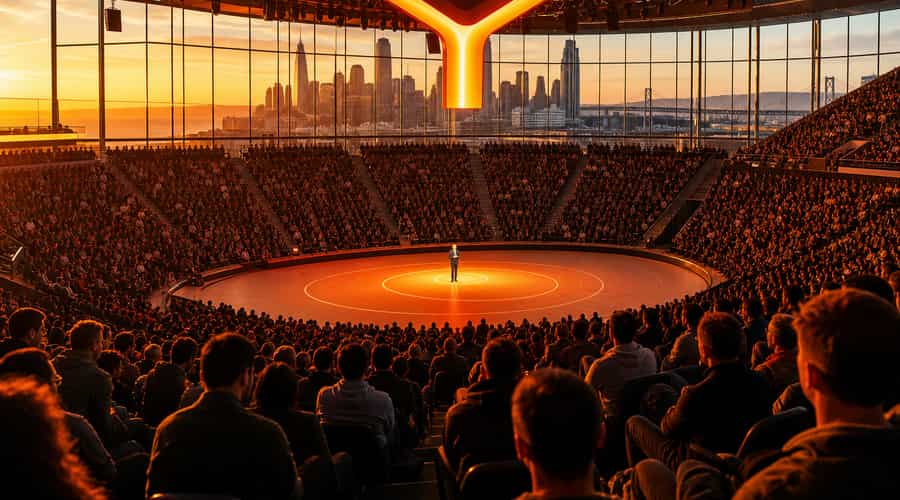
Y Combinator staged its 2026 Startup School at San Francisco's Chase Center on July 25-26, drawing 6,000 selected founders from a pool of 30,000-plus applicants across 120 countries, with Sam Altman and Jensen Huang headlining two days of talks inside a 20,000-seat NBA arena draped in YC orange.
The Golden State Warriors' home court is not an obvious venue for a founder education programme. But YC planted a large orange "Y" outside the Chase Center last weekend, turned the arena's signature blue and gold into its own brand colours, and filled the building with the most selective cohort of aspiring AI builders it has ever assembled. More than 30,000 founders applied. Fewer than one in five got in. The acceptance rate for YC's own flagship accelerator programme hovers around 1%. The math tells you something about the demand.
Jensen Huang was direct in a way that rarely translates from a stage this large. "If you're here, you're gonna make it," he told the crowd. Then, in a line that landed harder: "This is absolutely the single greatest time to start a company. I'm jealous of all of you." Huang recounted Nvidia's own near-death experience, the moment when the company had bet on the wrong architecture and had to teach itself out of the hole using textbooks bought at Fry's Electronics. His framing throughout was about confronting reality, not managing perception of it. "How hard could it be?" was the mindset he offered, and he meant it sincerely, not as bravado.
Sam Altman's message carried its own edge. According to accounts of the talk and a summary published by ProductMarketFit.tech, Altman told founders that AI models are currently ahead of the products being built with them. He called that a massive gap - and a massive opportunity. His advice: build with conviction, ignore the hype cycle, and make something only you can see. He was particularly pointed about the idea of using AI merely to cut headcount, arguing that founders who stop there are misreading the moment. That's the wrong move. The real play is redesigning the entire structure of the company around what these models can now do, and planning for the models that come next.
The numbers behind the orange arena #
The Chase Center event is three times the size of YC's previous in-person Startup School, which drew around 2,500 participants in San Francisco in 2025. That growth isn't just good marketing. It reflects a genuine supply-side surge in technical founders who have decided AI is the infrastructure layer they want to build on, and who are showing up with enough conviction to apply competitively for a seat in a room with people who built Nvidia and OpenAI.
Jeff Dean of Google was also on the programme, as were Alexandr Wang of Scale AI and Anthropic's Boris Cherny. The speaker list reads less like a curated panel and more like a concentration of the people who currently control the most critical inputs into any AI startup: compute access, data infrastructure, model capability, and deployment tooling. YC knows this cohort needs more than founder psychology. Attendees also received $25,000 in OpenAI credits and access to live robotics demos, both of which carry a practical signal: the emphasis is on building, not on listening.
What happens when the arena empties #
The harder question is what happens after. Six thousand founders with serious AI intent, a sub-1% filter, and two days of direct access to the industry's most influential operators is, on its face, an extraordinary thing. But VC capacity doesn't scale the way founder ambition does. The number of credible seed funds capable of writing a first check into an AI startup has not tripled in the last twelve months. The number of aspiring founders very clearly has. YC's own W25 and S25 batches already skew overwhelmingly toward AI companies. What the Chase Center event makes visible is a pipeline that the existing funding infrastructure will struggle to absorb at full volume.
Altman said this is the best time ever to build a startup. Huang said he's jealous of everyone in the room. Both statements are probably true. They're also the kinds of things that are worth interrogating. The window is real. The competition for the best early checks, the best infrastructure partnerships, and the best early customers is also real - and it gets more crowded every time YC turns an NBA arena orange. The founders who left Chase Center with a clear idea and a willingness to confront their own wrong technology bets will have the advantage. The ones who left with a badge and a great story about the weekend probably won't.
Also read: GlossGenius rebrands as Genius AI and closes a $44M Series D at a $1.15 billion valuation • AI is finding software vulnerabilities faster than security teams can fix them • Google AI Mode is now the default for a billion users and your startup's SEO playbook is already obsolete