TL;DR
Xpeng launched the L03 across 65 markets with its own Turing AI chips and second-generation VLA driving system on every trim.
The coupe-SUV carries up to three proprietary Turing AI processors and is the first vehicle from an Asia-Pacific automaker to ship with Google's Maps Auto SDK
Xpeng launched the L03 across 65 markets with its own Turing AI chips and second-generation VLA driving system on every trim.
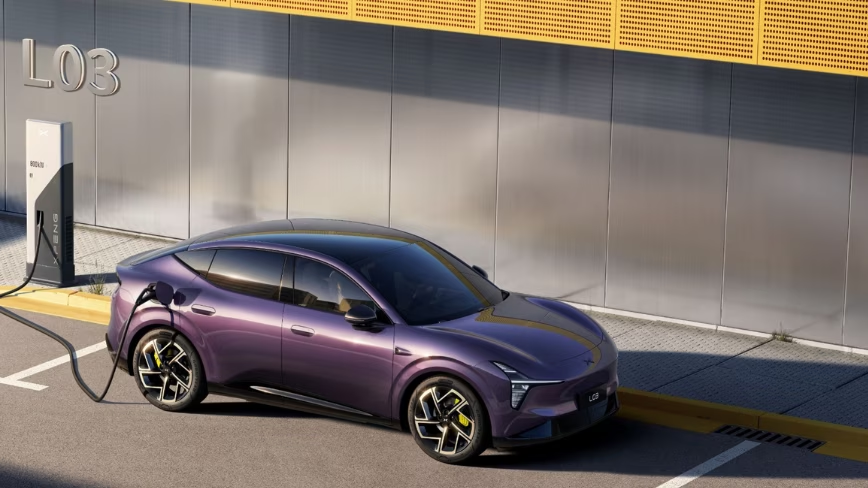
Xpeng debuted the L03 on Wednesday in Munich, launching its most internationally ambitious electric vehicle simultaneously across 65 markets. The coupe-SUV is built around the company’s proprietary Turing AI chips, with every trim shipping at least one and the top Ultra variant carrying three for a combined 2,250 trillion operations per second. It is the first consumer vehicle from a Chinese automaker where every configuration ships with in-house autonomous driving silicon as standard.
The chips power Xpeng’s second-generation VLA system, a vision-language-action model that the company describes as a physical-world foundation model for interpreting road environments and choosing driving responses. The system remains a driver-assistance feature, not full autonomy, and Xpeng plans to activate it progressively in Europe starting in 2027. The L03 is also the first vehicle from an Asia-Pacific automaker to ship with Google’s Maps Auto SDK built directly into the infotainment system, replacing the need for phone mirroring or a standalone navigation app.
The L03 was designed by a team led by JuanMa Lopez, who previously served as Ferrari’s head of exterior design and worked on models including the LaFerrari and SF90 Stradale. Its sloping roofline, frameless doors, and one of the lowest drag coefficients in the crossover segment give it a profile closer to a sports car than a family hauler. Xpeng offers it as a pure battery-electric vehicle with up to 625 kilometres of range on China’s CLTC cycle, and as a Power X range-extender with a claimed 1,330 kilometres.
The real story behind the L03 is not the car itself but the vertical integration it represents. Xpeng is one of a handful of Chinese automakers that have designed their own autonomous driving chips rather than buying them from Nvidia or Horizon Robotics, and it is now shipping that silicon in a mass-market vehicle priced from roughly $21,000 in China. Volkswagen, which holds a roughly five percent stake in Xpeng, has already adopted the Turing chip and the VLA system for its own vehicles, making it the first major Western automaker to license Chinese autonomous driving technology at that depth.
In Europe, the L03 starts at €34,990 in France and Belgium and €35,600 in Germany, undercutting Tesla’s Model Y and Hyundai’s Ioniq 5 in markets where Chinese EVs are still fighting for consumer trust. European WLTP range figures, which tend to be lower than Chinese test cycle numbers, have not been published yet. Charging from ten to 80 percent takes roughly 19 minutes, according to Xpeng.
The L03 arrives as Xpeng expands into robotaxis, humanoid robots, and flying cars, all running on the same Turing chip and VLA software stack that the company is now putting into production at its Guangzhou facility. Whether European and other international buyers will trust an unfamiliar Chinese brand with this much onboard computing power remains the central question Xpeng has not yet answered. The technology is shipping; the market acceptance is not guaranteed.
Get the most important tech news in your inbox each week.