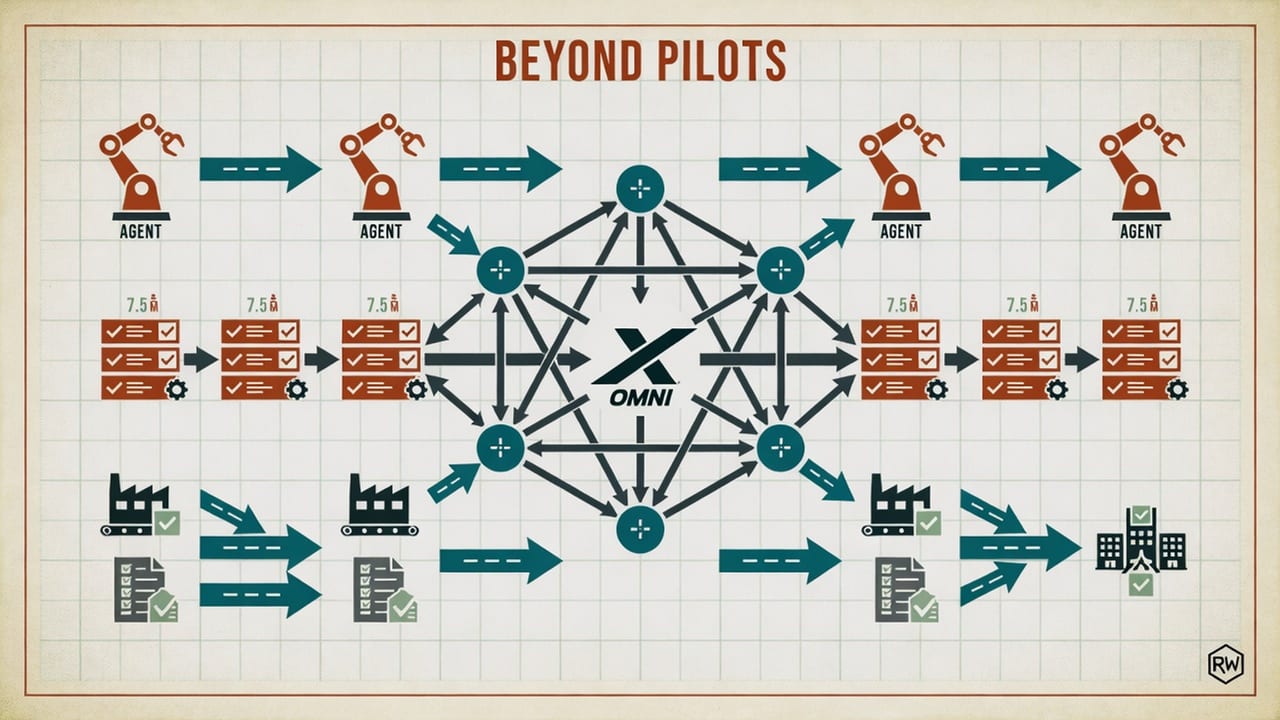
David Twizer, Ran Sheinberg, and Moriel Pahima have raised a $7.5 million seed round for Xpander, their attempt to turn the difficult work of deploying enterprise AI agents into a repeatable software product.
Xpander announced the financing on August 17, 2026, alongside the release of Omni, an agent that Xpander describes as an "agentic Forward Deployed Engineer." Pico Venture Partners led the round, with Emerge Ventures, Samsung Next, and SeedIL participating. Xpander says the money will support market expansion. The announcement gives no valuation, ownership terms, or operating metrics such as revenue, customer count, or growth.
The founders established Xpander in 2024 and serve as CEO, chief product officer, and chief technology officer, respectively. Xpander is headquartered in San Francisco, according to its funding announcement.
Twizer and Sheinberg each spent years at AWS. Twizer worked with large enterprises on complex cloud migrations, while Sheinberg worked on large-scale compute and big-data workloads. Twizer spent six years at AWS as a principal solutions architect and led its go-to-market generative AI solutions architecture team. Sheinberg spent five years there as a principal solutions architecture leader, including work involving EC2 Spot. Xpander identifies Pahima as a former AWS principal engineer.
Twizer has said his work helping large enterprises through complex, multiyear cloud migrations shaped Xpander's thesis: AI-agent deployments need a shared operational layer that replaces isolated pilots.
Omni is the founders' software version of a deployment engineer
Omni accepts a plain-language description of a business process and, according to Xpander, can connect tools, create and test an agent, repair integrations when APIs change, compare models, and move the resulting agent into production. One example on Xpander's Omni page asks the system to build an IT access agent connected to ServiceNow and Jira, automatically approve requests that match policy, and send exceptions for review. Both the platform and Omni are available at chat.xpander.ai.
Xpander says its platform handles runtime infrastructure, permissions, secrets, execution logs, model selection, spend attribution, and deployment across customer-controlled environments. Its documentation describes hosted and self-managed Kubernetes installations. In an official company blog post, Xpander says its VPC-native deployment keeps agent execution, tool calls, and memory operations inside the customer's security perimeter. Its self-hosted documentation says task execution, agent memory, connector credentials, model API keys, and user-facing services run in the customer's VPC. Xpander also claims support for private networks, on-premises environments, and air-gapped systems, and says it is SOC 2 Type II certified and GDPR compliant.
Xpander also says developers can bring agents built with frameworks such as LangChain, LangGraph, Agno, or the OpenAI Agents SDK. According to its deployment documentation, agents can be exposed through Slack, webhooks, APIs, scheduled tasks, chat interfaces, and the Model Context Protocol. Xpander says its model support spans commercial and open-weight systems.
Vendor neutrality is central to Xpander's sales pitch. Xpander says a customer can change the model, framework, or cloud underneath an agent while keeping its operating and governance layer. That proposition speaks directly to buyers wary of committing production workflows to a single model provider while model quality, pricing, and availability continue to change.
It also gives Xpander a demanding product scope. Each additional framework, model, connector, deployment target, and authentication method increases the number of failure paths Xpander must support. Enterprise buyers will judge the platform on incident response, auditability, upgrade safety, and the behavior of agents when connected systems change.
The pilot bottleneck is real
A 2025 McKinsey survey found that 88% of organizations regularly used AI in at least one business function. Roughly one-third had begun scaling AI across their enterprises, leaving nearly two-thirds in experimentation or pilot stages, and only around 1% described their deployments as mature.
The founders are building for the work between those states. Xpander says its product design centers on bounded permissions, durable integrations, monitoring, approval paths, cost controls, credential management, and execution logs for agents operating across company systems.
Xpander's pitch is that these controls should be shared across agents instead of rebuilt for each project. If the platform works as described, the first deployment creates reusable infrastructure for later ones. That would let Xpander expand inside an account as teams move from isolated assistants toward agents that can act across internal systems.
Xpander positions Omni as a clearer commercial wedge for that infrastructure. Platform layers can be difficult to sell before a buyer has deployed enough agents to feel the operational pain. Xpander promises an immediate outcome: give Omni a workflow, let it assemble the agent, and keep the resulting workload on Xpander. In effect, Xpander is packaging part of the professional-services labor commonly needed for enterprise AI projects into the product itself.
A benchmark claim with important limits
Xpander says Omni scored 90.9% on the GAIA validation benchmark and has published its results and methodology in a GitHub repository. That score measures general assistant performance; it does not establish production reliability, enterprise governance, or safe recovery from failed actions.
The result is a company-published claim, without an independent benchmark audit.
GAIA evaluates general AI assistants. It does not test the enterprise controls at the heart of Xpander's pitch, including permission boundaries, credential handling, regulatory compliance, integration durability, or safe recovery from a failed action. Evidence for those capabilities would need to come from customer deployments or independent testing.
Xpander says it works with organizations across retail, manufacturing, financial services, technology, and government. Its website displays customer or associated-company logos including Lenovo, Intel, Wix, Siemens, NVIDIA, SAP, Salesforce, and Workday, without specifying deployment size, contract value, or whether each relationship is commercial. Xpander has not disclosed customer count, revenue, annual recurring revenue, or retention. No independent customer or deployment data in the available materials establishes commercial traction or production reliability.
The seed round funds a distribution test
Pico Venture Partners led Xpander's seed round, backing infrastructure engineers who are turning their implementation experience into a platform.
Xpander faces alternatives that cover different portions of agent development and operations. LangGraph and LangSmith address agent construction, evaluation, observability, and deployment. Amazon Bedrock AgentCore, Microsoft Foundry, and Google Vertex AI Agent Builder connect agent tooling to their respective cloud platforms. Salesforce Agentforce and IBM watsonx Orchestrate focus on enterprise agents, workflows, and governance within broader software portfolios. Their scopes differ, so none is a direct feature-for-feature comparison. Xpander claims its distinction is portability across clouds, models, and frameworks, combined with deployment, governance, and operational controls.
Xpander must determine whether enterprises want another control plane between their agents and existing cloud stacks. It will need to show that portability and centralized governance justify adding a separate vendor, especially when major cloud and enterprise-software suppliers can bundle agent tooling into contracts customers already hold.
Twizer, Sheinberg, and Pahima have chosen a practical way to make that case. Omni can enter through one workflow, while Xpander becomes the infrastructure underneath it. Each successful agent could make the platform more valuable inside the account by reusing permissions, integrations, deployment patterns, and operating data.
The $7.5 million round gives the founders room to test whether that progression holds in real organizations. Twizer has said his AWS work helping enterprises through complex, multiyear cloud migrations inspired Xpander's platform. Xpander is built around the idea that software can perform a larger share of the implementation work required to put AI agents into production.