There is a new round of rumors about Xi’s health. I think the rumors are BS but since I have been getting lots of pings about it, it makes sense to address them. As I wrote in the Sinocism chat I started earlier today:
I believe the most amplification came from this X account, which does not have a track record that makes it worth believing without other, much more credible sourcing:
The good news is we will have an answer soon enough. Xi should be arriving in DC in a week, and as a friend who follows these things closely just said to me, there is no way He Lifeng comes to the US this weekend for talks with Bessent and Greer if Xi is sick as the rumors suggest.
We had a good discussion of AI and the upcoming Xi visit, among other topics, in this week’s episode of Sharp China - The Limited Potential for a Pacing Deal; MSS on PRC AI Risks; Distillation and Data Security; The Party’s Approach to Social Media:
On today’s show Andrew and Bill look at several dimensions of the PRC’s approach to AI. First: The various reasons a push for an agreement with U.S. labs to “pace” AI development is unlikely to bear fruit and the history of the CPC’s approach to control over technology. Then: The head of the MSS offers a view into CPC concerns around political security risks and data risks, while Anthropic CEO Dario Amodei proposes a misguided framework for forcing Chinese compliance with a slowdown agreement. From there: The U.S. reiterates its complaints about Chinese companies conducting “industrial-scale” distillation of U.S. AI models, while Anthropic suggests sensitive PRC data was shared with Claude. At the end: A law broadening exit bans goes live, the New York Times reports Chinese social media “getting dark,” while the Wall Street Journal highlights an influencer scandal captivating netizens.
You can listen to it here. In this issue:
-
Wang Yi meets Iran FM
-
US-China meetings
-
AI
-
PBoC Governor Pan Gongsheng in Qiushi
-
Latest issue of Qiushi
-
EU-China
The Feed: Business, Economy and Trade - Politics and Law - Foreign and Defense Affairs - Hong Kong - Taiwan - Tech and Media - Energy, Environment, Science and Health - Jobs and Events - Education
Today’s top items:
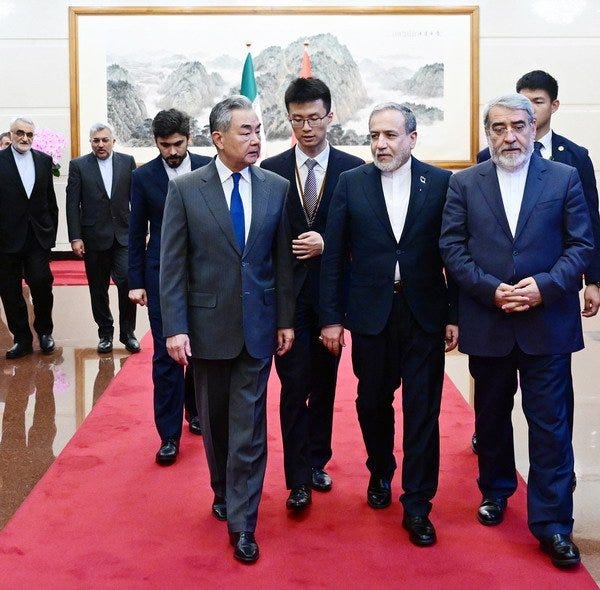
1. Wang Yi meets Iran FM - Iranian Foreign Minister Abbas Araghchi met with Wang Yi in Beijing. According to the readout, translated here, Wang told his counterpart:
We encourage Iran and the United States to remain rational and restrained, return as soon as possible to the Islamabad memorandum of understanding, rebuild the negotiation mechanism on the basis of the consensus reached so far, and hold substantive consultations on the issues of concern to each side. We support Iran in conducting dialogue with the Gulf states, respecting each other’s territorial sovereignty and national security, and safeguarding the region’s common interests in a constructive manner. We urge all parties to take effective measures to reopen the Strait of Hormuz at an early date, keep international shipping lanes open and safe, and maintain the stability of international energy transport and industrial and supply chains. We do not want regional tensions to spill over further toward Yemen and the Red Sea. We call on all parties to stop further complicating the situation and to resolve issues through dialogue and negotiation.
The latest Middle East supply disruption after the attack on the Saudi pipeline has pushed Chinese crude prices to record levels at the same time China is drawing down inventories more rapidly. The spike raises the risk that the exit from deflation becomes increasingly cost-push “bad inflation”, and that further complicates the case for conventional PBOC easing. And the global economic impact of another huge petrochemical price surge would damage the export markets the PRC economy needs. The PRC increasingly needs this conflict to end.
2. US-China meetings - Demetri Sevastopulo at the Financial Times has confirmed that He Lifeng is meeting with Scott Bessent and Jamieson Greer this weekend in New York, ahead of Xi’s visit to Washington next week. From his article:
US Treasury secretary Scott Bessent will meet his Chinese counterpart He Lifeng in New York on Sunday as the two sides try to bridge differences ahead of next week’s summit between Donald Trump and Xi Jinping in Washington…
Ahead of the summit in Washington, China has pushed to extend the Busan truce for the rest of Trump’s term. But several people familiar with the talks said the US was insisting on a six-month extension, partly because it believes China is not fully living up to the commitments on rare earths reached in Busan.
The US has also been pushing China to ease restrictions on rare earth exports to Japan, in pressure partly designed to help an ally but also because the restrictions are having a knock-on impact on US supply chains.
It is good news that the US is speaking up about the treatment of Japan, and only agreeing to a six-month extension would be disappointing to the PRC side, but as we have discussed multiple times here, the Chinese side has been underdelivering on the rare-earths deal and the US side has gotten very frustrated.
3. AI - The Zhong Sheng commentator at People’s Daily weighed in Wednesday on the US accusations that PRC AI firms are distilling US models. I have translated the full commentary here. Some highlights:
By elevating a common industry practice into a national-security issue, the United States is using the pretext of combating distillation to pursue industrial monopoly. Some U.S. artificial-intelligence companies have long abused their competitive advantages, inserting overbroad geographic restrictions and other onerous terms into their user agreements in an attempt to exclude competitors from countries including China from the global technology ecosystem and monopolize the gains from artificial-intelligence development. In this instance, U.S. security agencies directly issued the advisory, binding the interests of particular companies and capital to national security and using coercive state institutions to interfere in normal commercial activities. This unquestionably amounts to an endorsement of those onerous terms. For some time, the U.S. executive and legislative branches have repeatedly threatened sanctions and suppression against Chinese companies, with restrictions extending step by step from chip controls and computing-power blockades to areas such as model access. The United States is willing to mobilize state power to preserve technological hegemony and a monopoly over computing power. At root, this reflects deep anxiety over the possible loss of its technological hegemony and the same hegemonic logic that “only the United States may win alone; humanity may not win together.”..
美方将行业通行做法上升为国家安全问题,是以打击蒸馏为名,行产业垄断之实。长期以来,美国个别人工智能企业滥用竞争优势地位,在用户协议中设置宽泛的地域限制等霸王条款,试图将中国等国家的竞争者排除在全球技术生态之外,独占人工智能发展红利。此次美方由安全部门直接发布公告,将个别企业和资本利益与国家安全相捆绑,动用国家强权机构干涉正常商业活动,无疑是为这些霸王条款背书。一段时期以来,美国行政、立法机关频频发出对中国企业的制裁打压威胁,限制措施从芯片管制、算力封锁一步步延伸到模型访问等领域。美方不惜动用国家力量维护科技霸权和算力垄断,根源在于对自身技术霸权旁落的深层焦虑,奉行的依然是“只能美国独赢,不能人类共赢”的霸权逻辑。
It is hoped that the United States will meet China halfway, manage risks through dialogue and communication, and work together to create an open, equal, fair, and nondiscriminatory environment for artificial-intelligence development, so that artificial-intelligence technology benefits all humanity. But if the United States uses combating distillation as a pretext to take action to contain and suppress Chinese artificial-intelligence companies and harm China’s legitimate and lawful rights and interests, China will resolutely adopt countermeasures.
希望美方与中方相向而行,通过对话和沟通管控风险,共同营造开放、平等、公平、非歧视的人工智能发展环境,推动人工智能技术造福全人类。但如果美方以打击蒸馏为名,实施遏压中国人工智能企业的行动,损害中方正当合法权益,中方必将坚决采取措施予以反制。
The commentary was at the bottom of page 3:
The US and China should be talking about AI safety and governance, and while I am skeptical this can happen given the politics I thought it is still constructive to make some suggestions. I created this proposal with Astra after much back and forth. If the two sides are going to dialogue about AI, the AI should have a say - US-China Strategic AI Dialogue (SAID) Proposal.
4. PBoC Governor Pan Gongsheng in Qiushi - Pan Gongsheng has an essay in the new Qiushi, “Gain a Deep Understanding of Changes in China’s Financial Structure and Make Financial Services Better Suited to the Real Economy 深刻认识中国金融结构变迁 提升金融服务实体经济适配性.” Most of it expands his June Lujiazui Forum speech, updated with first-half 2026 data and a section on implementing the new 15th Five-Year Plan for Building a Financial Power. I have posted a translation here.
This line from Pan is getting the most attention:
Slower but higher-quality lending may become one of the new normal features of macroeconomic operations.
贷款降速提质或将成为宏观运行的新常态之一.
Pan writes that monetization of the economy is “basically complete,” that the financing market has moved from supply constraints to demand constraints, and that letting aggregates outrun the real economy would push up leverage and prevent the clearing of “backward production capacity and inefficient enterprises”.
He said much of this in Shanghai three months ago, so this is the new normal, and those trying to argue credit is too tight are not convincing the people that matter.