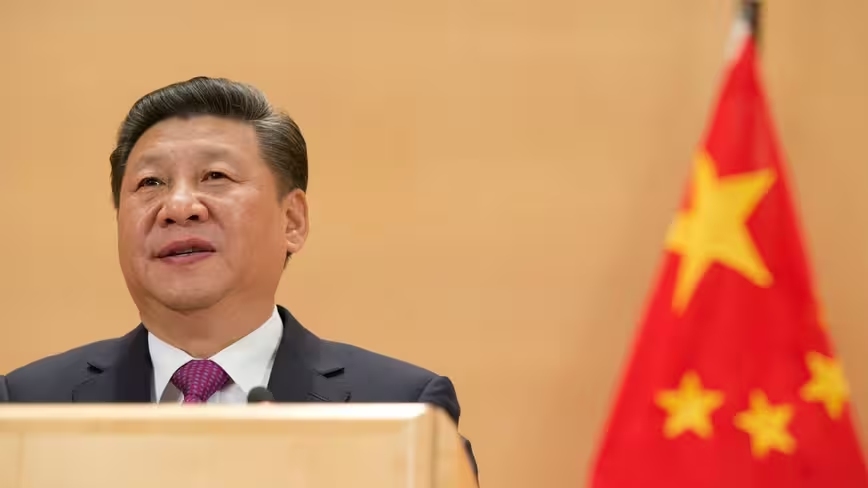
Xi Jinping will attend the opening ceremony of the 2026 World Artificial Intelligence Conference in Shanghai and deliver a keynote speech, a Chinese foreign ministry spokesperson announced on Monday.
It is the first time China’s leader has appeared at the country’s flagship AI event, and it comes at a moment when Beijing has been busy restricting overseas access to its best models and Washington has been busy accusing it of copying American ones.
The conference runs from 17 to 20 July, alongside a High-Level Meeting on Global AI Governance. Xi has previously left the event to his premier, which is the customary division of labour for a trade show. His presence changes what the week is.
Chinese state media has been signalling scale for weeks. Organisers expect more than 1,400 guests, including executives, investors, and academics, along with 12 government ministries, eight national laboratories, and more than 300 global product debuts. The theme is “AI Partnership for a Brighter Future”, which tells you precisely as much as it is meant to.
The high-level governance meeting is the part worth watching. It is a diplomatic format rather than an exhibition hall, and it exists to convene delegations, more than 10 international organisations among them, around a Chinese-drafted agenda.
The substance, if there is any, is likely to be institutional. China has been openly accelerating the establishment of a World AI Cooperation Organization, a proposed international body it wants headquartered in Shanghai, and analysts expect Xi to use the keynote to give it definition. Beijing has not confirmed that, and the organisation so far exists mostly as a stated intention.
Still, the shape of the play is legible. The United States has spent three years building a governance regime made of export controls and restricted-entity lists. China is proposing one made of membership.
Whether anyone joins is a different question, and it will be answered by countries that would rather not choose. The pitch to them is straightforward: open weights, cheaper models, and a seat at a table that Washington has not offered them.
That pitch has become considerably easier to make. Chinese labs now ship frontier-adjacent models at a fraction of the cost of their American counterparts, and DeepSeek is reportedly designing its own inference chip with SMIC to route around US export controls, which is either a workaround or a declaration of independence depending on how it performs.
The rivalry has also turned rhetorical in a way it was not a year ago. The White House has told China to stop distilling American models, a demand that is difficult to enforce and easy to repeat, and the two governments have taken to warning their own institutions against using each other’s AI systems on security grounds.
Against that backdrop, a head of state standing on a Shanghai stage to talk about international cooperation is doing something more specific than boosterism. He is claiming the vocabulary. Whoever gets to define what “global AI governance” means acquires a durable advantage over whoever has to respond to it.
Shanghai is not an incidental venue for any of this. The city has spent a decade positioning itself as China’s AI capital, with municipal funds, compute subsidies, and a cluster of labs to show for it, and hosting a permanent international body would give that claim an address.
None of which guarantees the speech lands. Xi’s set-piece addresses tend towards the general, and a keynote heavy on partnership and light on mechanism would leave the World AI Cooperation Organization roughly where it already sits, which is on paper.
What is not in doubt is the domestic signal. Xi does not turn up to conferences to fill a slot, and his appearance tells China’s ministries, provinces, and state banks exactly how seriously the technology is now being taken at the top.
The opening ceremony is on Friday. The interesting part will be whether he names an institution, and whether anyone outside China says yes to it.
Get the TNW newsletter #
Get the most important tech news in your inbox each week.