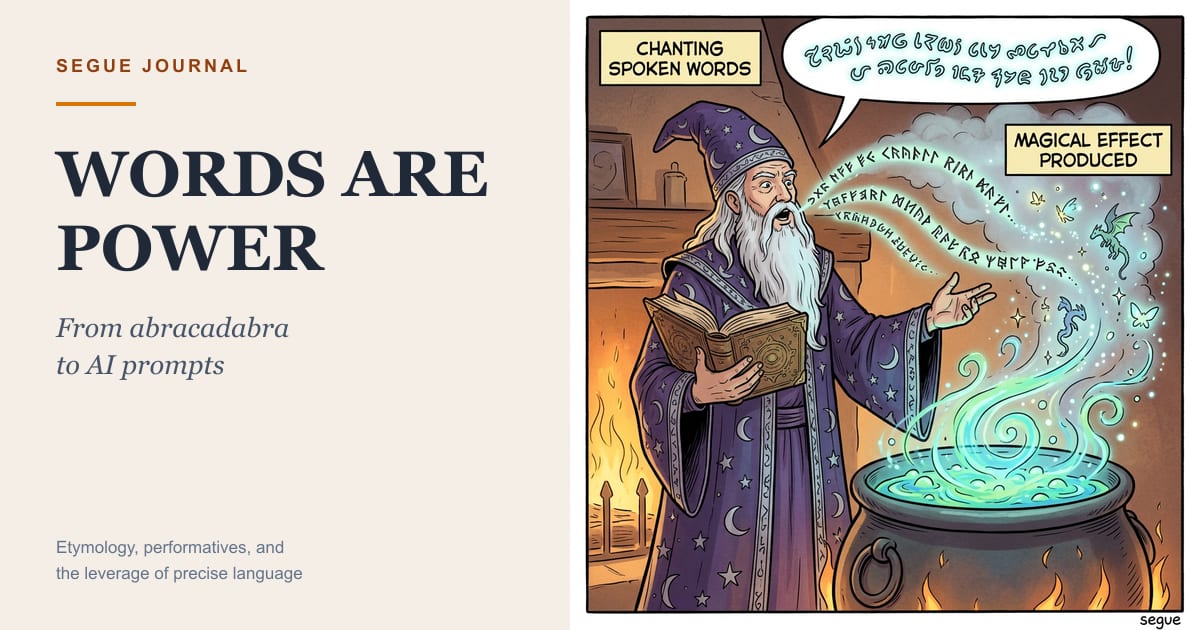
Back to Journal The power was never hidden in secret syllables. It belonged to whoever could name the thing, choose the formula, and recognize whether it worked. Prompting gives that old asymmetry a new interface.
In the third century, Quintus Serenus Sammonicus prescribed a word. His Liber Medicinalis instructed readers to write abracadabra in a diminishing triangle, hang it around the neck, and wear it against a recurrent fever, probably malaria ( CDC, Emerging Infectious Diseases). Not the word as advice or prayer. The word, taken as a dose.
The popular gloss “I create as I speak” is too perfect to be trusted. The word's origin remains disputed; proposed Aramaic, Hebrew, and Latin derivations are theories, not settled history. What the surviving text establishes is narrower and stranger: one medical text treated a written word as medicine.
To an observer, a spell is sound. To its practitioner, it is a sequence: words chosen, ordered, and delivered under rules. But sequence never acts alone. A wedding vow, a judge's sentence, and a password work because the right system receives them in the right circumstances and their effect can be recognized. The modern version of those conditions is a model, a context, and a test. We will return to all three.
English preserves several revealing links between learning and enchantment. The links are real. The neat story often told about them is not always so tidy.
Grammar, grimoire, glamour: related histories #
The dictionary evidence is better than the candlelit folklore. French grimoire is an alteration of Old French gramaire, which could refer to grammar, a learned work, or a book of witchcraft ( Merriam-Webster). In early eighteenth-century Scots, a form of grammar became glamour, meaning a magic spell or enchantment ( Merriam-Webster's word history). Modern glamour — allure, polish, celebrity — came later.
Etymology does not prove a theory of language. It preserves a social intuition: learning lets one person see and do what another cannot yet name.
Two histories hiding inside “spell” #
Modern English makes spell look like one word with a magical double life. It is actually several homographs. The noun behind a magic spell descends directly from Old English spel, meaning speech, story, or sermon; gospel preserves that older sense as “good tale” or good news. The verb meaning to name letters reached Middle English by a different route, through Anglo-French espeller. The two senses converged in modern English, although their deeper Germanic histories may be related ( Merriam-Webster's history of spell). Their meeting still feels exact: in both spelling and spell-casting, sequence carries the consequence. Get it wrong and the charm fails. Ask any programmer.
Invoke, conjure, enchant: the programmer's séance #
To invoke a function is standard technical English. The verb came through Latin invocare, “to call upon,” and still also means to appeal to an authority or put something into operation ( Merriam-Webster). Conjure followed a different path, from Latin conjurare, to join in taking an oath, toward summoning by incantation ( Merriam-Webster). Developers use it informally when a command seems to produce a whole environment at once. The vocabulary makes software sound like a séance: exact words entered, distant machinery stirred. The joke became an interface.
The power of the true name #
The true name is a recurring device rather than one universal rule of magic. Rumpelstiltskin loses his leverage when his name is discovered; Ursula K. Le Guin makes knowledge of true names central to Earthsea's fictional magic. The pattern works because a name can turn an unknown thing into a particular one. Prompting inherits that practical advantage. Asking for “that painting style with the dramatic light” is ambiguous; naming tenebrism supplies a recognized concept for a model to interpret. One term replaces a gesture with a distinction.
When a word is a weapon #
Words have also served as checkpoints. In Judges 12, Gileadite guards at the Jordan fords make suspected Ephraimite fugitives say shibboleth; the pronunciation sibboleth identifies them for execution. The passage reports 42,000 Ephraimites dead in the conflict, not 42,000 individually documented pronunciation tests ( Judges 12:4-6). Shibbolethnow names a word or custom that distinguishes insiders from outsiders. It is also the essay's darkest verification test: a word spoken into a system, measured against a standard, with consequences determined by the result. Long before software, language was already serving as a checkpoint.
Words that do things #
In his 1955 William James Lectures, J. L. Austin examined utterances that perform an action rather than report one: “I do,” “I name this ship,” “I hereby resign.” He also gave their failures a name: infelicities. “I do” outside a recognized wedding marries no one; a judgment pronounced by a bystander carries no legal force. A performative succeeds when speaker, procedure, and circumstance line up. The lectures became, perfectly, How to Do Things with Words ( Oxford Academic).
A prompt usually has the force of a directive: typing it performs the request, not the action requested. What follows is a response made possible by the system around the words. Austin supplies the bridge from spell to software: language acts only through conditions outside itself. For prompting, practical success depends on the model, the context, and the test. The model must be capable, the context must carry what the task needs, and the result must face a standard. Vocabulary lets the person at the keyboard state that standard more exactly.
The machine at the other end of the words #
Prose has begun to behave like code. Write a sentence, and software changes what it does next. Not with a compiler's certainty: prompting changes the odds, not the laws. Tell a generative model make it better and it must guess what better means. The prompt names no desired change and no way to recognize one. Backlit, by contrast, names a lighting relationship; terse names a constraint on length and delivery. Each word gives the request a handle where vague approval gave it only a gesture.
One famous historical snapshot makes that sensitivity visible. In 2022, Kojima and colleagues added the five-word instruction *“Let's think step by step”*and raised text-davinci-002's MultiArith accuracy from 17.7% to 78.7%, and its GSM8K accuracy from 10.4% to 40.7% ( Kojima et al., 2022). Then Zhou and colleagues handed the search for the instruction to the model. Its automatically discovered version lifted the same scores again, to 82.0% and 43.0% ( Zhou et al., 2023). The machine had picked up the chalk. The phrase is not current advice or a universal charm; the result records what a particular model revealed about the leverage of wording.
Even typography enters the ritual. In few-shot experiments, Sclar and colleagues measured gaps of up to 76 accuracy points between plausible prompt formats for LLaMA-2-13B ( Sclar et al., 2024). In text classification experiments, Salinas and Morstatter observed answers changing after a perturbation as small as a trailing space ( Salinas & Morstatter, 2024). Those are not victories for prompt craft. They are evidence of brittleness: format noise can swamp meaning. Precision governs the aim, not the hit. It makes the intended direction inspectable even when the model's mapping from words to answers is noisy.
Modern models complicate the story. Hua and colleagues found in 2025 that some reported prompt sensitivity shrank when semantically equivalent answers were judged as equivalent ( Hua et al., 2025). That is the direction better models should move: rescuing more mumbles and reducing the value of prompt folklore. It does not reduce the value of direction. The durable advantage is not getting something good; it is getting closer to the thing you meant, then having words precise enough to judge it.
The same trade works in text. “Make this email more professional” invites generic business prose; make it terse, plainspoken, with no hedging and one apology at most, and the request acquires choices a person can inspect. The advantage is not merely that the prompt is longer. Its author can name what generic professionalism leaves blurry.
The old asymmetry, in a new interface #
The interface even preserves ceremonial names. A system prompt lays down standing instructions; a negative prompt names exclusions in some image workflows. But the deeper inheritance is the asymmetry. The old stories hid power in a secret word. Austin found it in the fit between an utterance and the world prepared to receive it. Prompting makes a related fit visible.
One person asks for dramatic light. Another asks for tenebrism, backlighting, and negative space. The second has not acquired a charm; they have acquired more handles on the world. They can aim more exactly, revise more deliberately, and say why the result does or does not work. The machine supplies possibilities. Vocabulary lets its user make distinctions among them.
The spellbook, as vocabulary #
The vocabulary of verbal magic survives because it names a durable hope: that an intention can be shaped into words, and words into action. Words of Power follows that vocabulary through its histories, metaphors, and modern echoes.
incantationa ritual formula whose words are treated as the mechanism
invocationcalling on a power by name séancea meeting held in an attempt to receive spirit communications
[conjureto summon by invocation, or produce as if by magic](https://segue.app/word/conjure)

[grimoirea spellbook; from an alteration of French grammaire](https://segue.app/word/grimoire)

[glamoura Scots alteration of grammar that once meant enchantment](https://segue.app/word/glamour)

[runea character from an early Germanic alphabet, later used in magic](https://segue.app/word/rune)

[sigila sign or emblem used in magical practice](https://segue.app/word/sigil)

[abracadabraa magic word recorded in an ancient fever remedy](https://segue.app/word/abracadabra)

[open sesamethe phrase that unlocks what force cannot](https://segue.app/word/open-sesame)

[shibboletha word used as a border checkpoint](https://segue.app/word/shibboleth)

[benedictiona spoken blessing](https://segue.app/word/benediction)

[true namea name that grants power in myth and fiction](https://segue.app/word/true-name)
From metaphor to practice #
Words of Power follows the ritual vocabulary behind the metaphor. Creative Direction puts the same thesis to work in lighting, composition, color, and tone. The first explains the hook; the second supplies the handles.