Join independent journalists and industry decision-makers at
GamesBeat NEXT, returning to San Francisco November 2–3. The event brings together 500 executives, founders, investors and tech leaders shaping the $200 billion interactive economy for candid discussions on gaming, entertainment, technology and AI, plus executive networking and opportunities to build partnerships and close major deals. Wonder Interactive has unveiled Strata, an AI-powered dev tool that that can turn Unreal Engine projects into playable browser links using WebAssembly and WebGPU.
That’s a pretty big feat, considering Unreal Engine games are pretty beefy and getting them to run on the open web isn’t easy. And this process can be initiated through a single natural-language prompt. Strata and SimplyStream are live and developers can sign up here.
For game studios and publishers, the technology could make it possible to distribute playable demos, run external playtests and reach new audiences through a simple web link, without requiring players to download and install a traditional game client, said Alex St. Louis, cofounder and COO of Wonder Interactive, in a message to GamesBeat. Wonder Interactive is an Epic MegaGrant recipient and an Unreal Engine Authorized Service Partner.
“Tim Sweeney is right. AI is the future of game development, and every studio should be adopting it for every part of the workflow, because it’s an accelerant and a force multiplier. But agents need the right infrastructure to actually build, test and ship games. We’re giving them that, and making the browser a first-class platform for Unreal Engine,” St. Louis said.
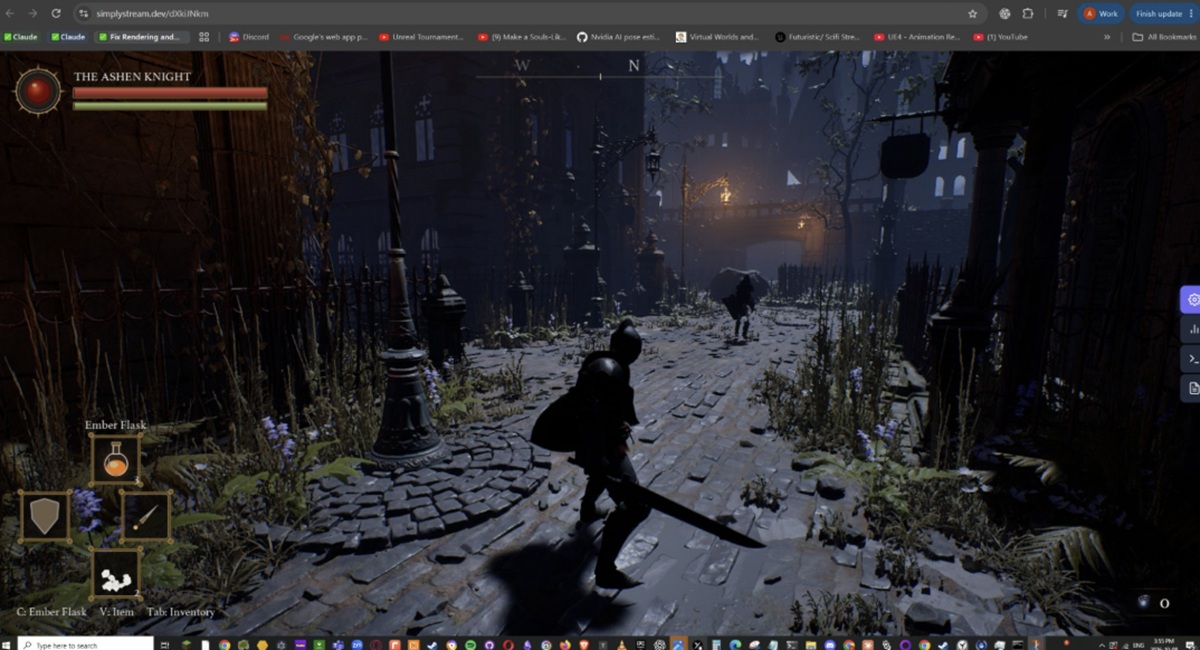
The platform integrates game-project version management, build automation, testing and deployment into a workflow accessible through AI coding assistants. The Ashen Knight, an Unreal game that St. Louis built, is playable here in the browser: simplystream.dev/brXkAj05. And the city sample is available here.
The goal is to allow studios to spend less time maintaining build infrastructure and preparing separate browser versions of their games, and more time developing the games themselves.
Strata works alongside SimplyStream, Wonder Interactive’s existing platform for running Unreal Engine applications directly in modern web browsers.
While SimplyStream provides the browser runtime, hosting and distribution infrastructure, Strata manages the development pipeline that prepares projects for it.
From source code to a playable URL
Traditionally, preparing a large Unreal Engine project for another platform can involve specialized engine builds, asset conversion, compatibility testing, infrastructure configuration and multiple manual deployment steps.
Wonder Interactive envisions AI agents handling much of that work.
Using an AI coding assistant such as Claude Code or Codex, developers can connect to Strata and submit their Unreal Engine projects for packaging and deployment. Once connected, a developer can initiate the entire process with a single natural-language prompt, instructing the agent to package and publish an Unreal Engine project to the browser without manually managing each step.
Strata builds the project against Wonder Interactive’s browser-compatible Unreal Engine runtime, publishes the resulting WebAssembly and WebGPU build and performs automated checks using a real GPU.
The system can then return a browser URL that developers can share with teammates, testers or players.
Because Strata maintains a version history of project files and builds, subsequent changes can be submitted and evaluated through the same process.
Its support for large binary assets is particularly relevant for Unreal Engine projects, where source control and asset management can become difficult as environments, textures and other content grow.
Strata’s tools work over MCP. Developers paste one prompt into Claude Code, Codex, Cursor or any AI IDE that has their Unreal project folder open. The Unreal Editor doesn’t need to be running. They approve a single confirmation email, and the agent builds, verifies on a GPU and returns the play link. The prompt which developers could take straight from the article and paste into Claude, etc and it’ll make a web build of their Unreal game instantly. Prompt below:
“Read https://api.stratavcs.com/v1/ and set me up on Strata: my email is YOUR@EMAIL and the game is MY-GAME. Keep going until it’s deployed and verified, then send me the play link.”
There’s also a CLI option for people who’d rather skip the agent. It runs on macOS, Linux and Windows. You run “strata init” and “strata push” in the project folder, and Strata builds in the cloud and plays the game on a cloud GPU before it goes live. There’s no engine install and no build machine, and it works alongside Git without touching it.
Bringing demanding Unreal Engine workloads to the browser #
Wonder Interactive has also reached a new technical milestone with its browser runtime.
The company says it has successfully run Epic Games’ City Sample in the browser, demonstrating support for a substantially more demanding Unreal Engine environment than a conventional HTML5 game. In the city, players download about 3% of City Sample’s data before they can start walking around, and the rest streams in as they move.
The WebGPU renderer fully supports both Lumen and Nanite, two technologies central to modern Unreal Engine graphics.
For context, City Sample is a high-fidelity urban environment associated with Epic’s The Matrix Awakens demonstration. It provides an ambitious test case for engine features, memory usage, rendering and asset management. Running such a demanding Unreal Engine 5 environment directly in a browser represents a significant technical achievement, demonstrating how far WebAssembly and WebGPU have progressed toward supporting the kinds of high-fidelity experiences traditionally reserved for PCs and consoles.
In SimplyStream’s native browser mode, games execute through WebAssembly and use WebGPU to access the player’s local graphics hardware rather than streaming a video feed from a remote server.
Toward automated game optimization
The longer-term significance of Strata may lie in what happens after a game is first deployed.
By connecting project versioning, automated builds, runtime diagnostics and AI coding agents, Wonder Interactive is creating the foundations for an iterative development workflow.
An agent can work on a project, submit a new revision, review build and test results, and make further changes. That could ultimately enable more automated cycles of debugging, performance optimization and quality assurance.
More importantly, Strata is designed to support a continuous AI-driven optimization loop. Agents can modify a game, deploy a new build, playtest it directly in the browser, analyze performance profiling data, identify bottlenecks and implement improvements before repeating the cycle. By comparing results across successive builds, agents can progressively refine performance, memory usage and gameplay, turning development and optimization into an iterative, increasingly autonomous process.
It also creates new possibilities for studios looking to distribute browser-playable demos and playtests without requiring users to download large game clients.
There are still technical constraints. Complex Unreal Engine projects may require adjustments to rendering features, plugins, memory consumption or platform-specific code, and successful packaging does not automatically guarantee acceptable performance on every device.
But Wonder Interactive’s approach is aimed at lowering those barriers over time.
Rather than treating the web as a separate platform requiring an entirely different development pipeline, the company wants to make web deployment and optimization another automated step in a studio’s existing development workflow.
For the long term, St. Louis hinted that Wonder Interactive is building a direct-to-consumer “Steam for the web” marketplace on top of this.