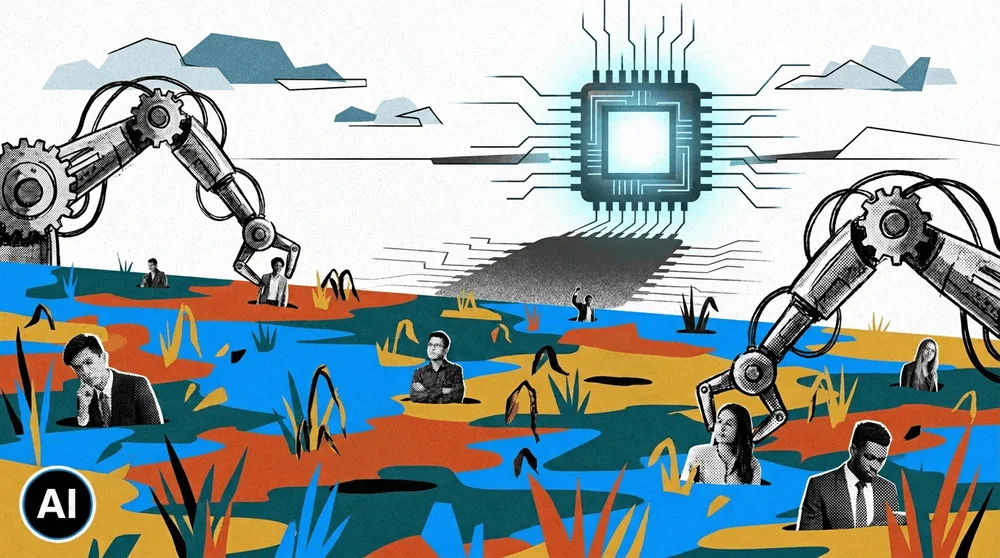
The real danger isn't that AI is "too good," but that it removes the apprenticeship phase of professional growth. You can't simply jump into a senior architect or lead strategist role without having spent years doing the grunt work—the tedious documentation, the basic coding, the manual data cleaning—where the actual intuition for a craft is built. By automating the "boring" junior tasks, we are effectively deleting the training wheels that allow a novice to become a master.
We are essentially looking at a delayed-action crisis. The benefits of this efficiency are visible on this quarter's balance sheet, but the cost is deferred. The gap will likely become a chasm between 2030 and 2045. By then, the industry will realize it has a massive shortage of experienced leaders because the junior talent pool of the 2020s was replaced by a prompt engineering workflow. When the AI hits a wall or a complex, novel problem arises that requires deep, first-principles human intuition, there won't be anyone left who knows how to solve it from scratch.
To avoid this, we need a more intentional AI workflow that treats junior roles as learning centers rather than cost centers. Instead of using AI to replace the junior, we should be using it to accelerate the junior's path to seniority. This means shifting from "AI as a replacement" to "AI as a mentor."
For anyone building an LLM agent or implementing a new deployment strategy in their office, the goal should be to automate the repetition, not the learning. If a junior dev only ever reviews AI-generated code without ever struggling to write a function from a blank page, they aren't actually learning to code—they're learning to edit. That is a fundamentally different skill set, and it's one that might not be enough to sustain a profession over the next two decades. We need to protect the "cognitive commons" before we realize we've spent our intellectual capital for a few percentage points of quarterly growth.

[AI books now make up 20% of Amazon's self-publishing catalog 9m ago](https://promptcube3.com/en/news/6438/)
People actually prefer AI stories until they find out a bot 6d ago
Next AI books now make up 20% of Amazon's self-publishing catalog →