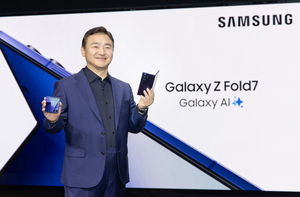
New foldables, pricing strategy, personalized AI to take center stage at July 22 event in London Samsung Electronics is set to unveil its next-generation foldable phones and wearable devices at Galaxy Unpacked in London on July 22, with a new wider book-style foldable phone, a separate Ultra foldable model and an expanded lineup of devices powered by artificial intelligence expected to take center stage.
Held under the slogan “A New Shape Unfolds,” the event is expected to go beyond the annual refresh of Samsung’s book-style Fold and clamshell Flip lineups.
While Samsung has yet to confirm the product names or specifications, industry watchers expect the lineup to include the Galaxy Z Flip8, Galaxy Z Fold8 and Galaxy Z Fold8 Ultra, along with the Galaxy Watch9 and Galaxy Watch Ultra 2. The company may also provide further details on its AI-powered smart glasses. A wider Fold after seven years
The main attraction is expected to be a shorter and wider book-style foldable, marking the most significant change to the Fold’s proportions since the first Galaxy Fold was introduced in 2019.
Often described as passport-shaped, the device is expected to open into a display closer to a 4:3 aspect ratio. The wider cover screen could be easier to use like a conventional smartphone, while the main display would offer a more tabletlike space for reading, video and multitasking.
The change will matter only if Samsung’s software makes full use of it. Apps, multitasking layouts and Galaxy AI tools will need to be adapted to the wider screen rather than simply stretched across it.
A week ahead of Unpacked, Samsung also introduced Flex Titanium, a new display structure that uses a titanium-alloy film and plate. The company says the technology is designed to reduce the visible crease while improving durability and structural stability.
Standard Fold or Ultra
Samsung is expected to divide its book-style foldable lineup into standard and Ultra models.
One scenario circulating in the industry is that the new wider device will take the Galaxy Z Fold8 name, while the taller design succeeding the Fold7 will move upmarket as the Galaxy Z Fold8 Ultra.
That would leave Samsung with three distinct foldable offerings: the compact Flip, a wider mainstream Fold and an Ultra model aimed at premium and productivity-focused users.
The standard model could compete on its new form factor and a lower starting price, while the Ultra is expected to offer a larger display, upgraded cameras, a bigger battery and more advanced productivity features.
Samsung will need to establish a clear difference between the two, particularly in camera performance, battery life, multitasking, memory and stylus support.
The Flip8 is also expected to be thinner and lighter, with attention focused on battery life, heat management and improvements to the display crease.
Higher prices amid the memory crunch
Pricing is likely to be the most immediate concern for consumers.
Strong demand from AI data centers has led memory chipmakers to prioritize high-bandwidth memory and server DRAM, tightening the supply of mobile memory and raising costs for device manufacturers.
According to Counterpoint Research figures cited in local reports, memory accounted for about 14 percent of the component cost of an $800 smartphone in early 2025. That share has since risen to around 40 percent, while the combined cost of DRAM and NAND reportedly increased from about $63 to $291.
Foldables are particularly exposed because they already rely on expensive flexible organic light-emitting diode panels, complex hinges and high-end processors. On-device AI also requires greater memory and storage capacity.
Samsung has already raised prices for the Galaxy S26 series and some higher-capacity Fold7 and Flip7 models, indicating that it has begun passing part of the increased component costs on to consumers.
European price leaks suggest the wider Fold8 could retain a starting price of around 1,999 euros ($2,283), while the Fold8 Ultra may start at 2,199 euros, about 100 euros greater than its predecessor. The Flip8 could also rise by roughly 100 euros.
The figures remain unofficial. Samsung may try to hold the starting price of the standard Fold while concentrating increases on the Ultra and higher-storage models.
AI that understands users
Personalized AI will be another central theme.
In a Samsung Newsroom column published July 8, Roh Tae-moon, a Samsung Electronics co-CEO and head of the Device eXperience division that encompasses smartphones as well as TVs and home appliances, said the best AI experience comes not from the smartest model, but from the device that understands its user best.
"The upcoming Galaxy Unpacked is where we will show what’s next in bringing all this together: more personal, natural AI experiences on a foundation more partners can build on," he said.
The focus is expected to be on how smartphones, watches and other Galaxy devices share context across schedules, tasks, health data and daily routines, rather than on the number of new AI features alone.
Samsung will also need to show how it plans to protect personal information and give users control over how AI services use their data.
Watches and first AI glasses
Samsung’s next Galaxy watches are expected to move beyond recording health data toward interpreting the user’s condition and recommending what to do next.
The devices could analyze sleep, heart rate, breathing, skin temperature and blood oxygen levels, then offer guidance on exercise intensity and recovery. The Watch Ultra 2 is expected to target outdoor and endurance users with a larger battery, brighter display and expanded storage.
Samsung may provide further details on its first AI-powered glasses, developed with Google and built on Android XR with Gemini.
The glasses are expected to support functions such as photography, messaging, navigation, object recognition and real-time translation through cameras, microphones and speakers.
Samsung and Google unveiled two intelligent eyewear designs developed with Gentle Monster and Warby Parker at Google I/O, Google’s annual developer conference, in May, but pricing, detailed specifications and market availability remain unclear. Samsung has also yet to confirm whether the products will carry the Galaxy Glasses name.
Samsung heads into the event as Chinese smartphone-makers expand their foldable lineups and Apple is widely expected to unveil its first foldable iPhone, a similarly wide book-style model, alongside the iPhone 18 Pro series in September.
How Samsung prices and differentiates the new models — and how well its software supports the wider form factor — will be closely watched as competition in foldables enters its next phase.
yeeun@heraldcorp.com