Why the next wave of AI startups won’t optimize infrastructure – until they have to
For most AI startups, infrastructure isn’t the first problem to solve; speed is. At the earliest stages, success is defined by how quickly a team can move from idea to product, from prototype to traction. The constraints are immediate and unforgiving: limited runway, small teams, and the constant pressure to prove value before the next funding milestone.
Startups don’t win at the earliest stage by minimizing cost per token or optimizing silicon performance. They win by compressing the cycle from idea to shipped product to customer learning – often in days or weeks, not quarters – and by repeating that cycle faster than competitors.
So, they do what makes sense: they build on the best available tools. They use mature APIs, rely on hyperscale cloud platforms, and prioritize developer velocity over system-level optimization.
And for a while, that’s exactly the right approach. But it raises an important question: Which decisions made for speed today will limit options tomorrow?
The hidden infrastructure decisions startups are already making
There’s a subtle dynamic at play. Even when startups aren’t explicitly thinking about infrastructure, the everyday choices they are making – frameworks, cloud platforms, deployment assumptions – quietly shape what will be possible later.
A decision to rely heavily on a single cloud provider’s proprietary services can accelerate early development. But it can also make it harder to move workloads, control costs or adapt architectures down the line.
A model strategy optimized purely for ease of integration today may limit flexibility tomorrow.
Even an assumption as simple as “this will always run in the cloud” can become a constraint when customers demand lower latency, stronger privacy guarantees or on-device intelligence.
Most startups aren’t choosing infrastructure directly. But they are making architectural decisions that define their future degrees of freedom.
When infrastructure suddenly matters
At some point, the equation changes. It doesn’t happen at seed stage and often it doesn’t even happen at Series A. But as AI startups grow, three pressures tend to emerge:
Costs start to matter: What was once an acceptable cloud bill becomes a core driver of unit economics, especially for inference-heavy applicationsLatency becomes product-critical: User experience – and in some cases, safety – depends on real-time responsivenessAI moves beyond the cloud: Customers increasingly expect intelligence to run on devices, at the edge or within controlled environments
This is the moment when infrastructure shifts from background detail to strategic concern. And it’s also the moment when earlier choices begin to show their consequences.
Some teams find they can adapt quickly. Others discover they’ve effectively boxed themselves in – facing costly rewrites, performance bottlenecks or limited deployment options.
The real advantage: architectural optionality
The startups that navigate this transition best aren’t the ones that optimized infrastructure from day one. They’re the ones that didn’t over-optimize too early but also didn’t lock themselves into narrow paths. In other words, they preserved optionality.
In practice, that means:
- Avoiding deep dependence on any single vendor’s proprietary stack
- Choosing tools and frameworks with broad ecosystem support
- Building with the expectation that workloads may need to move across clouds, across environments or closer to the user
This doesn’t slow them down early. In fact, it often does the opposite. It allows teams to move quickly without accumulating hidden constraints that surface later.
And when the time comes to optimize – whether for cost, performance or deployment flexibility – they’re able to do so without starting over.
The role of architecture, whether you see it or not
This is often where the underlying compute platforms startups build on begin to matter. Today, modern computing spans hyperscale cloud instances, smartphones, embedded systems and edge devices. When those environments share common architectural foundations, they can create a level of continuity across the cloud platforms, AI services and devices that startups rely on every day.
A team might start by building and scaling in the cloud, using standard tools and services. But as their needs evolve – whether to optimize cost, improve efficiency or deploy AI capabilities at the edge – they can do so within an architecture that already spans those domains.
Instead of rewriting applications or rethinking core assumptions, they can adapt.
This is the difference between an architecture that constrains decisions – and one that keeps them open.
Beyond GPUs: a more flexible future
The conversation around AI infrastructure is often dominated by GPUs, and for good reason. They’ve been central to the rapid progress of modern AI.
But the long-term trajectory is more heterogeneous.
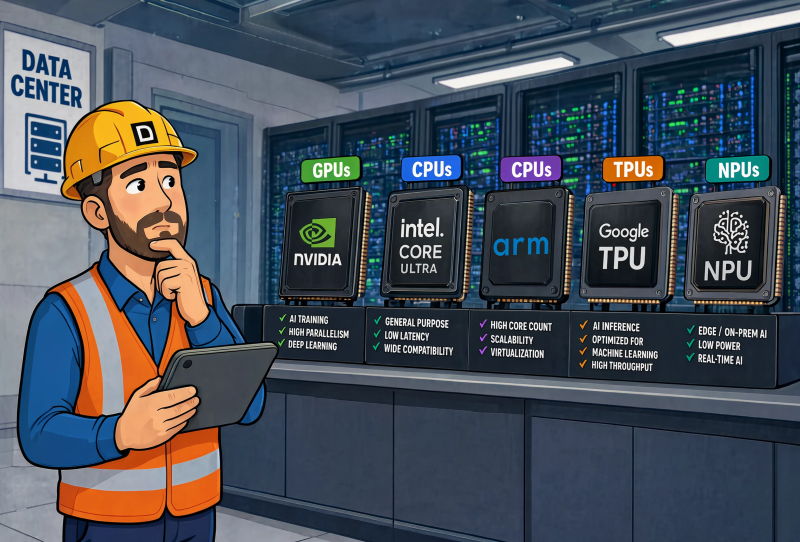
AI systems are increasingly built from a mix of compute elements – CPUs, GPUs, NPUs and specialized accelerators – working together to handle different parts of the workload. This shift allows for more precise optimization, better resource utilization, and improved performance across a wider range of use cases.
For startups, this doesn’t mean managing that complexity directly from day one. In most cases, it remains abstracted by cloud providers and platforms. But it does reinforce the importance of building on foundations that can support that diversity over time, without requiring fundamental redesign.
Choosing what not to decide – yet
The biggest mistake AI startups can make isn’t ignoring infrastructure early. It’s locking themselves into it too soon.
The most effective teams focus first on speed and product-market fit. But they do so in a way that avoids unnecessary constraints, keeping their options open as they grow.
Because while infrastructure may not be the first problem to solve, it inevitably becomes one of the most important. And when it does, the startups that win won’t be the ones that optimized earliest.
They’ll be the ones that chose architectures that allowed them to evolve – without starting over.
Paul Williamson is senior vice president of strategic ventures at Arm Holdings Ltd., where he leads strategic investments and mergers and acquisitions initiatives. He wrote this article for SiliconANGLE.
Image: TK
Support our mission to keep content open and free by engaging with theCUBE community. Join theCUBE’s Alumni Trust Network, where technology leaders connect, share intelligence and create opportunities.
15M+ viewers of theCUBE videos, powering conversations across AI, cloud, cybersecurity and more** 11.4k+ theCUBE alumni**— Connect with more than 11,400 tech and business leaders shaping the future through a unique trusted-based network
Are you an AWS customer? Support SiliconANGLE financially by buying your AWS services from our Marketplace portal page and links: https://siliconangle.com/aws-marketplace/
About SiliconANGLE Media
theCUBE AIand theCUBE SuperStudios — with flagship locations in Silicon Valley and the New York Stock Exchange — SiliconANGLE Media operates at the intersection of media, technology and AI.
Founded by tech visionaries John Furrier and Dave Vellante, SiliconANGLE Media has built a dynamic ecosystem of industry-leading digital media brands that reach 15+ million elite tech professionals. Our new proprietary theCUBE AI Video Cloud is breaking ground in audience interaction, leveraging theCUBEai.com neural network to help technology companies make data-driven decisions and stay at the forefront of industry conversations.