[ Thought Leaders
](https://www.unite.ai/series/thought-leaders/)


[Add Unite.AI to your preferred sources on Google](https://www.google.com/preferences/source?q=unite.ai)
Artificial intelligence is entering a period where infrastructure strategy is becoming inseparable from model capability. For years, hyperscale datacenters have powered the rise of large scale training, enabling frontier models to grow from millions to trillions of parameters. But as AI adoption accelerates across enterprises, industries, and real-time systems, inference is replacing training as the dominant workload, and inference has fundamentally different requirements.
The next era of AI cannot be supported by hyperscale facilities alone. Instead, a hybrid model is emerging where centralized campuses for training are complemented by distributed, power aligned, commercial scale datacenters for inference. This shift is being driven by latency constraints, data sovereignty needs, energy realities, and the physical limits of continued hyperscale expansion.
The Divergence of Training and Inference #
Training remains a centralized activity. It demands massive clusters, high-speed data pipelines, and long duration jobs that benefit from economies of scale. Hyperscale campuses are optimized for this with dense compute, specialized networking fabrics, and global availability. But inference behaves differently. It is short duration, high volume, latency sensitive, and often tied to geography or enterprise boundaries. Analyses from Akamai’s recent work on agentic systems show that most organizations now target sub 500 millisecond end-to-end latency for critical AI use cases, and multi-agent workflows frequently exceed that threshold simply due to network transit and CPU side execution.
Latency is not an abstract metric. In robotics and autonomous systems, control loops often run at 100 to1,000 hertz every 1 to 10 milliseconds. Any off-board intelligence must respect those timing constraints. A 50 millisecond round trip to a distant datacenter breaks the control regime entirely. In financial trading and fraud detection, milliseconds determine economic outcomes. In industrial automation, delayed inference can destabilize processes or compromise safety. And in interactive experiences like gaming, AR/VR, and real-time copilots, responsiveness degrades sharply above 100 to 150 milliseconds.
Modern AI systems increasingly rely on multi-agent workflows consisting of chains of dozens of sequential calls. Akamai’s analysis shows that CPU side execution can account for the majority of total latency, and each network round trip adds additional delay. A workflow with 50 sequential calls may incur seconds of transport latency when routed to a distant hyperscale region. Place that same workflow in a hyperlocal datacenter located on the same campus or metro area and the physics change. Local inference can deliver 1 to 5 millisecond round trip latency. A 50 step workflow that would take seconds in a distant region can complete in 50 to 250 milliseconds locally, staying within enterprise latency budgets.
Data Sovereignty and Grid Realities Driving Local Deployments #
Latency is only one part of the story. For regulated industries such as healthcare, finance, and public sector, data sovereignty is often the primary driver for local inference. Running AI workloads behind an enterprise firewall preserves existing security perimeters, reduces multitenant exposure, simplifies compliance, and keeps sensitive data off shared cloud infrastructure. Hyperscale providers offer strong security, but the attack surface and trust chain are inherently broader. Enterprises increasingly prefer inference architectures that align with their existing security posture.
In addition to concerns over latency and security, power availability is becoming an equally important constraint. Large hyperscale campuses often face multiyear delays due to transmission constraints and interconnection queues. Smaller commercial scale deployments, especially those sited near existing loads or distributed generation, can often be energized far more quickly. This matters because AI demand is colliding with a strange paradox.
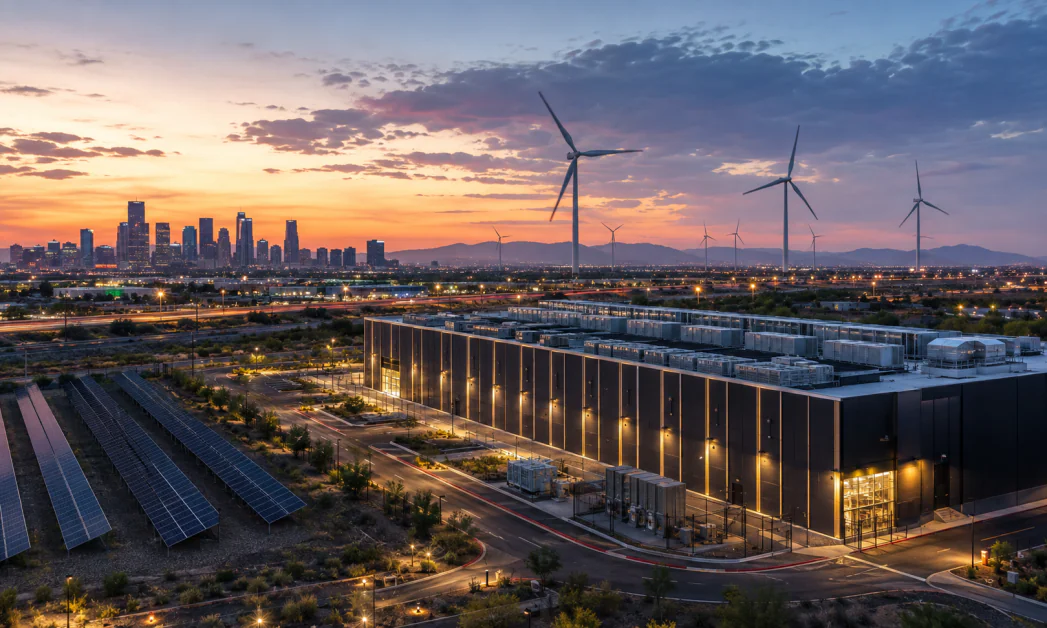
At the same time operators struggle to secure new grid connections, enormous amounts of renewable energy are being curtailed. Globally, renewable energy curtailment now exceeds 200 terawatt-hours per year. In the United States, curtailment is estimated at approximately 20 terawatt-hours annually. ERCOT alone curtailed over 9 terawatt-hours of wind and solar generation in a recent year. Meanwhile CAISO discarded 3.4 terawatt-hours of solar and wind in 2024, with solar accounting for 93% of all clipped output. Energy system surveys consistently show that both solar and wind face significant curtailment when generation exceeds grid capacity. Solar curtailment is particularly common in regions with strong midday peaks, while wind curtailment often occurs during off-peak hours or in constrained corridors. Distributed datacenters sited near generation, especially solar rich regions, can convert stranded energy into useful inference capacity.
Hyperscale campuses will remain essential for training, but they face growing physical and economic limits. Connecting to the transmission grid can be a lengthy process, it requires new substations, transmission upgrades, multi-agency permitting, and community review. These are processes that routinely take years. Hyperscale facilities require large land footprints, significant water allocations, and complex environmental approvals. Communities are increasingly resistant to new datacenter development due to noise, water use, and land impact. And centralized campuses concentrate risk such that weather events, grid outages, or geopolitical disruptions can affect large portions of global compute capacity. Distributed architectures provide geographic redundancy and operational resilience.
The Future is a Multi-Tier AI Architecture #
When it comes to ensuring inference compute runs seamlessly, efficiency may become as important as raw capacity. Inference consumes energy continuously, and industry analysts suggest that inference may ultimately represent the majority of AI-related energy consumption. Efficiency gains from local renewable integration, reduced transmission losses, right sized deployments, improved thermal profiles, and higher utilization rates will become essential to meeting global AI demand sustainably. Distributed commercial scale datacenters are well positioned to deliver these gains because they can be sited where energy is abundant, inexpensive, or underutilized.
The next phase of AI infrastructure will be a hybrid mixture of hyperscale campuses dominating training, distributed commercial scale datacenters servicing inference, and edge devices servicing ultra local workloads. This multi-tier architecture reflects the physical realities of power, latency, security, and scale. As AI becomes embedded in real-time systems across every industry, the infrastructure must evolve accordingly to bring inference closer to the world it serves.