Member-only story
On August 27, 2025, the open-source lab Prime Intellect shipped a product with an unusually blunt pitch: reinforcement-learning environments are “the key bottleneck to the next wave of AI progress,” and the big labs are “locking them down” (Prime Intellect, Aug 2025). Less than a month later, TechCrunch reported that leaders at Anthropic had discussed spending more than $1 billion on RL environments over the following year, and that a startup called Mechanize was offering engineers $500,000 salaries to build them (TechCrunch, Sep 21 2025).
If you have been reading about context engineering and agents that write their own code, this is the layer underneath all of it: the training grounds where agents learn to act. In 2026 that layer became the most contested resource in AI. Here is why the bottleneck moved — and why building these environments is harder than the funding headlines suggest.
What an RL environment actually is #
Pretraining taught models to predict the next token from a frozen snapshot of the internet. That produces something that can talk. It does not, on its own, produce something that can finish a 40-step task in a terminal without drifting off course.
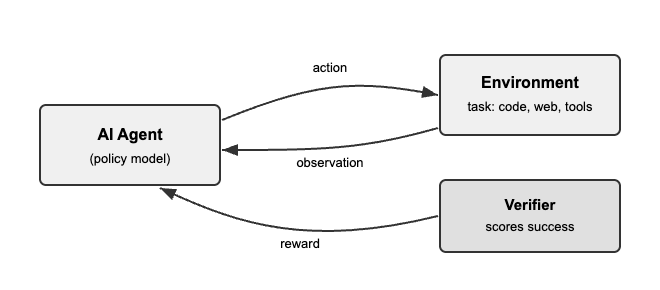
An RL environment is the fix. At its core it is a simulated version of a real task — a codebase with failing tests, a browser with a form to submit, a spreadsheet to reconcile — paired with a verifier that decides whether the agent succeeded. The agent…