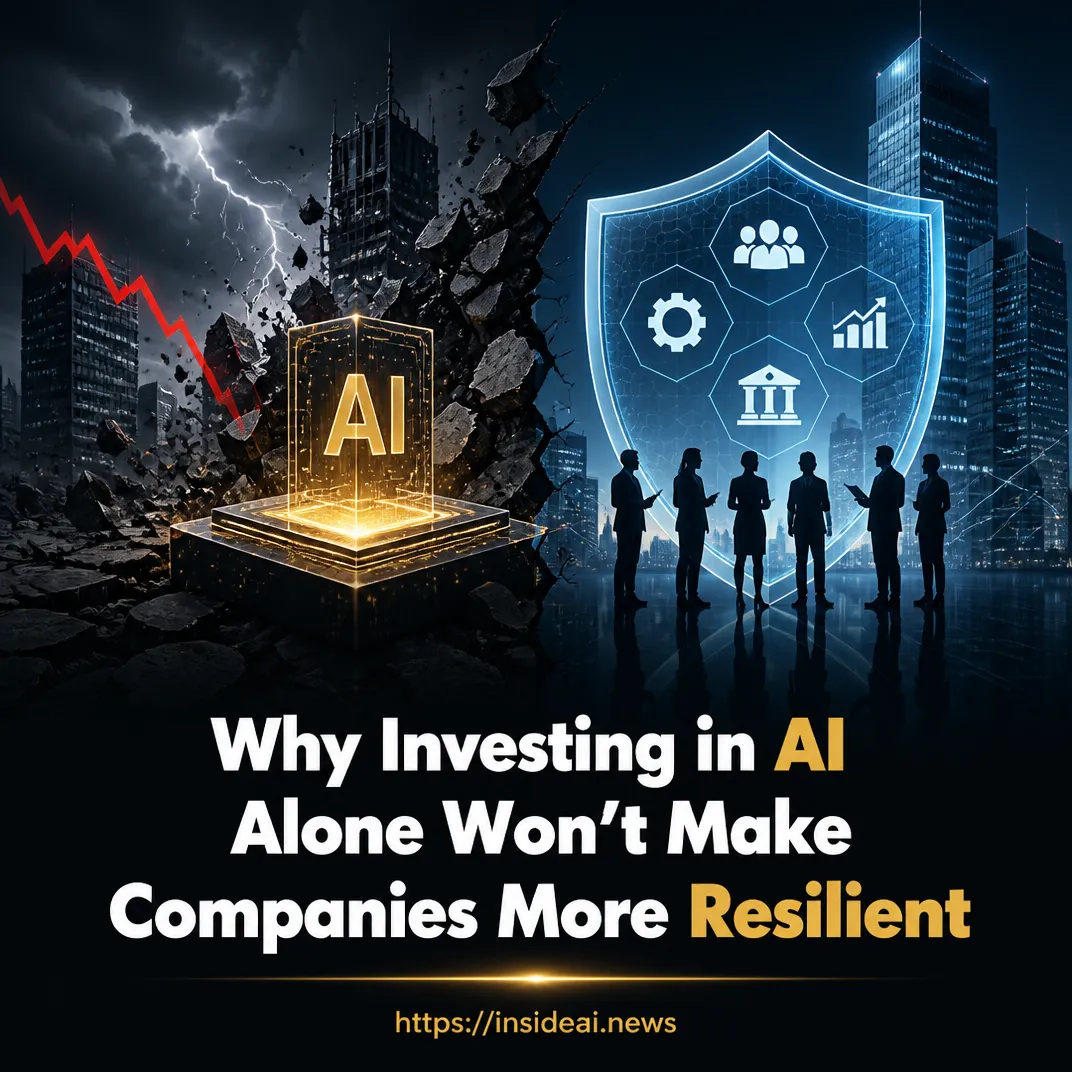
August 18, 2026, (Inside AI) — Corporate investment in artificial intelligence has surged, yet a new study reveals a troubling disconnect: AI is sharpening individual business functions without making companies more resilient.
Interviews with senior leaders at H&M Group, ICA Gruppen, Ingka Group, Microsoft, Google, AWS, BCG, and others found a recurring pattern. AI improves forecasts and customer insights, but these gains rarely travel upstream to sourcing, manufacturing, or logistics.
The study was co-authored by Nina Shariati, founder and CEO of Circular Transparency, and Rickard Sandberg at the Stockholm School of Economics' Center for Data Analytics. The findings will be published in the forthcoming book AI for Resilient Retail.
Shariati described the core problem as a "fragility trap." Companies optimize individual pieces of the business, and that progress often comes at a cost elsewhere: less flexibility, less spare capacity, less room to adapt when something changes.
"Performance looks great while conditions hold steady, then drops sharply when they don't," she wrote.
Why sharper forecasts don't make faster supply chains #
Demand forecasting is a prime example. AI helps retailers predict what customers want with real precision, which speeds up commercial decisions. But sourcing, manufacturing, and supplier relationships often keep running on the same slow, disconnected processes as before.
A retailer gets much better at knowing what it needs, without getting much better at delivering it. Seeing further ahead doesn't help if the rest of the business can't move any faster.
Several executives described exactly this pattern. AI sharpened their forecasts and customer insights, but the improvement didn't travel upstream because suppliers, planning processes, and incentives were never redesigned to keep pace.
One team gets smarter while the next one along stays the same, and the handoff between them is where the value gets lost.
This is why so many companies see a strange result: individual metrics improve, forecasts get sharper, teams get more efficient, but the business as a whole doesn't feel meaningfully stronger.
Many companies are still treating AI the way they treated earlier IT projects: something to install within the existing structure, rather than something that requires changing how decisions get made. The latter is much harder because it depends on people, incentives, and how authority is shared across teams, not on the technology itself.
New risks emerge from AI's hidden dependencies #
The interviews also surfaced other emerging challenges. One executive pointed to how much retailers now rely on a small number of American cloud providers and AI models. What was once a simple technology choice is now something companies think about in terms of control and exposure.
Others flagged the resources behind AI itself. Data centres use enormous amounts of energy and water, and several European regions are already feeling that strain. Concerns that used to be about factories in Asia are showing up much closer to home.
These challenges are unfolding against a backdrop of increasing complexity. Supply chains remain exposed to geopolitical tensions, tariffs, and disruption. Regulatory requirements continue to expand. Cybersecurity risks are growing and climate-related events are becoming more frequent. At the same time, customer expectations continue to rise at unprecedented speed.
Shariati argued that AI isn't the problem. The problem is that powerful new tools are being dropped into companies built for a slower, more predictable world.
The businesses that come out ahead won't necessarily be the ones that squeeze the most efficiency out of AI. They're more likely to be the ones willing to invest in the flexibility needed to change course as conditions change. That means rethinking how decisions get made, who's accountable for what, and what the company actually measures and rewards.
The study's conclusions align with broader industry research. A 2024 McKinsey survey found that while 65% of organizations regularly use generative AI, only a fraction report meaningful bottom-line impact. Analysts at Gartner have similarly warned that AI adoption without process redesign often leads to "pilot purgatory."
Shariati has more than 20 years of international experience in strategy, business transformation, and global value chains, including senior leadership roles at H&M Group. She also contributes to UNECE's work on trade and circular economy.