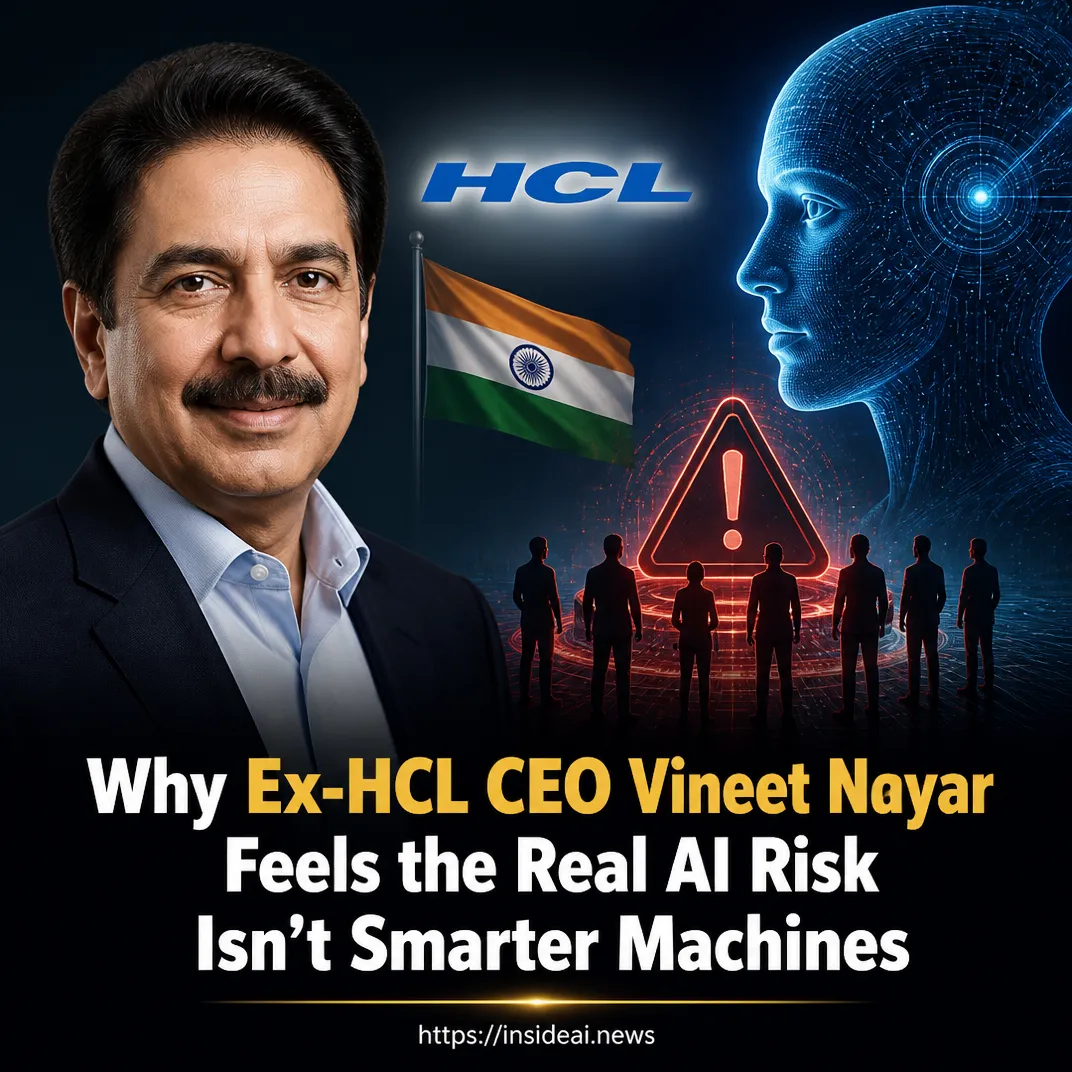
August 9, 2026, (Inside AI) — Former HCL Technologies CEO Vineet Nayar warns that the gravest danger from artificial intelligence is not smarter machines, but a quiet erosion of human ambition. In his new book, Humans First, Machines Second, Nayar draws on four decades in tech and a decade working with rural schoolchildren in India to argue that breakthroughs come from belief, not just knowledge.
The book’s title is a deliberate provocation. Nayar insists he did not write a book about AI, but about people. He fears that as machines take over more tasks, humans will lower their expectations of themselves, a risk he considers far more urgent than any technical alignment problem.
Nayar’s perspective shifts the AI debate from capability to psychology. While industry leaders scramble to build more powerful models, he asks a different question: will humans still believe they are capable of extraordinary things? His answer, shaped by years inside boardrooms and village classrooms, is that restoring that belief matters more than any investment in technology alone.
“Most people think I wrote a book about AI. I didn’t. I wrote a book about people. As machines become more capable, I am asking if human beings will still believe they are capable of extraordinary things? That question stayed with me for years and eventually became the reason I wrote this book.” Vineet Nayar, former CEO, HCL Technologies
Nayar’s argument lands at a time when global AI investment is projected to surpass $300 billion by 2027, according to IDC, while corporate training budgets remain flat. This imbalance, he suggests, is a symptom of a deeper problem: a cultural obsession with machine intelligence that overlooks the human capacity for imagination and resilience.
His experience with rural schoolchildren in India became a crucial data point. He observed that children who believed they could learn, despite lacking resources, often outperformed those with better tools but lower self-belief. The lesson, he says, applies directly to the modern workplace: technology creates opportunities, but people create breakthroughs.
“Every conversation I heard was about investing in AI. Almost no conversation was about investing in people. Yet, my four decades in the tech industry has taught me something simple. Technology creates opportunities, but people create breakthroughs.” Vineet Nayar, former CEO, HCL Technologies
The Belief Gap No One Is Measuring #
Nayar’s thesis echoes research on self-efficacy by psychologist Albert Bandura, who found that belief in one’s own ability is a stronger predictor of success than actual skill. Yet, no major AI ethics framework today includes metrics for human confidence or aspiration. The focus remains on bias, fairness, and safety, not on whether people will still dare to dream beyond what machines can do.
This oversight has real-world consequences. A 2025 Gallup survey found that 41% of workers globally fear AI will make their jobs obsolete, and 28% report feeling less motivated to learn new skills as a result. Nayar would argue that this resignation is the true crisis, not the technology itself.
His book arrives alongside a small but growing movement to reframe AI adoption. The World Economic Forum’s 2026 Future of Jobs report emphasizes human-centric skills like creative thinking and resilience. Yet, Nayar believes such efforts still treat people as assets to be retrained, rather than as agents of change who need belief first.
Can Companies Invest in Belief? #
Nayar’s prescription is simple but difficult to scale: organizations must deliberately cultivate belief. At HCL, he famously inverted the corporate pyramid, putting frontline employees first. The result was a tripling of revenue in five years. He attributes that success not to strategy, but to a workforce that believed it could achieve the impossible.
In the age of AI, he says, the same principle applies. Companies that invest only in tools will be disrupted by those that invest in people’s confidence to use them creatively. This is not a call to slow down AI development, but to accelerate human development alongside it.
Nayar’s message is a corrective to the dominant narrative of technological determinism. He does not deny that AI will transform industries. He simply insists that the most important variable remains the human mind’s stubborn, irrational belief that it can do what no machine can.