Where Japanese IP Advice Can Miss Contracts, Corporate Practice, and Community Norms
I regularly receive requests for advice on the use of licenses, primarily Open Source licenses, and often have occasion to provide my own interpretation. In doing so, I sometimes refer to the interpretations and views of outside experts. However, I do not often find those interpretations convincing. In particular, I frequently feel that explanations and advice from Japanese intellectual property lawyers are somehow subtly off the mark.
This is not to say that Japanese lawyers in general have this problem. I am well aware that there are excellent scholars and practitioners, particularly in the field of copyright law. However, when matters extend to Open Source, Source Available licenses, and terms governing AI models, explanations confined to Japanese copyright doctrine increasingly fail to address what is required in practice. As a result, the gap has become more noticeable in a growing number of situations.
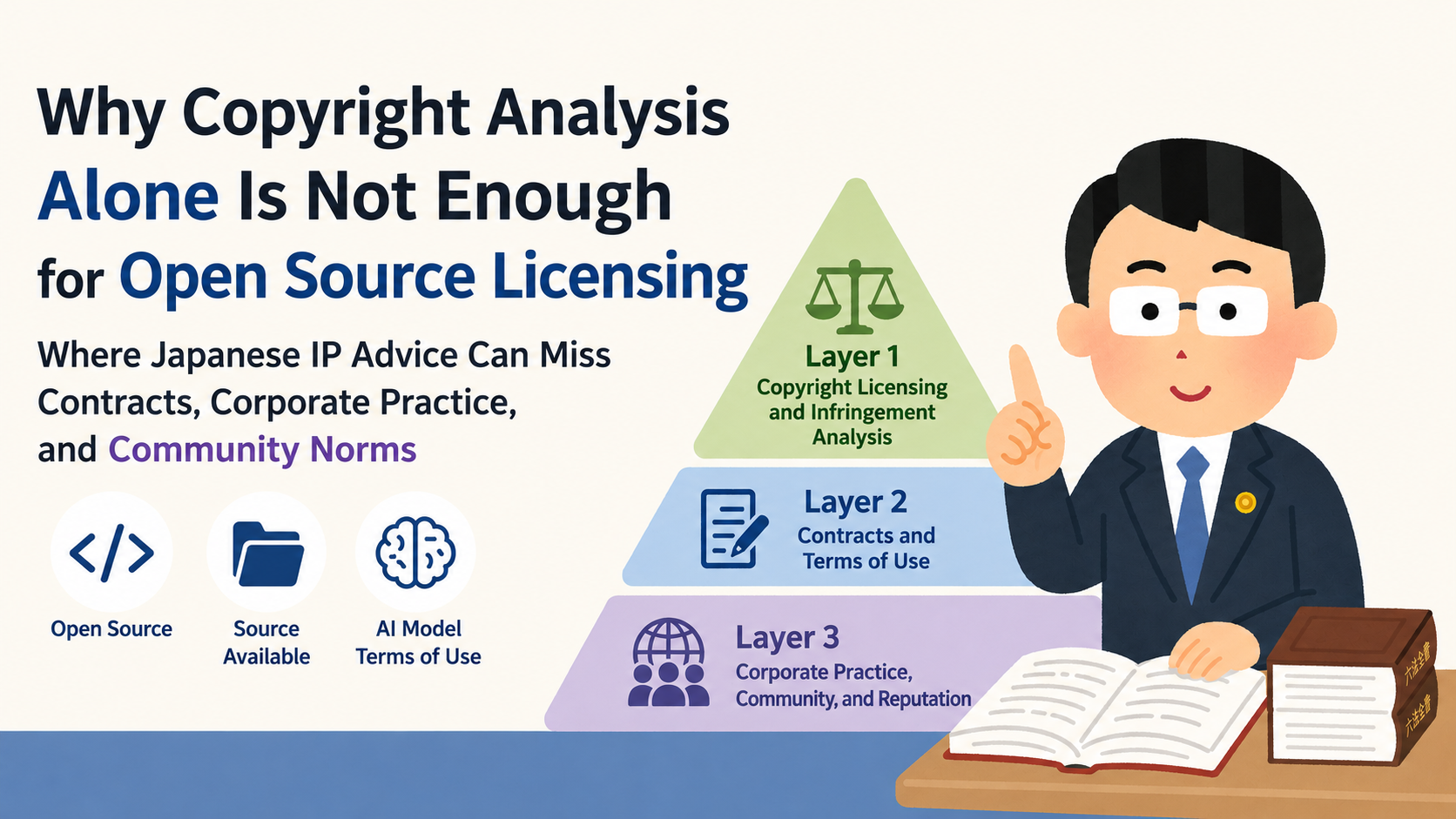
To understand this gap, Open Source-related licensing needs to be considered through at least three layers. Layer 1 is the legal analysis of copyright licensing and infringement. Layer 2 concerns contractual issues arising from license conditions and terms of use. Layer 3 is the practical business assessment, including corporate operations, global compliance, community relations, and reputation. My sense is that the gap in much Japanese IP commentary arises mainly when conclusions are reached at Layer 1 without adequate consideration of Layers 2 and 3.
Layer 1: Copyright Licensing and Infringement
Traditional software licenses are first analyzed in terms of copyright permissions and the legal issues arising from acts such as reproduction, adaptation, distribution, and public transmission. Even with the GPL, questions such as whether particular code constitutes a derivative work, whether distribution has occurred, and whether there is an obligation to provide Corresponding Source belong primarily to the copyright layer. In this respect, interpreting the relevant issues under Japanese copyright law is naturally important.
For use by a Japanese company, it is necessary to examine rights such as reproduction, adaptation, and public transmission under Japanese law. The point is not that such analysis is wrong. The problem arises when that analysis alone is treated as sufficient to determine whether the company should ultimately permit the use. Layer 2: Contracts and Terms of Use
Modern licensing practice cannot be adequately addressed through copyright licensing and infringement analysis alone.
Since Artifex v. Hancom, this issue has received particular attention, at least in the United States. Even a license such as the GPL raises not only the question of whether its conditions operate as conditions of copyright permission, but also the question of how its contractual character should be understood. If a violation of license conditions may give rise not only to copyright infringement but also to breach of contract, the analysis cannot stop with copyright law.
With terms governing AI models such as Llama and Gemma, an explicit contractual and terms-of-use layer sits on top of the copyright layer. Where the terms incorporate use restrictions, redistribution conditions, an Acceptable Use Policy, commercial-use restrictions, restrictions on the development or improvement of other models, governing-law provisions, forum-selection clauses, or obligations to delete materials upon termination, assessing only whether there is copyright infringement under Japanese law is insufficient for enterprise risk analysis.
Even if a particular use is permissible under copyright law, a company is not necessarily free to proceed if the use may violate contractual restrictions. Conversely, doubts about the enforceability of a contractual provision under Japanese law do not make it safe for a company simply to disregard it. Practical risks remain, including suspension of use by the vendor, termination, deletion demands, account suspension, and the burden of responding to a dispute.
The same is true of so-called Source Available licenses such as the Server Side Public License (SSPL). The fact that source code is visible does not mean that the software can be treated as Open Source. The source may be available, but it is not necessarily free to use in the same sense as Open Source software. Use in a competing service may be subject to onerous conditions, and offering the software as SaaS may trigger broad source code disclosure obligations. In other words, source availability and freedom to use are separated.
If the analysis focuses only on whether the source code has been published or how far copyright law permits its use, it may lead to an incorrect assessment of both its status as Open Source and the way it should be handled within a company. Source Available licenses and terms governing AI models are often designed not merely as copyright licenses, but as contracts intended to control user conduct more broadly. The analysis therefore needs to cover not only the scope of copyright rights, but also contract formation, incorporation of terms, enforceability, governing law, jurisdiction and forum, and the consequences of breach.
Layer 3: Corporate Practice, Community, and Reputation
Another important point is that these licenses and terms of use operate within global business practice. Even when a Japanese company uses software or a model in Japan, the relevant software or model is often provided by a US company under terms that select US law and specify a US forum.
Once GitHub, Hugging Face, cloud services, overseas subsidiaries, overseas customers, M&A transactions, and supply chains are taken into account, the issue cannot be decided solely by asking how a Japanese court would evaluate a particular clause.
What is needed is not merely a conclusion on legal validity, but a practical decision as to whether the company should accept the license or terms. This includes deciding whether internal use should be approved, whether redistribution should be permitted, whether the material may be included in customer deliverables, whether subsidiaries or affiliates may use it, whether a modified model may be released, and whether contributions may be made upstream.
Even if a provision may be unenforceable under Japanese law, it may be assessed differently in relation to overseas subsidiaries or customers. It may also become an issue in M&A or investment due diligence. Suspension of a cloud service or platform may affect business continuity. In practice, a company must consider not only whether it would ultimately prevail in court, but also suspension risk, negotiation costs, accountability, and the impact on customers.
The Open Source ecosystem also has its own community ethics, norms, and reputational considerations. Conduct or labeling that may not be immediately unlawful can still create a serious corporate problem if it is regarded as inappropriate by the Open Source community.
Calling a Source Available product Open Source, describing an AI model subject to use restrictions as Open Source, or using code or other outputs in a manner contrary to upstream expectations may appear to be no more than a matter of terminology or community etiquette. In reality, such conduct can create risks to corporate trust, recruitment, relationships with technical communities, and future business.
In Open Source use decisions, what is legally permissible is not necessarily what the community will accept. Likewise, what the community will accept is not necessarily something the company can use on a stable and sustainable basis.
Layer 1 May Be Correct While the Overall Conclusion Is Still Off
These three layers need to be analyzed separately and then integrated into a single use decision.
The reason explanations of Open Source-related licensing by Japanese IP lawyers can appear off the mark is therefore not usually a lack of knowledge of Japanese law. Rather, the copyright analysis may be correct within the boundaries of Japanese law, while contractual practice, risks arising under US law, the operations of a global company, Open Source community norms, and an OSPO (Open Source Program Office) perspective are left out. The resulting conclusion is then misaligned with what is required in practice.
Even a sophisticated Layer 1 legal analysis does not produce an answer that a company can actually adopt unless Layer 2, covering contracts and terms of use, and Layer 3, covering corporate practice, community, and reputation, are also considered.
Nevertheless, if the explanation ends with statements such as “there is no issue under Japanese law,” “this does not constitute copyright infringement,” or “this clause may be unenforceable under Japanese law,” a gap remains between the advice given and the question the client actually needs answered: whether the proposed use should be permitted.
What Is Needed Is an OSPO-Oriented Assessment
In US companies, in-house legal teams commonly work with OSPOs, engineering departments, security, compliance, DevRel, and other relevant functions when making these decisions. This makes it possible to view a license not only as a legal document, but also in terms of how it actually functions within software development and its surrounding community.
The same should be true in Japan. Decisions should not be left solely to outside counsel or the legal department. People with OSPO expertise, engineers, security teams, and business units need to assess the issue together.
Lawyers have a role in analyzing legal validity and litigation risk. Engineers have a role in understanding the technical mode of use and the method of distribution. An OSPO has a role in integrating the definition of Open Source, community practice, relationships with upstream projects, and internal policy. These functions must work in coordination with one another.
What Companies Should Really Be Asking
When seeking advice on Open Source or AI model licenses, the necessary question is not simply, “Is this clause enforceable under Japanese law?”
The company also needs to ask: “Can we accept this license in a global business environment?” “How should it be treated under our internal policies?” “Can it be incorporated into customer deliverables or services?” “Can we describe it as Open Source?” and “Can we explain our position to the community and our customers?”
Interpreting Open Source-related licenses is no longer a matter of copyright law alone. If the combined complexity of these three layers is overlooked, even a precise Layer 1 legal analysis may still produce a conclusion that is subtly off the mark and cannot realistically be adopted by the company.
Original Japanese Version: https://shujisado.com/2026/07/13/why-copyright-analysis-alone-is-not-enough-for-opensource-licensing/