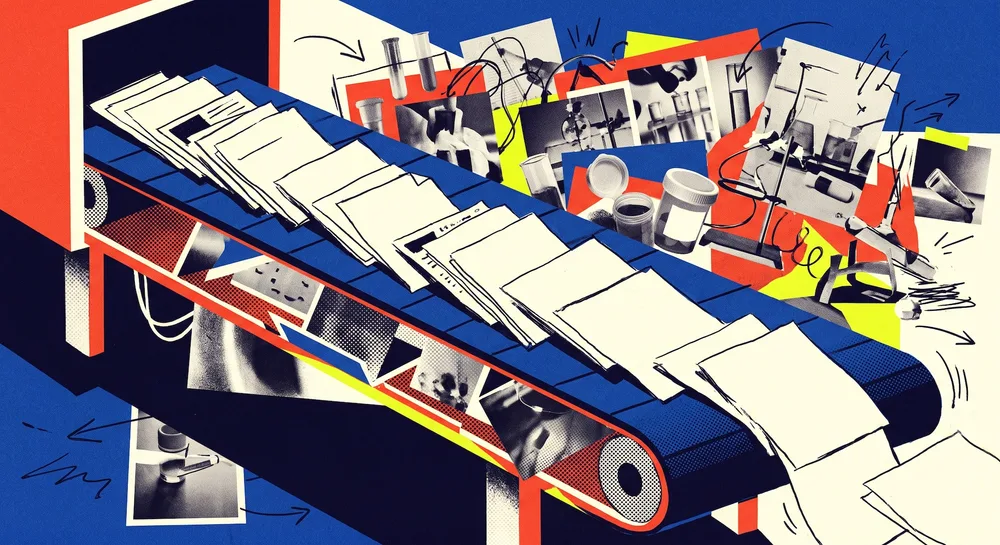
The core issue isn't the technology itself, but the economic and psychological way researchers allocate their time. When an AI tool automates the tedious parts of a paper—the literature review summaries, the initial coding of a simulation, or the formatting of data—it effectively lowers the "cost" of starting a new project.
The trap of the "new project" cycle #
In a traditional workflow, a scientist might spend months refining a single hypothesis, running multiple iterations of an experiment, and obsessively polishing a manuscript. The friction of manual labor acts as a natural filter, forcing them to prioritize only the most promising ideas.
Once you introduce a high-speed AI workflow, that friction vanishes. The study modeled various scenarios of how researchers might use their "saved" time, and the results were telling:
The Volume Trap: Instead of spending ten extra hours perfecting a single experiment, a researcher uses those ten hours to launch two new, mediocre experiments.Quality Erosion: In two out of three modeled scenarios, the actual quality of individual publications dropped significantly compared to a human-only baseline.Diluted Focus: The "saved" time gets funneled into the expansion phase of research (starting things) rather than the optimization phase (making things better).
Why "more" isn't "better" in academia #
This creates a perverse incentive structure. If the metric for success in academia remains the sheer number of publications or the frequency of grants, AI becomes a tool for "quantity over quality" on steroids. We are essentially looking at a future where the scientific literature becomes a massive, high-speed stream of "good enough" papers that lack the profound, deep-dive insights that come from slow, painstaking manual verification.
If an LLM agent can help you draft a complete methodology section in thirty seconds, you are statistically more likely to move on to the next hypothesis than you are to sit there and rethink if your methodology was actually sound. We are essentially automating the "grind," but the grind is often where the critical thinking happens. This isn't a technical problem of prompt engineering or model accuracy; it's a fundamental misalignment between AI productivity and the scientific method. If we want to avoid a future of "more work, less well," we need to figure out how to use these tools to deepen our existing investigations rather than just accelerating our ability to move on to the next thing.
Next Why your AI agent might hesitate to fire someone even when they →
these real-world AI monetization case studies, with plenty of directly applicable cases.
All Replies (0) #
No replies yet — be the first!