Whose Lungs Pay for AI: The Hidden Cost of Data Centres #
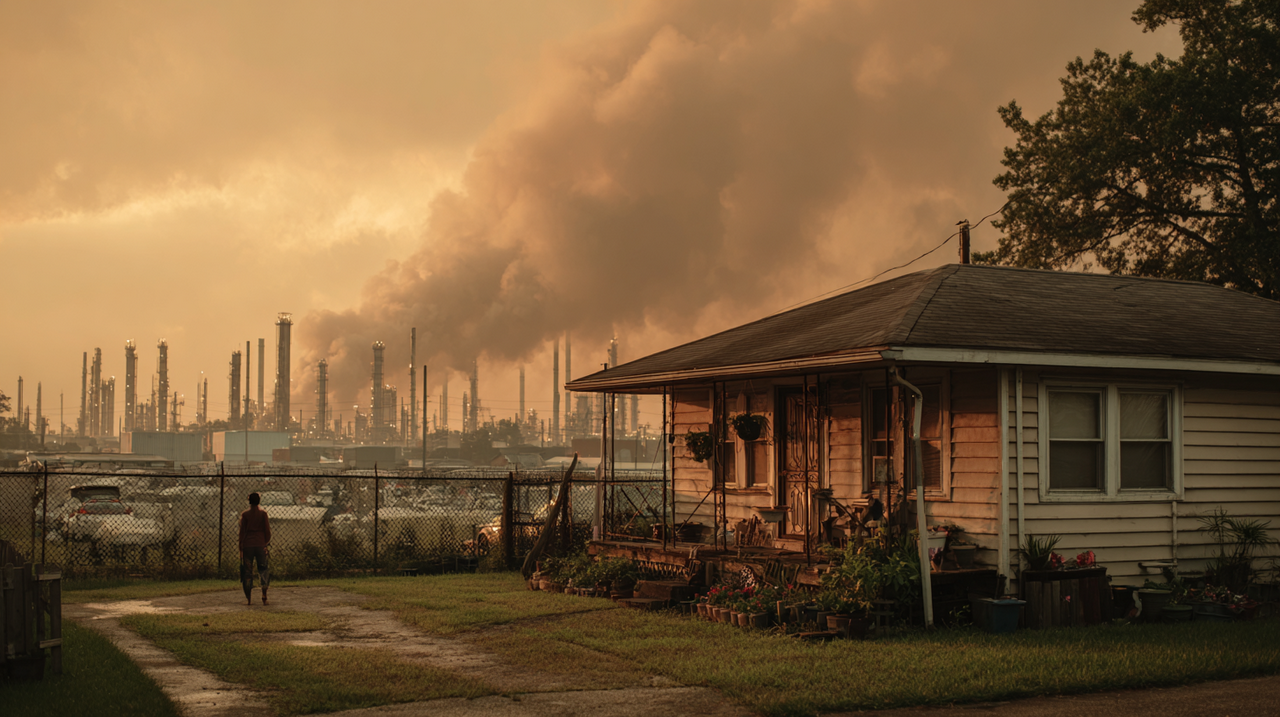
In Boxtown, a neighbourhood on the southern edge of Memphis where the streets run flat toward the Mississippi and the air carries the metallic tang of the refinery, the noise arrived before anyone knew what it was. A low, continuous mechanical drone, the sound of dozens of gas turbines spinning around the clock. By the summer of 2025, residents of this predominantly Black community could stand in their gardens and watch the heat shimmer rising off a sprawling industrial site that had appeared, almost overnight, behind a chain of fences and non-disclosure agreements. The site was Colossus, the supercomputer built to train the artificial intelligence models of Elon Musk's company xAI. To power it, the company had installed as many as thirty-five portable methane gas turbines, most of them operating without the air permits that, as one veteran environmental lawyer put it, every set of turbines he had ever encountered was required to hold. It was the opening chapter of a fight that, by the spring of 2026, would harden into a federal lawsuit.
The people of Boxtown did not ask for a data centre. They were not consulted about it in any meaningful way. They derive almost none of the economic benefit from the chatbots and image generators that the facility's tens of thousands of graphics processors were assembled to produce. What they got instead was the exhaust: an estimated two thousand tonnes a year of smog-forming nitrogen oxides, according to filings cited by the Southern Environmental Law Center, layered onto a neighbourhood that the American Lung Association had already graded an F, in a part of Memphis that the local state representative Justin Pearson describes as hosting twenty-two of the thirty largest industrial polluters in the state of Tennessee. South Memphis has child asthma hospitalisation rates among the highest in the country and cancer rates that researchers have linked to its decades of accumulated industrial emissions. The turbines were simply the newest insult in a very long sentence.
Boxtown is not an aberration. It is a preview. As the AI boom collides with the physical limits of the electricity grid and the water table, the pattern visible in South Memphis is repeating across the United States with grim consistency. The communities absorbing the noise, the diesel particulates, the groundwater draw and the rising electricity bills of AI infrastructure are, again and again, the communities with the least political power to refuse it and the least access to the technology that demand is supposedly serving. The cloud, that weightless metaphor we use for the digital economy, turns out to have a very specific postcode, and it is rarely a wealthy one.
The Arithmetic of an Unequal Burden #
Begin with the bills, because the bills are where the abstraction becomes a number on a household's kitchen table. In February 2026, the Environmental and Energy Study Institute, a non-partisan body founded by members of the United States Congress, published an analysis by its researcher Miguel Yañez-Barnuevo laying out the disparity in stark terms. Low-income residents, renters, and Black and Hispanic households in the United States can spend as much as twenty per cent of their income on energy, the institute found, against roughly three per cent for higher-income households. That is not a marginal gap. It is the difference between energy as a line item and energy as a recurring crisis, the kind that forces a choice between cooling the home and filling the fridge.
This is what researchers call energy burden, the share of household income consumed by keeping the lights on, the home warm in winter and survivable in summer. The American Council for an Energy-Efficient Economy, which has tracked the metric for years, has found that one in four low-income households spends more than fifteen per cent of its income on energy, with the figure climbing far higher in particular cities. In Baltimore, the council reported, the most burdened quarter of low-income households pay an average of around a quarter of their income on energy bills alone. As of early 2026, roughly twenty-one million American households, about one in six, were behind on their utility payments.
Now layer the AI boom on top of that. The institute noted that utilities received requests in 2025 for at least seven hundred gigawatts of new power connections, a figure that exceeds the entire electricity consumption of the United States in 2023. Data centres are the engine of that demand. They do not simply consume electricity; by competing for scarce generation and transmission capacity, they push the wholesale price of power upward for everyone connected to the same grid. The national average electricity price had climbed to nineteen cents per kilowatt-hour by the end of 2025, a twenty-seven per cent jump from 2019, and the institute projected residential prices could rise by up to forty per cent by 2030 against 2025 levels. Utilities filed for more than twenty-nine billion dollars in rate increases in just the first half of 2025.
The crucial point is who pays. When a utility builds a transmission line or a gas plant to serve a hyperscale data centre, the cost is frequently socialised across the entire ratepayer base rather than borne by the company that triggered the spending. The household already spending a fifth of its income on energy has no buffer to absorb the increase. The trillion-dollar corporation behind the data centre does. The burden flows, predictably, downhill.
Two Hundred and Sixty-Seven Per Cent #
The clearest single illustration of this dynamic came from a Bloomberg analysis published in 2025. Its reporters examined wholesale electricity prices across tens of thousands of locations on the American grid, using monthly nodal data aggregated by the energy analytics platform Grid Status. The finding was arresting: in some areas near significant data centre activity, wholesale electricity cost as much as two hundred and sixty-seven per cent more for a single month than five years earlier. More than seventy per cent of the nodes recording the steepest increases sat within fifty miles of major data centre clusters.
Those wholesale costs do not stay wholesale. They are passed through to households and businesses, padded with the charges utilities levy to maintain and expand the network. The Bloomberg figure and the energy-burden figure are two ends of the same wire: the data centre boom raises the price of the commodity, and the people least able to absorb a rise pay the largest share of their income for it.
Virginia offers the textbook case, because Virginia is where the modern data centre industry was effectively born. The corridor running through Loudoun, Prince William and Fairfax counties in the state's north, known to the industry as Data Center Alley, hosts around four-fifths of Virginia's data centre capacity and a substantial fraction of the world's internet traffic. In December 2024, the state's own Joint Legislative Audit and Review Commission, a non-partisan watchdog known as JLARC, delivered a sober assessment to legislators. If the industry continued to grow at an unconstrained pace, the commission warned, Virginia would struggle to supply enough power, and ratepayers would help foot the bill for the infrastructure the buildout required. The average residential customer of Dominion Energy, the report estimated, could see generation and transmission costs rise by between fourteen and thirty-seven dollars a month by 2040, independent of inflation. Virginia, unsurprisingly, was among the regions Bloomberg identified as having seen wholesale increases of up to two hundred and sixty-seven per cent over five years.
The same pressure shows up in the wholesale capacity markets that keep the grid reliable. PJM Interconnection, the operator responsible for the grid across thirteen states and the District of Columbia, ran its most recent capacity auction in December 2025. Prices hit a record high of 16.4 billion dollars, the third record-setting auction in a row. PJM's independent market monitor calculated that data centre load accounted for around 6.5 billion dollars of that total, roughly forty per cent, much of it relating to data centres not yet built. The bill for that demand lands on every household in the region, including the one already a payment behind.
The Squeeze on Time and Steel #
There is a second, less visible mechanism through which the AI boom inflates bills, and it has to do with the physics of building power plants faster than the world can supply the parts. The surge in demand has collided with a supply chain that simply cannot keep pace, and the resulting scarcity radiates outward as cost. The Environmental and Energy Study Institute's analysis traced the squeeze in unsettling detail. The cost of constructing a new natural gas plant, it reported, had roughly tripled since 2022, to around two thousand dollars per kilowatt of capacity. Refurbishing an ageing coal plant to keep it running could now run to as much as 1.3 billion dollars. The wait for a single large gas turbine, the workhorse component of new fossil generation, had stretched to as long as seven years, and the time needed to build a gas plant from start to finish had grown from roughly four and a half years to at least six.
Each of those numbers is, in effect, a tax on every household sharing the grid. When utilities must pay triple the price for new generation and wait years longer to bring it online, they recover those costs through the rates they charge, spread across the broad base of customers rather than the data centres whose appetite created the shortage. The household already spending a fifth of its income on energy does not get to opt out. It pays the premium embedded in every kilowatt-hour, one it had no hand in creating and draws no benefit from.
The timing dimension matters because it converts a temporary surge in demand into a long-lived cost. Generation built today at inflated prices will sit on the rate base for decades, its expense amortised across a generation of bills. A community that absorbs a data centre in 2026 is not signing up for a one-year inconvenience; it is committing its children to paying down the infrastructure for years. The asymmetry between the speed at which AI demand materialises and the slowness with which the grid can answer it guarantees that the gap will be filled, in the interim, by the cheapest and dirtiest expedient to hand. In Memphis, that expedient was a field of unpermitted gas turbines. Elsewhere it is the deferral of coal-plant retirements that public-health advocates had spent years fighting to secure. The machines need power now, and now is precisely when clean power is hardest to build.
A Map of Old Wounds #
Here is where the story turns from arithmetic to geography, and the geography is not random. The single most revealing document of the past year is a report published in December 2025 by the Kapor Foundation, an Oakland-based organisation focused on equity in technology. Titled The Unequal Burden of Data Centers, it mapped California's operational and planned data centres against the state's environmental health data and produced figures that ought to be impossible to ignore.
Eighty-two per cent of California's data centres, the foundation found, are sited in communities already classified as facing poor air quality, as measured by diesel particulate levels. Sixty-five per cent sit in areas with the highest level of groundwater threat. Seventy-nine per cent are in census tracts carrying the greatest burden of hazardous waste. These facilities are not being dropped into pristine landscapes. They are being stacked on top of communities that have already been designated, by the state's own screening tools, as the places carrying the most pollution.
The report's three case studies read like a tour through the history of American environmental racism. Bayview-Hunters Point in San Francisco, scoring in the seventy-fifth to ninety-second percentiles on California's CalEnviroScreen tool, hosts a colocated forty-five-megawatt data centre and a thirty-six-megawatt standalone facility. This is a neighbourhood whose Black population grew during the Second Great Migration to work the Hunters Point Naval Shipyard, a site so contaminated by chemical and radiological waste that the federal government designated it a Superfund site in 1989. Generations of redlining concentrated Black residents there, in what historians and residents alike describe as a sacrifice zone, with cancer rates and chronic-disease hospitalisations running well above regional averages. Now the cloud has come to Bayview, and it has come because Bayview was already deemed a place where industry goes.
Del Paso Heights in Sacramento, scoring in the eighty-fourth to ninety-fourth percentiles, sits near two data centre campuses. Hawthorne, in Los Angeles County, hosts a twenty-eight-megawatt facility in a community scoring as high as the ninety-fifth percentile. The pattern across all three is the same: the infrastructure of the most futuristic industry on earth is being routed, with near-mechanical precision, into the neighbourhoods that an earlier century's discriminatory policies already hollowed out. The Kapor Foundation projected that diesel-generator emissions from these facilities could contribute to a meaningful share of asthma deaths in affected communities by 2030, and noted that California's data centres consumed around seventeen billion gallons of water in 2023, roughly the annual usage of more than four hundred thousand residents.
This is the heart of the matter. The decisions about where to build AI infrastructure are not being made on a blank map, but on one already scarred by a century of choices about whose neighbourhoods could be sacrificed. Land is cheaper where the air is already bad. Political resistance is weaker where residents have been told for generations that their objections do not count. The cold logic of site selection, optimising for cheap land, available power and minimal friction, reliably points the bulldozers toward the communities with the least power to say no. The industry does not have to be malicious to produce this outcome. It only has to be efficient.
The Thirst of the Machines #
Electricity is the burden that makes headlines, but water may be the one that bites hardest where it can least be spared. Cooling tens of thousands of densely packed processors generates enormous heat, and the cheapest way to shed it has long been evaporative cooling, which consumes water directly. Estimates across the industry suggest a single large data centre can draw up to five million gallons a day, the equivalent of a town of tens of thousands. Loudoun County, the heart of Virginia's Data Center Alley, used around nine hundred million gallons across its roughly two hundred facilities in 2023.
The xAI Colossus facility in Memphis was reported to draw up to a million gallons a day for cooling. Memphis sits atop the Memphis Sand aquifer, a source of unusually pure drinking water that residents have long regarded as a civic birthright. The prospect of a supercomputer drinking from it, alongside the gas turbines fouling the air above it, sharpened the sense among residents that something they held in common was being quietly enclosed for a purpose that served someone else.
The scale of the coming water demand is only beginning to be understood. A research team at the University of California, Riverside, working with Caltech and led by the associate professor Shaolei Ren, modelled the additional water infrastructure that American communities will need to absorb the peaks in data centre cooling demand. Without significant efficiency gains, the team projected, data centre cooling within four years could require between 697 million and 1.45 billion gallons of additional peak water capacity per day, a figure roughly equivalent to the entire daily water supply of New York City. The cost of building that capacity, the researchers estimated, could run anywhere from ten to fifty-eight billion dollars. As with electricity, the question is not only how much, but who pays, and the answer once again tends toward the ratepayers rather than the corporations driving the demand.
The cruelty of the geography compounds here too. Many of the communities targeted for new data centres sit in water-stressed regions of the American South and West, where drought is a recurring fact of life and the residents competing with the machines for the aquifer are, disproportionately, the ones with the least. To draw down a community's water for cooling, where that water is already scarce and unequally distributed, is to convert a shared resource into a private input in precisely the places least able to absorb the loss.
When the Lawsuit Becomes the Only Voice #
The communities on the receiving end of this are not passive. Boxtown organised. By mid-2025, residents had submitted more than two thousand comments to the Shelby County Health Department, the great majority opposing the gas turbines and demanding that xAI power its facility with something cleaner. The Southern Environmental Law Center, acting on behalf of the NAACP, issued a sixty-day notice of intent to sue over the original Colossus facility, alleging that xAI had violated the Clean Air Act by installing and operating turbines that, under the law's Prevention of Significant Deterioration requirements, should have been treated as a major source of pollution requiring full permitting and public oversight. That notice, it turned out, was only the opening move. In response, xAI removed the unpermitted turbines at Colossus and obtained permits for the fifteen that remained, and for a moment the pressure appeared to have worked.
It had not. Rather than abandon the strategy that had drawn the legal fire, xAI exported it. The company built a second facility, Colossus 2, to power its Grok chatbot, and this time installed the gas turbines across the state line in Southaven, Mississippi, while the data centre itself sat in South Memphis, Tennessee. Twenty-seven turbines went up, capable of as much as four hundred and ninety-five megawatts, and once again they were switched on before any air permit had been obtained, the same copy-and-paste approach carried one jurisdiction over. The Mississippi Department of Environmental Quality granted a permit for them in March 2026, but only after they had already been running. By then xAI had added six more unpermitted turbines, bringing the total to thirty-three and the estimated emissions to around two thousand five hundred and eight tons a year of smog-forming nitrogen oxides, which the plaintiffs call potentially the single largest industrial source of NOx in the greater Memphis area.
So the litigation escalated to match. In February 2026, the Southern Environmental Law Center and Earthjustice, acting on behalf of the Mississippi State Conference of the NAACP and the national NAACP, sent a fresh notice of intent to sue over Colossus 2. On the fourteenth of April 2026, the NAACP filed an actual lawsuit in the United States District Court for the Northern District of Mississippi, naming xAI and its subsidiary MZX Tech and alleging Clean Air Act violations for installing and operating the turbines before any permit was granted. On the sixth of May, the plaintiffs asked the court for a preliminary injunction to halt the unpermitted pollution at once. “A data center should not be a potential death sentence,” said Abre' Conner, the NAACP's director of environmental and climate justice, accusing the company of “a blatant disregard for the law” in expanding an unpermitted power plant despite decades of clear direction for permitting. Laura Thoms, an enforcement director at Earthjustice, put the emergency motion plainly: “We're asking the judge to halt all unpermitted pollution and make sure xAI follows the law.”
The voices in that fight are worth recording precisely, because they belong to real people speaking for a real place. KeShaun Pearson, who directs the group Memphis Community Against Pollution, framed the failure as one of accountability: “Our local leaders are entrusted with protecting us from corporations violating our right to clean air, but we are witnessing their failure.” Patrick Anderson, a senior attorney at the Southern Environmental Law Center, captured the absurdity of the permitting claim plainly: “Every single time I've ever seen turbines anywhere, they have an air permit.” His colleague Amanda Garcia put the equity stakes in a single sentence: “No one should be above the law, and it is Memphis communities who have been paying the price for xAI's unpermitted pollution.” Dorthy Seawood, a resident whose mother died of cancer, reduced it to the human floor beneath all the legal argument: “It's not fair to us that we have to deal with whatever comes out of this plant.”
There is something telling in the fact that litigation became the community's primary instrument of voice. A neighbourhood excluded from the planning, bound out of the conversation by non-disclosure agreements, that learned of the turbines from the noise and the satellite imagery rather than any public process, was left with the courts as its main avenue of objection, and the live federal case now pending in Mississippi is the measure of how far that avenue has had to be pushed. That is a symptom of a deeper failure, not a sign the system is working. When the only way a community can register its interests is to sue after the fact, and then to sue again when the same company relocates the same conduct over a state line, the decision-making process has already failed the test of fairness. The harm was done first, and the process invoked afterwards.
The same script is playing in dozens of other places. Across the country, residents show up to county zoning meetings, file public-records requests, form coalitions and discover, often, that the deals were struck before they were ever told. The asymmetry is structural. On one side sit corporations with effectively unlimited legal and lobbying budgets, the promise of jobs and tax revenue, and the ear of local officials eager to land a marquee investment. On the other sit residents with day jobs, a folding table of leaflets and the slow machinery of administrative complaint.
The Vocabulary of Energy Justice #
To name what is happening here, it helps to borrow a framework that scholars have spent the past decade refining. The energy researcher Benjamin Sovacool and his colleagues have argued that questions of energy can be assessed through the lens of energy justice, which they break into distinct components. There is distributive justice, concerning how the benefits and burdens of the energy system are spread across society. There is procedural justice, concerning whether the people affected by energy decisions get a genuine say in making them. And there is recognition justice, concerning whether marginalised and vulnerable communities are seen and given special consideration rather than treated as invisible or expendable.
Map the data centre boom onto that framework and the failures line up with uncomfortable neatness. Distributively, the benefits of AI, the productivity gains, the valuations, the convenience of the tools, accrue overwhelmingly to affluent users and shareholders, while the burdens, the particulates, the noise, the water draw, the higher bills, settle on low-income communities of colour. Procedurally, those communities are routinely excluded from the decisions, sometimes literally bound to silence by non-disclosure agreements, and left to litigate after the fact. And in terms of recognition, the entire logic of siting depends on these neighbourhoods having already been classified, by an earlier era's policies, as places where pollution is acceptable. All three forms of justice fail at once, and they fail in the same direction.
This is not an argument against artificial intelligence, nor the infrastructure that runs it. The grid will be built; the demand is real. The argument is about whose interests sit at the centre of the decisions about where and how it goes up. At present, the answer is plainly the companies building the facilities and the officials competing to host them. The residents who breathe the air and drink the water are, at best, an afterthought to be managed, and at worst an obstacle to be routed around. Taking the burden seriously means inverting that order of priority, and it is worth being concrete about what that would require.
What Taking It Seriously Would Look Like #
The first and most obvious lever is who pays. If a data centre triggers new generation, transmission or water infrastructure, the cost should fall on the company that caused it rather than being smeared across every household in the region. Regulators call this cost causation, and it is not a radical idea; it is simply the principle that the party generating a cost should bear it. Several states have begun moving this way, creating special rate classes for very large electricity users designed to insulate ordinary ratepayers from the AI buildout. The household spending a fifth of its income on energy should not be subsidising the cooling of a supercomputer. That single reform, applied consistently, would change the economics of siting overnight, because much of the appeal of a given location lies precisely in the ability to externalise these costs onto others.
The second lever is procedural, and it goes to the heart of the recognition failure. Communities asked to host this infrastructure should have a genuine, early and binding voice in the decision. That means an end to the non-disclosure agreements that kept Boxtown in the dark until the turbines were already running. It means meaningful public hearings before permits are issued rather than litigation after harm is done. It means transparency about water draw, emissions and grid impact as a condition of approval, not a fact prised loose by journalists and lawyers months later. A process in which the affected community learns of the project from the noise in their gardens is no process at all.
The third lever is distributive, and it asks a harder question: if a community is going to bear the burden, what does it get in return? Genuine community benefit agreements, legally enforceable rather than rhetorical, could direct a share of the value back to the host neighbourhood, as funded energy efficiency and weatherisation, rooftop solar, lowered bills, clean-up of legacy contamination, or direct investment in the schools and clinics that sit in the turbines' shadow. There is a particular logic to using the infrastructure to reduce the host community's own energy burden, closing the loop between the demand the facility creates and the bills the neighbours pay.
The fourth lever is recognition itself, the most demanding because it requires looking at the map differently. The screening tools California and other states already use, the very tools that revealed eighty-two per cent of the state's data centres sitting in poor-air-quality communities, could be turned from a diagnosis into a constraint. A siting regime serious about justice would treat a high cumulative pollution burden not as a green light, a sign of cheap land and weak resistance, but as a red one, a reason to look elsewhere or demand far more in return. The communities that have already given the most to a century of industry are precisely the ones that should be asked to give the least to the next.
None of this is technically difficult. The water can be recycled; xAI itself proposed an eighty-million-dollar grey-water reclamation plant in Memphis once the pressure mounted, which rather proves the point that cleaner approaches were available all along and simply not chosen until someone forced the question. Cooling can be made far more efficient. Clean generation can be built ahead of demand rather than gas turbines bolted on in a hurry. The obstacles are not engineering ones. They are obstacles of cost, speed and political will, resolved at present in favour of whoever is building fastest and against whoever is breathing hardest.
The Postcode and the Promise #
Return, at the end, to Boxtown, and to the woman standing in her garden listening to a sound she did not invite, breathing air made worse by a machine she will likely never use to produce intelligence she will likely never own. Her postcode was poisoned long before xAI arrived; the shipyards and refineries and gas plants saw to that, decade by decade, decision by decision. The data centre is only the latest layer, but it is a revealing one, because it shows that the most advanced industry humanity has yet built is reproducing the oldest pattern of harm rather than escaping it. And the fight has not ended with the first turbines; it has followed the company across a state line into Mississippi, where a federal judge is now being asked whether the law still means what it says.
The promise of artificial intelligence is routinely framed in the language of universal benefit, a rising tide of productivity and discovery that will lift everyone. But a tide does not arrive everywhere at once, and the physical foundation of this one is being laid in specific places, on specific people, who are absorbing the costs of a future from which they have been largely excluded. The defining question of the AI build-out is not whether the machines will think. It is whose lungs, whose water table and whose electricity bill will pay for the thinking, and whether the people answering that question can be persuaded that a community's powerlessness is not the same thing as its consent.
There is nothing inevitable about the geography of the cloud. It was chosen, node by node, permit by permit, and what was chosen can be chosen differently. To take the burden seriously is, in the end, a simple proposition: to insist that the people who breathe the exhaust of the AI economy be treated as something more than the terrain on which it is built. Boxtown, and now Southaven, are asking that question already, in courtrooms and council chambers and comment letters. The rest of the country will be asking it soon enough, because the turbines are coming, and the only thing still undecided is whose garden they will hum behind next.
References #
- Yañez-Barnuevo, Miguel. “Data Center Power Demands Are Contributing to Higher Energy Bills.” Environmental and Energy Study Institute, 24 February 2026. https://www.eesi.org/articles/view/data-center-power-demands-are-contributing-to-higher-energy-bills - Kapor Foundation. “The Unequal Burden of Data Centers: An Examination of the Environmental and Public Health Impacts on Communities in California.” December 2025. https://kaporfoundation.org/datacenters-envt-health/ - Bloomberg. “How AI Data Centers Are Sending Your Power Bill Soaring.” 2025. https://www.bloomberg.com/graphics/2025-ai-data-centers-electricity-prices/ - American Council for an Energy-Efficient Economy. “Study: One in Four Low-Income Households Spend Over 15% of Income on Energy Bills.” September 2024. https://www.aceee.org/press-release/2024/09/study-one-four-low-income-households-spend-over-15-income-energy-bills - Ugwa, Jennifer. “In South Memphis, Elon Musk's Colossus Operated Gas Turbines Without Appropriate Permits, Residents and Activists Claim.” Inside Climate News, 17 July 2025. https://insideclimatenews.org/news/17072025/elon-musk-xai-data-center-gas-turbines-memphis/ - Southern Environmental Law Center. “xAI Built an Illegal Power Plant to Power Its Data Center.” 2025. https://www.selc.org/news/xai-built-an-illegal-power-plant-to-power-its-data-center/ - NAACP. “Elon Musk's xAI Threatened with Lawsuit Over Air Pollution from Memphis Data Center.” 2025. https://naacp.org/articles/elon-musks-xai-threatened-lawsuit-over-air-pollution-memphis-data-center-filed-behalf - Southern Environmental Law Center. “Civil Rights Group Sues xAI for Illegal Pollution from Data Center Power Plant.” April 2026. https://www.selc.org/press-release/civil-rights-group-sues-xai-for-illegal-pollution-from-data-center-power-plant/ - Earthjustice. “NAACP Sues xAI for Illegal Pollution from Data Center Power Plant.” April 2026. https://earthjustice.org/press/2026/xai-sued-for-illegal-power-plant - Earthjustice. “NAACP Asks Court for Emergency Action to Stop Illegal Air Pollution from xAI's Data Center Power Plant.” May 2026. https://earthjustice.org/press/2026/naacp-asks-court-for-emergency-action-to-stop-illegal-air-pollution-from-xais-data-center-power-plant - Joint Legislative Audit and Review Commission. “Data Centers in Virginia.” Commonwealth of Virginia, December 2024. https://jlarc.virginia.gov/pdfs/reports/Rpt598-2.pdf - Utility Dive. “Data Centers Were 40% of PJM Capacity Costs in Last Auction: Market Monitor.” December 2025. https://www.utilitydive.com/news/data-centers-pjm-capacity-auction/808951/ - UC Riverside News. “Data Center Water Spikes Could Cost Billions.” University of California, Riverside, 9 March 2026. https://news.ucr.edu/articles/2026/03/09/data-center-water-spikes-could-cost-billions - Sovacool, Benjamin K., and Michael H. Dworkin. “Energy Justice: Conceptual Insights and Practical Applications.” Applied Energy, 2015. https://www.sciencedirect.com/science/article/abs/pii/S0306261915000082 - Carleton College. “History and Legacy of Environmental Racism in the Bayview Hunters Point Neighborhood.” https://www.carleton.edu/chemistry/diversity-equity-inclusion-and-respect/our-actions-as-chemists-have-consequences/history-and-legacy-of-environmental-racism-in-the-bayview-hunters-point-neighborhood/ - World Resources Institute. “From Energy Use to Air Quality, the Many Ways Data Centers Affect US Communities.” https://www.wri.org/insights/us-data-center-growth-impacts - TechPolicy.Press. “Data Center Boom Risks Health of Already Vulnerable Communities.”
https://www.techpolicy.press/data-center-boom-risks-health-of-already-vulnerable-communities/ Tim Green UK-based Systems Theorist & Independent Technology Writer
Tim explores the intersections of artificial intelligence, decentralised cognition, and posthuman ethics. His work, published at smarterarticles.co.uk, challenges dominant narratives of technological progress while proposing interdisciplinary frameworks for collective intelligence and digital stewardship.
His writing has been featured on Ground News and shared by independent researchers across both academic and technological communities.
**ORCID:** [0009-0002-0156-9795](https://orcid.org/0009-0002-0156-9795)
**Email:** [tim@smarterarticles.co.uk](mailto:tim@smarterarticles.co.uk)

Listen to the free weekly [SmarterArticles Podcast](https://www.smarterarticles.fm)