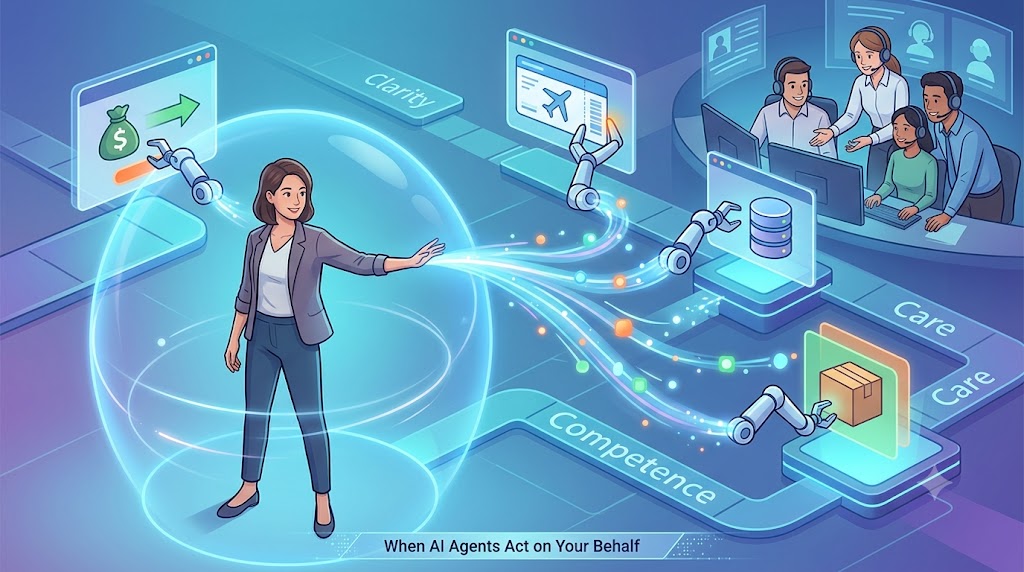
The Banks Just Answered, and Customers Lost #
by Braden Kelley and Art Inteligencia
Picture a customer who is tired of managing her money. She hires an AI agent to watch her accounts, dodge fees and move cash to wherever it earns the most. She hands over her login, goes to dinner, and comes home to a drained account.
Whose problem is that? This week, a growing list of banks answered the question, and the answer was: hers.
I think this is one of the most important customer experience stories of the year, and it’s hiding inside a quiet update to some legal terms. It’s about who bears the risk when software acts on a customer’s behalf. But it’s also about something bigger, and more uncomfortable for every company that sells to people: your customer is about to stop being just a person.
The short version: Citi, PNC and Citizens updated their customer terms this week, joining JPMorgan and Bank of America, to say customers are responsible for what third-party AI agents do with their accounts, even if the agent is hacked. Citi’s own agents are carved out. The law underneath is unsettled, the banks’ reasons are real, and the experience design challenge is wide open.
What the banks actually did #
According to TechCrunch, Citi updated its online user agreement this week so that customers who give third-party AI tools access to their accounts are responsible for activity through them. Citi’s terms also cover security failures: if the tool leaks credentials or is hacked, the customer is responsible for what the hackers do. PNC changed its terms the day of the report, Citizens emailed customers a similar warning, and JPMorgan and Bank of America announced similar policies last month. The banks say they won’t reverse transactions initiated by automated assistants, whether those were mistakes or not.
Here’s the detail I can’t stop thinking about: Citi’s own AI agents can be used without the customer taking on that added liability. TechCrunch doesn’t say whether the other banks offer a similar exemption. So, at least at Citi, the same task, performed by software, carries different risk depending on whose software it is.
Citi’s spokesperson said the bank wants customers “to understand the risks associated with sharing banking credentials.” That’s fair, as far as it goes.
Why the banks aren’t being irrational #
I want to be fair to the banks, because their concerns aren’t imaginary.
- The security stories are real.American Banker reports that at least five large banks (JPMorgan Chase, Citi, Bank of America, Wells Fargo and Morgan Stanley) are blocking external AI agents from customer accounts. It describes one unnamed bank whose monitoring caught an agent resetting a password, accessing an account, changing the approved transfer destinations and moving $100,000. That bank’s fraud team then recommended blocking all external agents.
- Banks often can’t tell who’s acting. One security write-up, based on reporting from Axios and Reuters, put the problem in a line I like: “a valid login no longer proves that a person chose the action.” It reports no public breach of the named banks’ core systems and no confirmed customer losses so far, so this is risk management, not a response to a wave of victims.
- There may be a competitive motive too. TechCrunch notes that banks are also worried AI tools could help customers avoid fees or low-yield deposit accounts. I can’t tell you how much that weighs against the security concerns, and the banks haven’t said. But it’s worth noticing that the people who profit from customer inertia are now facing a tool built to defeat it.
The law isn’t settled, and that’s the real story #
I’m not a lawyer, and nothing here is legal advice. But the sources I read agree on one thing: nobody knows how this will shake out.
An October column in Payments Dive by financial services consultant Aaron Cheiffetz says it plainly: “There’s no clear legal rule for who bears the loss when an AI tool exceeds its mandate.” He notes that, under Regulation E, a consumer can be liable for transfers made by someone they gave access to, even if that person exceeded their authority, but that it’s unclear whether sharing credentials with an AI tool triggers that rule.
The law firm Goodwin reads the current rules in a way that helps the banks. In its analysis of agentic payments, “a transfer is presumed authorized if a consumer furnishes credentials to authorize an agent to make payments,” which means an agent that goes beyond what you intended can still produce a transfer the law treats as authorized. For credit cards, the standard is looser: a payment is authorized if the person initiating it has “actual, implied, or apparent authority.” Goodwin also notes that outcomes “depend on the facts: what the user said, what the agent understood, and what records exist.”
That last phrase matters, and I’ll come back to it. There’s also a policy gap underneath. The security write-up I mentioned says no federal rule defines delegated agent access, and that the CFPB’s open banking rule is enjoined. It also points out that in the U.K., most victims of push-payment fraud have been entitled to reimbursement up to £85,000 since October 2024. That’s the write-up’s characterization, so check it before you quote it. The point is that the U.S. is choosing a very different default.
The banks have a defensible position under today’s ambiguity. Contract terms are an easy tool to reach for when the rules are unclear. But “defensible” and “good customer experience” are different measures, and companies that confuse them tend to learn the difference the hard way.
The experience design problem nobody has solved #
Here’s where I stop being a spectator and start being a designer.
Today’s banking experience, like most customer experiences, assumes a human at the keyboard. Login, authentication, fraud detection, error resolution, dispute processes: all of it was designed around a person who clicks a button, feels a certain way and can be called on the phone. Now a piece of software sits between the customer and the company. Both sides are improvising.
The customer’s real need hasn’t changed: do this for me, safely, within limits I set, and let me undo it if it goes wrong. What’s missing is the experience layer that makes that possible. Goodwin’s recommendations read like a design brief:
- Define delegated authority precisely: amounts, merchants, categories, timing and how much discretion the agent has.
- Keep retrievable records of what the customer reviewed and approved. A voice prompt or a checkbox alone isn’t enough.
- Add -and-confirm checkpoints for unusual merchants, atypical amounts or new payment rails.
- Let customers narrow or revoke authority , with changes taking effect before the next transaction.
- Show the terms up front , including refund and return policies, before the agent completes a purchase.
Notice what that list isn’t. It isn’t “tell customers they’re on their own.” It’s a set of designed experiences: permission slips with limits, receipts, confirmation moments, an off switch. The banks that build those will be able to say yes to agents. The banks that don’t will be left saying no, while customers take their business, and their agents, somewhere less restrictive. As consultant Jeff McMillan told American Banker, if banks block agents, “the agents will go and open accounts for consumers at other firms that are not as restrictive.” He added: “Agents aren’t going anywhere.” American Banker also reports that some bankers think the block is only temporary.
The second problem: whose side is the agent on? #
Liability is the headline, but there’s a quieter issue that applies to every company, not just banks. If an agent is choosing for your customer, what is it optimizing?
A Columbia and Yale research team studied this in a paper titled “What Is Your AI Agent Buying?” The authors built a sandbox where AI shopping agents chose among products and then tested how the agents behaved. Their findings should make any brand manager nervous:
- The model matters enormously. The same fitness watch captured about 45% market share under one model, about 77% under a newer version of that same model, and only about 6% under a different provider’s model. The authors write that “model updates can drastically reshuffle market shares.”
- Presentation quirks decide outcomes. Listing position had large effects that varied by provider and version. The agents consistently penalized “Sponsored” tags and rewarded “Overall Pick” endorsements.
- Sellers can game it. AI-edited product descriptions raised market share in most of the tested buyer agents, with gains of up to about 15 percentage points.
Their conclusion: “agentic markets are volatile and fundamentally different from human-centric commerce.” Remember that these were lab tests, run on specific models in a sandbox, not live shopping. But the direction is clear. If your customer’s agent is the first thing evaluating your offer, then the agent’s quirks become part of your customer experience, and a model update you don’t control can change your sales overnight.
What this means for the rest of us #
You don’t have to be a bank to be affected. If you sell, book, ship, support or bill, agents are coming to your front door. The questions that follow are experience questions:
| Moment | The question to ask |
|---|---|
| Identity | Can we tell the difference between a customer, a customer’s authorized agent and a rogue one? What do we do when we can’t? |
| Authority | Can customers set limits for an agent (amounts, categories, time) and see them recorded? |
| Confirmation | Where does a human get pulled back in? Do we make that moment easy or irritating? |
| Error and recovery | When an agent makes a mistake, what does our dispute and refund process look like? Who pays? |
| Discovery | How do we show up when an agent, not a person, is doing the comparing? Is our information accurate and complete? |
| Fairness | Do our terms treat customers’ agents differently from our own? Can we defend that to a customer’s face? |
| Trust | If we’re building our own agents, can customers tell whose interests they serve? |
These are exactly the kinds of gaps an experience audit is built to find: the places where the journey you designed meets the journey customers actually take. The next version of that journey includes a robot, and almost nobody has walked it yet.
Opportunities for innovators #
Where there’s friction, there’s room to build. Here’s where I’d look:
- A standard “mandate” for agents. A portable, machine-readable record of what a customer authorized, which any bank or merchant can read and honor. Payments Dive’s author recommends exactly this kind of recorded limit.
- Shared-liability models. Cheiffetz argues losses should be allocated among issuers, networks, merchants and AI-tool providers without shifting the burden onto consumers. Whoever designs a fair, insurable version of that wins a lot of trust.
- Agent identity and kill switches. Ways to verify an agent, limit what it can do and stop it instantly.
- Verifiable loyalty. A way for a customer to know that their agent is working for them, not for whoever pays it a fee.
- Agent-ready experience design. Companies that make their information, policies and recovery paths clear to both people and machines will be the easy ones to do business with.
My verdict #
The banks’ move is understandable, and I wouldn’t call it villainy. When the rules are unclear and the risks are new, protecting yourself in the contract is the reflex. But it’s a reflex, not a strategy.
The better question for any leader is: what would it take for us to say yes? Not “yes to anything,” but yes with limits, records, checkpoints and a fair answer to “who pays when it goes wrong?” The first organization in each industry to build that experience will turn a liability headache into a reason for customers to choose them.
Because here’s the thing I keep coming back to. The customer who sends a robot to the bank isn’t trying to be reckless. She’s trying to get her time back. A company that makes that safe is giving her something she values. A company that says “you’re on your own” is telling her what it thinks of her.
A note on what I could and couldn’t verify #
The bank policy details come from news reports (principally TechCrunch), not from reading each bank’s agreement, so check the actual terms before quoting their wording. The JPMorgan and Bank of America details come mainly from secondary reporting. The legal commentary reflects individual authors’ readings of unsettled law, and none of it is legal advice. The Columbia and Yale findings come from a research sandbox, and its authors say the results vary by model and version.
Want to know what your experience looks like to an agent? #
If you’d like an independent look at how your customer, employee and partner journeys hold up as AI agents join the process, that’s what the Customer Experience Audit is for. If you want to put a number on what friction costs you first, the CX ROI Calculator is free. And if you’d like to talk it through, get in touch.
Sources #
Image Credits: Gemini
Content Authenticity Statement: The topic area, key elements to focus on, etc. were decisions made by Braden Kelley, with a little help from Claude to clean up the article.
Sign up here to get Human-Centered Change & Innovation Weekly delivered to your inbox every week.