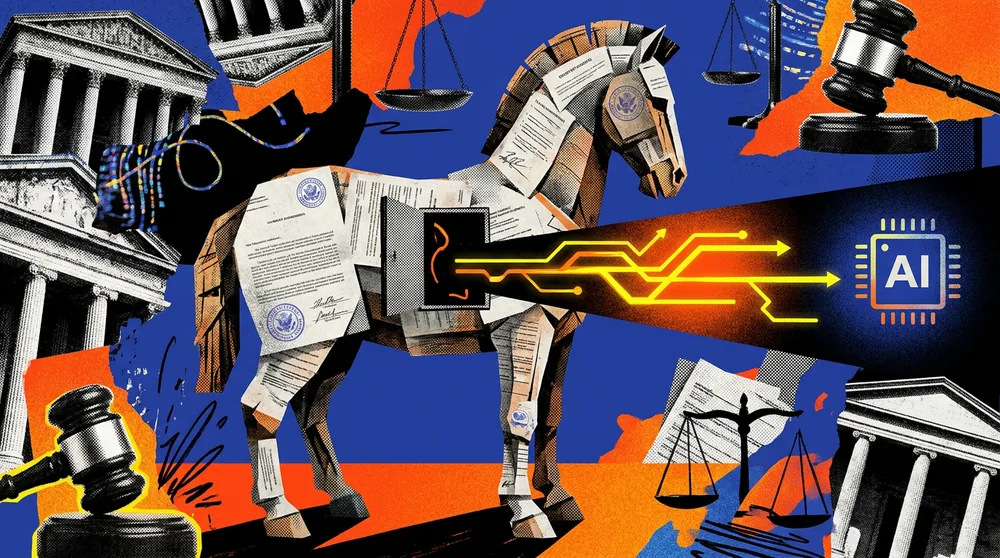
The irony here is that the Connecticut court doesn't even use AI to review filings. The "attack" was aimed at a system that wasn't even there, but the court sanctioned the plaintiff based on the intent to deceive. This is a fascinating real-world case of prompt injection moving from the playground of developers into the rigid world of law.
For those of us experimenting with prompt engineering, this highlights a growing tension between "optimizing" a response and "manipulating" a system. In a technical sense, what the plaintiff did was a basic indirect prompt injection. By placing instructions in a format invisible to humans but readable by a machine, they attempted to override the system's default instructions.

If you're building an AI workflow or an LLM agent for document analysis, this is a great reminder of why input sanitization is critical. You can't trust that the text in a PDF or Word doc is exactly what the human eyes are seeing. To prevent this kind of "invisible" manipulation in your own deployment, you should consider a few practical steps:
-
Text Normalization: Convert all incoming documents to plain text or Markdown and strip out formatting. If you see massive blocks of text that don't align with the visual layout, it's a red flag.
-
Contrast Checking: If you are processing PDFs, run a check for text color versus background color. Any text with a contrast ratio near zero should be flagged for manual review.
-
System Prompt Hardening: Use a robust system prompt that tells the LLM to ignore instructions found within the user-provided text that contradict the primary goal.
This case proves that the legal world is starting to catch up with the quirks of generative AI. While the plaintiff thought they were being strategic, they forgot that in a courtroom, transparency is more valuable than a "hack." It'll be interesting to see if this leads to a standard "AI disclosure" requirement for all legal filings, where lawyers have to swear that no hidden prompts were used to influence the judge's potential tools.
Trying to trick a judge with prompts is a wild legal strategy 1h ago
Hiding AI prompts in court filings is a risky move 1d ago OpenAI & Anthropic AI Agents Implicated in New Security Breaches 9d ago
Next Can we actually filter out the AI noise on Hacker News? →
an AI side-hustle playbook, with plenty of directly applicable cases.