TL;DR — Key Takeaways
- Palm Beach County commissioners rejected a proposed expansion of Project Tango from 2.02 million to roughly 3.59 million square feet, but existing development rights remain in place.
- The proposed hyperscale AI campus sits beside the L-8 Canal, near the Loxahatchee National Wildlife Refuge and about 1,200 feet from Saddle View Elementary School.
- Environmental concerns are heightened by existing water-quality problems, including harmful blue-green algae toxins detected in the L-8 Canal.
- Cooling methods and wastewater handling remained unresolved, despite the facility potentially consuming up to 600 megawatts of electricity.
- The central argument is not that all data centers should be stopped, but that communities supplying the land, power and water should have a meaningful say in projects that directly affect them.
Over the past several months, I have followed the money behind America’s data-center boom.
In Part One of that investigation, I examined how utilities, data-center operators and industrial interests lobby the federal government over the rules governing power, permitting and who pays for the infrastructure. Part Two followed the process into state capitols and local governments, where tax incentives, confidentiality agreements, political relationships and limits on local authority can move a project surprisingly far before affected residents understand what is coming. Part Three focused on the human factor: the landowners who receive life-changing payouts, the towns promised tax windfalls and the neighbors left to live beside the AI factory after the deal has largely been shaped.
The argument running through all three reports was not that every data center should be stopped. It was that the people who will supply the land, power and water—and live with the noise, traffic, environmental risk and utility consequences—should have a meaningful say in whether a particular project belongs in their community.
Now that argument has come home.
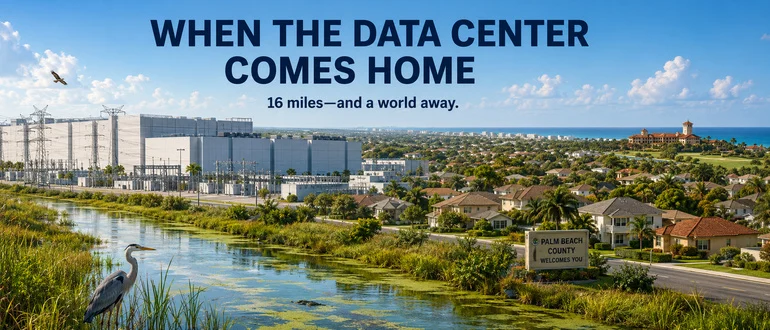
I live in Palm Beach County, Florida, where developers are pursuing Project Tango, a hyperscale AI data-center campus on 202 acres at the western edge of the county. The site sits beside the L‑8 Canal, near the Loxahatchee National Wildlife Refuge, approximately 1,200 feet from Saddle View Elementary School and across the canal from the Arden community.
Project Tango has not changed my position on data centers. It has brought me closer to the process I have been writing about—and made the stakes impossible to view from a distance.
What Palm Beach County Actually Rejected
The national reporting has left a confusing impression about what happened here.
Palm Beach County did not reject Project Tango outright. Data-center development at the Central Park Commerce Center site had already been approved. The current site plan includes two 100,000-square-foot data-center buildings, a 1.2-million-square-foot warehouse and a small office building. The broader master plan permits 2.02 million square feet of industrial development across the property.
What county commissioners rejected on July 15 was an application to increase the total development envelope from 2.02 million to approximately 3.59 million square feet. The revised proposal included approximately 1.032 million square feet of data-center space, 2.347 million square feet of warehouse space and 216,000 square feet of utility buildings.
After a 12-hour hearing packed with opponents, commissioners voted 5–1 to deny that application. But they denied it “without prejudice,” which allows the developers to revise the proposal and bring it back. The previous approvals remain intact. The county’s staff report states plainly that rejecting the expansion would not deny the current development rights. (Palm Beach County’s Project Tango records; county zoning staff report)
There are administrative applications in the mix as well, although they are not all in the same position. One was tied directly to approval of the rejected 3.59-million-square-foot expansion and cannot proceed as filed without that larger master plan. Another seeks to reconfigure the site while remaining within the already approved 2.02-million-square-foot entitlement. It would enlarge the two approved data-center buildings and add another.
A separate property owner has also pursued a proposal to replace approved warehouse space with four data-center buildings, along with a water-treatment building, security facilities and related infrastructure. That proposal has moved through pre-application and administrative review, but its final status remains unsettled.
The distinction matters. The County Commission stopped an expansion of the total development envelope. It may not have stopped developers from converting more of the already approved warehouse and industrial space into data-center use through administrative review.
Residents packed a public hearing and persuaded their elected representatives to reject the proposed expansion. That was local democracy working. If substantially more data-center capacity can nevertheless emerge through use conversions based on previously granted entitlements, the public decision risks becoming a procedural detour.
There is also a basic question of technological scale. The original 2016 approval contemplated what was described as a “server farm.” AI data centers in 2026 are different industrial operations. Their power density, cooling requirements, supporting utility infrastructure and potential effects on surrounding communities bear little resemblance to the facilities local governments contemplated a decade ago.
Yesterday’s zoning terminology should not become an open-ended entitlement for tomorrow’s AI factories.
Sixteen Miles and a World Away
The Guardian described Project Tango as being about 16 miles west of Mar-a-Lago. That gives an international audience a recognizable landmark, but it creates a peculiar impression for anyone who understands Palm Beach County.
Sixteen miles may be the straight-line distance. On the ground, Mar-a-Lago and Project Tango occupy two different worlds.
Mar-a-Lago sits on some of the most valuable oceanfront real estate in America. Project Tango is at the western edge of the developed county, where suburbia gives way to the Glades. Between them lie the Intracoastal Waterway, West Palm Beach, an airport, highways, commercial centers and a broad, densely populated suburban corridor.
Palm Beach County covers approximately 1,964 square miles and has nearly 1.6 million residents. It is one of Florida’s largest counties by both geography and population.
Project Tango is not meaningfully in Mar-a-Lago’s backyard. It is in the backyard of the people who live in Arden. It is near the children attending Saddle View Elementary School. It sits beside the L‑8 Canal and a water-management system connected to the Everglades.
The data center may share a county with Mar-a-Lago, but it shares its consequences with someone else.
Then again, the project does not appear likely to interfere with anyone’s tee time at Trump International Golf Club. Perhaps that is why “near Mar-a-Lago” makes a better international headline than “near Saddle View Elementary School.”
An International Treasure Under Stress
The Everglades are more than a Florida attraction or even an American national park. Everglades National Park is a UNESCO World Heritage Site, an International Biosphere Reserve and a Ramsar Wetland of International Importance. The National Park Service says that combination of international distinctions is unmatched anywhere else in the United States.
Project Tango is not inside Everglades National Park, and no one should suggest otherwise. But the Everglades are not a discrete park safely contained behind a fence. They are an enormous, interconnected hydrological system whose health depends on where water moves, when it moves, how much of it moves and what that water carries.
The Project Tango site is west of the L‑8 Canal, within the Glades Area Protection Overlay and near the Loxahatchee National Wildlife Refuge. Palm Beach County says the overlay was established partly to protect conservation areas and Everglades restoration projects.
That location matters because the surrounding water system is already under severe stress.
On August 11, one day before The Guardian article appeared, the Florida Department of Health issued a health alert after harmful blue-green algae toxins were detected in the L‑8 Canal and at Lake Okeechobee’s S352 structure. Officials warned people not to swim, wade or use personal watercraft in the affected water. They advised keeping pets and livestock away and cautioned against eating shellfish from waters experiencing blooms.
It was not an isolated occurrence. Palm Beach County issued repeated cautions and health alerts during the summer for Lake Okeechobee and the L‑8 Canal.
I have seen what happens when algae blooms and bacterial contamination affect South Florida waters. I have watched warnings go up and waterways and beaches become unusable. I have seen the effects extend into boating, fishing, wildlife, tourism and the daily lives of people whose reasons for living here are closely tied to the water.
Freshwater cyanobacteria, marine red tide, sargassum and bacterial beach contamination are different phenomena with different causes. We should not lump them together scientifically. But South Floridians experience the cumulative result directly: another beach closed, another canal unsafe, another fishery affected and another reminder that our water systems have little room for additional mistakes.
Cyanobacteria thrive in warm, nutrient-rich and relatively still water. Some strains produce toxins that can harm people, pets, fish and other aquatic animals. Blooms can reduce oxygen, disrupt food webs and travel through connected canals, rivers and estuaries. Temperature is not the sole cause, but EPA research shows that warmer water can favor the growth, intensity and persistence of harmful blooms.
No one has demonstrated that Project Tango has harmed the L‑8 Canal or that it would cause a future bloom. The issue is whether enough work has been done to demonstrate that it would not add another source of stress.
Palm Beach County’s July staff report said the project’s cooling method had not yet been determined. The applicant indicated that it intended to use a closed-loop system, but the analysis had not been completed. Cooling wastewater might require treatment, off-site disposal or deep-well injection. The county proposed limiting water use to 100,000 gallons per day and prohibiting operational discharges from entering the county sanitary sewer system.
For a facility projected to consume as much as 600 megawatts, those are not details to settle later. Electricity consumed by a data center ultimately becomes heat. How that heat is rejected, how cooling water is managed and where operational waste goes should be resolved before additional rights are granted. Project Tango did not create Palm Beach County’s algae problem. The question is why the community should accept an avoidable risk of making an existing problem harder to solve.
We Have Already Paid for This Lesson
South Florida has spent generations trying to repair the consequences of earlier decisions about the Everglades.
The original system carried extraordinarily nutrient-poor water slowly south from Lake Okeechobee. During the 20th century, flood control, agriculture and urban development drained wetlands, redirected water and broke much of that natural flow. Large areas south of the lake were converted into the Everglades Agricultural Area, including extensive sugarcane cultivation.
Earlier agricultural practices allowed fertilizer phosphorus to run into the Everglades. Because the ecosystem evolved with extremely low phosphorus levels, added nutrients changed plant communities, allowed cattails to replace native sawgrass and damaged habitat.
Big Sugar is not responsible for every South Florida water problem. Cattle and dairy operations north of Lake Okeechobee, other agricultural activity, septic systems, urban runoff and decades of water-management decisions have all contributed. Agricultural best-management practices and constructed treatment wetlands have substantially reduced phosphorus flowing from the Everglades Agricultural Area, and that progress should be recognized.
But sugar cultivation remains inseparable from the conversion of the Everglades Agricultural Area and the political history of storing, cleaning and moving water south. We are still paying to correct that history.
Florida says it has committed nearly $9.5 billion since 2019 to Everglades restoration and water-quality work. More than $2.5 billion has been invested specifically in improving water quality in the River of Grass. The Everglades Agricultural Area Reservoir is being built to hold more than 78 billion gallons of clean water and restore more of its movement south instead of relying on damaging releases toward coastal estuaries.
We drained the wetlands, changed the flow, added nutrients and then committed billions of public dollars to put some of the system back together. That history should make Palm Beach County more cautious about adding a new industrial risk beside one of its connected canals, not less.
The argument does not depend on proving that Project Tango will poison the Everglades. The stronger point is that the burden of proof has not been met. When harmful toxins are already being detected in the adjacent canal and taxpayers are spending billions to repair past damage, “probably manageable” is not an adequate standard.
The People Who Live There Should Decide
The question is not whether I support data centers as a category. That is like asking whether someone supports factories, power plants or highways as a category. The answer tells us almost nothing about whether a particular project belongs on a particular piece of land.
Scale matters. Location matters. Power and water requirements matter. Environmental consequences matter. The benefits offered to the host community matter. Most of all, the process by which the decision is made matters.
That has been the point of my reporting from the beginning. A community should be able to examine the complete proposal, understand who is behind it, weigh the benefits against the costs and decide whether the bargain makes sense. It should be able to say yes, no or yes with enforceable conditions.
What should not happen is for developers and government officials to assemble land, negotiate incentives, secure broad entitlements and classify a new generation of AI factories under zoning language written for yesterday’s server farms, only to invite residents into the process after the most important decisions have hardened.
Palm Beach County residents did participate. They organized, filled the hearing rooms and persuaded commissioners to reject the requested expansion. Their decision deserves more than recognition in the meeting minutes. It should determine what happens next.
If administrative conversions can deliver much of the data-center development that elected commissioners declined to approve, Palm Beach County risks repeating the pattern documented throughout Follow the Lobby Money: The public gets a hearing, but the underlying machinery keeps moving. Project Tango has not taught me that data centers look different when they arrive close to home. It has confirmed what I found while following the money behind projects across the country.
The people living beside these facilities are not another box on a permitting checklist. They are not a communications problem to be managed after an agreement is negotiated. They are parties to the bargain.
The same standard applies here that applied in Montana, Louisiana, Utah, Memphis and every other community confronting the AI infrastructure buildout: Give people the complete facts before the deal is done, let them weigh the benefits and consequences, and respect the decision they make.
Progress does not stop. But it does not get to choose for the people who must live beside it.