How open-weight models went from a curiosity to great in 2 short years.
No matter the trough from which you greedily snarf your newsslop, be it X, Insta, or god forbid LinkedIn, you’ve probably seen some dramatic headlines around unfamiliar AI models with weird, foreign sounding names:
Kimi3 just
murderedClaude SonnetQwen 3.8 just made OpenAI’s GPT 5 look like a
child’s playthingDeepseek v4 just
obliteratedGoogle’s Gemini 3.6 on ChudBench XXL, outperforming the smartest person you know on the hardest thing everAI Lab CEOs
HATEthis one set of weights. You won’t believe where they came from
These models are the new kids on the block, and they’re **open weights. **This means that, and we’ll get into this in more detail in a bit, the researchers that built them openly publish their secret mathematical sauce on the web for anyone with a big enough computer to use. Contrast this with models like Claude(s) and ChatGPT, where their weights are carefully guarded behind lock and key.
But despite all the progress and hype for open weights models, almost all of us are still using Claude and ChatGPT. This is no accident. The frontier labs have spent an unprecedented amount of capital to do a few key things:
Create amazing AI
modelsthat write code, build financial models, and draft legal memos better and faster than you.Create great, user friendly
applicationslike Claude Code and ChatGPT desktop, and pair them with highly optimized user acquisition funnels such that you slide down it into their ecosystem as if covered in venture-backed baby oil.
And, and this is the one I take issue with,
position themselves as the only viable options for serious work. The Coke and Pepsi; the Marlboro and Camel; the McDonalds and Burger King of AI. Would you bring RC cola to your niece’s quinceanera? Would you light her up a Parliament? Absolutely not. Me neither, my niece is going to be a Marlboro girl.
The truly superior model and harness quality of the big labs was a reality for a brief moment around 2024, which made their claims about being the only serious options generally true unless you were a turbonerd (we are turbonerds, which is why you pay us).
But over the past 2 years, the rate of advances in open source models and harnesses have outpaced the frontier labs, and that old RC cola setup is starting to taste pretty damn good.
In this series, we’ll cover what the open source AI community has been up to, why you might want to leverage their work, and how to get started if you’re serious about churning off the big two.
The components of an AI stack #
When you ask ChatGPT what to make for dinner or why your life didn’t go how you wanted it to go, you’re not just using a model. You are using two things:
A
model A
harness
These terms are worth defining in detail. Recently, my colleague at Technically, Paul Iusztin, wrote a great article on Harness engineering that lays out the components of an AI stack beautifully, so I’m going to steal heavily from him here.
A model can only talk. A model answers a prompt with the words it predicts are most likely to come next in an appropriate response based on its weights. Weights is an astoundingly unsexy term for the most important component of an AI model. Weights tell the model how to mathematically predict the best responses to given inputs. Anthropic and OpenAI serve closed weights models, keeping their math behind a wall, but allowing you to talk with the model through their products. Open weights models from companies like Qwen and Moonshot publish their weights on the internet for anyone to host and use.
A harness is everything around the model and how you use it; and increasingly where much of the real value in AI comes from. Harnesses include pretty much everything you need to use a model that’s not the model itself:
The literal application you use to interact with the model’s API
What allows the model to run code that it writes, using sandboxes
What makes it feel like the model “remembers” things about you between sessions, by using agent memory
What allows it to search the web for answers or draft word documents via tools
…and more, depending on your setup
The harness is what makes AI useful for real day to day work, as opposed to the raw model which is really just the brains of the operation. This combination of a model and harness is known as an agent.
Claude and ChatGPT are examples of closed source chat harnesses, and Cursor, Codex, and Claude Code are closed source coding harnesses. Specialized harnesses are increasingly popular as well, such as Harvey for legal matters and Figma AI for design.
On the open source side, OpenCode and Pi lead the coding harnesses. LibreChat, AnythingLLM, and Jan are open-source chat harnesses, giving you a self-hosted ChatGPT-style interface that can plug into any model. For general-purpose personal assistance, OpenClaw does the same thing outside a chat window, connecting any model to messaging apps like Telegram and WhatsApp with persistent memory and a skills system to let it run your life. OpenClaw is also a harness! It’s a piece of software that’s primary job is to talk to a model and make its output useful for your task.
For a deeper dive into harnesses, check out Paul’s post here. Alright, so we’ve got the components down. With these definitions in mind, let’s discuss what’s been going on in the open weights/source world.
What’s going on in the open weights AI world? #
Models
In the beginning there was GPT from OpenAI. Anthropic quickly followed with Claude and Google with Gemini, and for a while, that was about it. Then a number of Chinese AI labs came out with good LLMs, and unlike the above players, published their weights on the internet for anyone to use.
The strategic decision to open source is complicated, kind of out of scope for this piece, and not made by one company or government unilaterally. One plausible high level explanation is that Chinese labs realized that to compete for global influence in the AI market (the market largely propping up the global economy), they couldn’t just make another chat app. The world already had a few good ones. Instead, they needed to target a different group of consumers - developers. Developers love open source technology, and choose open source options to build atop of. And so they decided to open source their models and capture influence and business through the hosting and harness layers. But first they had to make them good.
And make them good, they did.
One way of measuring “good” is benchmarks, standardized exams for model performance (that are not without their pitfalls). If a model is good, it gets into Stanford (gets released, marketed, and adopted); else it’s SUNY with the rest of us.
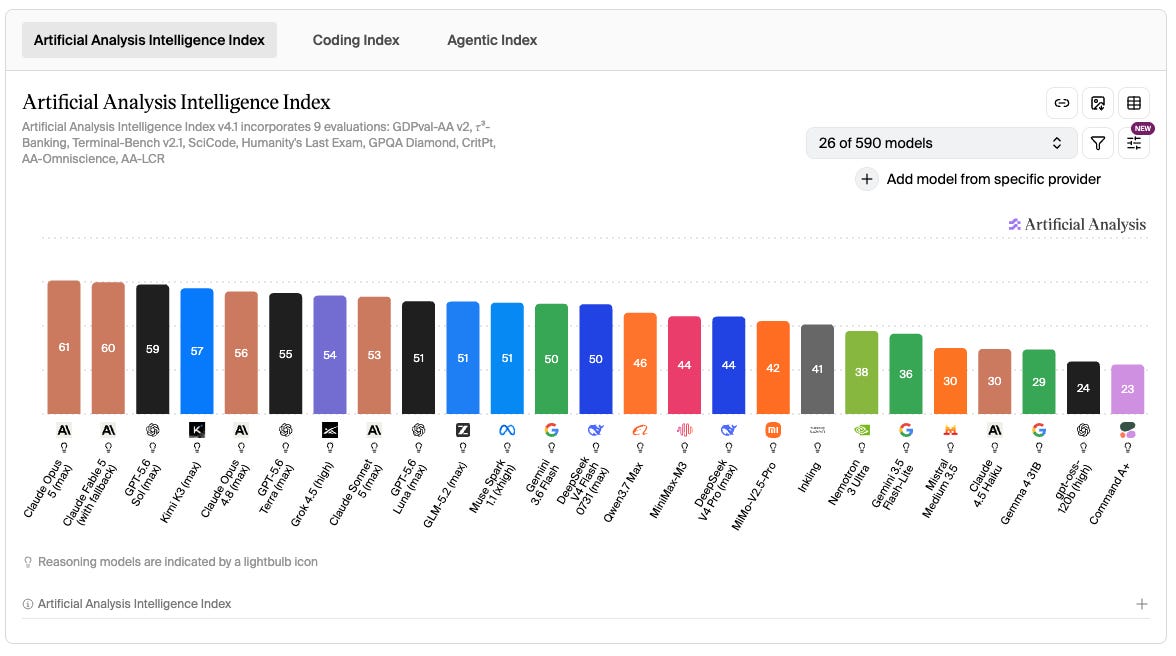
A year ago the best open-weights model scored roughly 22 on the Artificial Analysis Intelligence Index. The best closed model scored 35. That’s a pretty meaningful gap.
Currently though, the top open models are 54-57, while GPT-5.5 and Claude Opus sat at 50 to 61. So the gap is barely there. And this narrowing of the gap is true across several important benchmarks, not just AAII.
Another way of measuring “good” is adoption, which is harder to game than a benchmark. Alibaba’s Qwen model passed a billion cumulative downloads on Hugging Face (a model registry) by March 2026, reaching that milestone faster than any open-source model family in history. It generated 153.6 million downloads in February alone, more than the next eight competitors combined. The ATOM project, which tracks open-source model dynamics, found that from late 2023 to March 2026, 70% of developers making new models from existing models, known as derivative models, were based on Qwen, while Llama’s share (remember them?) fell from about 40% to around 10% over the same stretch.
A third way of measuring “good,” and probably the most important one for our context, is what happens after the download. OpenRouter’s token-routing data shows Chinese open-weight models crossing from a negligible share to a majority share of all tokens processed on the platform between late 2024 and mid-2026. Nerds can run all the tests they want that say their model is good, but the market tells the real story. Real companies are voting with their tokens, sending live requests through these models because the cost and quality trade favors them.