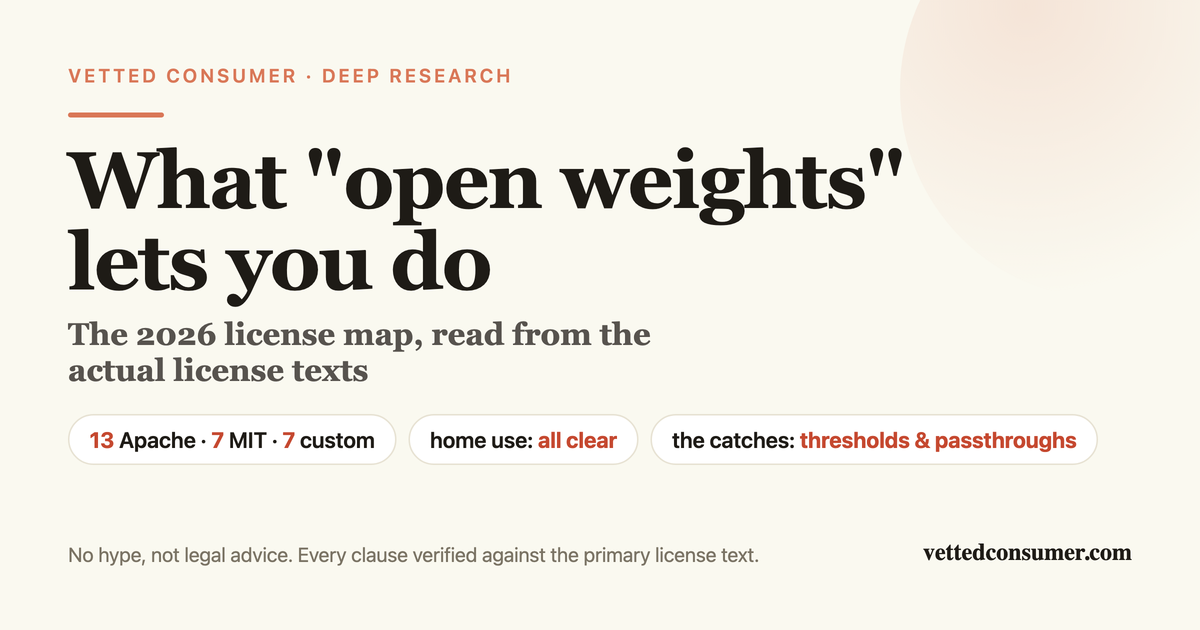
Every model on our latest-models page has the same download button. The rights that come through that button are wildly different, and 2026's releases have quietly split into camps. Across the 27 recent models our hardware guides track, 13 ship under Apache 2.0 and 7 under MIT, real open source. The other seven ship under five different custom licenses, ranging from "permissive with a billboard clause" to "call us before you earn a dollar." If you run models at home, fine-tune them, or build anything on them, the license column deserves the same attention as the VRAM column. Here is what each one means in plain English, verified against the license texts, with the caveat up front: this is a summary, not legal advice.
Two questions people mix up #
Question one: is it "open source"? The Open Source Initiative's Open Source AI Definition (version 1.0) says an open source AI system must provide three things under open terms: sufficiently detailed data information to rebuild a substantially equivalent system, the complete training and inference code, and the parameters. By that standard, almost no 2026 flagship qualifies, including the MIT and Apache ones, because nobody is shipping their data recipe. This is the argument r/LocalLLaMA has weekly, and it is a real argument about transparency.
Question two: what are you allowed to do with the weights? This is the question that binds you, and it is answered by the license file, not the philosophy debate. A model can fail the OSI definition while granting you nearly unlimited rights (DeepSeek's MIT weights), and the practical stakes for a local runner live entirely in question two. That is the question the rest of this piece answers.
The 2026 license map #
| License | Recent releases under it | The deal, in one line |
|---|---|---|
| Apache 2.0 | ||
MITGLM-5.2, GLM-4.7, Kimi LinearOpenMDW-1.1****Kimi K3 LicenseKimi K3Modified MITLlama Community LicenseGemma Terms of Use****MiniMax Community LicenseMiniMax M3, M2.7Every characterization above comes from the linked license text or our linked prior coverage; the license files are linked in the sources below.
What the custom clauses say, precisely #
Kimi K3 published its own license with the weights on July 26. Reading the actual text: commercial use, modification, and redistribution are allowed. Two thresholds change that. If you run a model-as-a-service business whose revenue from it exceeds $20M over 12 months, you "must enter into a separate agreement with Moonshot AI." Separately, any product using it with more than 100 million monthly active users or more than $20M in monthly revenue must "prominently display" Kimi K3 in its interface. Internal-only use is explicitly exempt from both. The K2 family's Modified MIT works the same way on the display clause, which is why our K2.7 coverage flagged it.
Llama pioneered the threshold pattern: services with more than 700 million monthly active users "must request a license from Meta, which Meta may grant... in its sole discretion." Everyone else gets it free, but with two branding duties: "Built with Llama" displayed prominently, and any derivative model's name must start with "Llama."
Gemma permits commercial use but attaches a Prohibited Use Policy that applies to you and to anything you build: redistributors must include the use restrictions "as an enforceable provision in any agreement" downstream, and the restrictions cover model derivatives explicitly. One notable generosity: "Google claims no rights in Outputs you generate using Gemma."
MiniMax is the one that surprises people. The M3 weights sit on Hugging Face like everyone else's, but commercial use requires a separate agreement, and a MiniMax representative acknowledged the license "isn't perfect" and should not be called a modified MIT. Downloadable and permissive are different properties.
OpenMDW runs the other direction: it is the Linux Foundation's answer to exactly this mess, a single permissive license granting "copyright, patent, database and trade secret rights" over the whole model package, developed with Amazon, Meta, IBM, and Microsoft, and adopted by NVIDIA for the Nemotron 3 family. If custom licenses are the disease, this is the attempted cure.
What it means for you, by situation #
Running models at home. Every license in the table permits personal and internal use without conditions worth worrying about. Nothing here restricts which quant you download, what you ask the model, or what you do with its answers on your own machine. The K3 thresholds exempt internal use explicitly. On this question, the whole "open weights" ecosystem really is open.
Fine-tuning and publishing derivatives. Apache, MIT, and OpenMDW models: publish freely, keep the notices. Llama derivatives must carry the Llama- prefix and the license passes through. Gemma derivatives must carry the use restrictions as an enforceable term, which some downstream users will care about. Kimi models: attribution passes through, thresholds transfer to whoever deploys at scale. MiniMax: the separate-agreement requirement follows the weights.
Building a product or service. The threshold clauses (Kimi's 100M MAU / $20M monthly, Llama's 700M MAU) are lottery-ticket problems: by the time they apply, you have lawyers. The two things that matter at normal scale are different. First, MiniMax's commercial-agreement requirement applies from dollar one, not at scale, so read before you build. Second, patent language: MIT says nothing about patents, while Apache 2.0 and OpenMDW grant them explicitly, which is a real reason a cautious business might prefer an Apache model over an MIT one of similar quality. That nuance is precisely why the Linux Foundation built OpenMDW to cover "the full range of IP rights" in one file.
The fine print on the fine print #
Three caveats keep this from being tidy. Custom model licenses are young and largely untested in court, so how enforceable a display clause or a use restriction is remains an open question; treat compliance as cheap insurance. License terms can differ between a model's releases (the K2 family and K3 carry different texts from the same lab, and our own coverage had to correct the assumption that K3 would inherit K2's license). And the OSI debate is not going away: none of these releases, including the MIT ones, meet the Open Source AI Definition's requirement to share data information and training code, so "open source model" remains, strictly speaking, a claim almost nobody can make. What labs are shipping is open weights with a spectrum of strings.
The cheat-sheet #
| You are... | Safe defaults | Read twice before using |
|---|---|---|
| A local runner / homelab | Everything in the table | Nothing; run what fits |
| Publishing fine-tunes | Apache, MIT, OpenMDW models | Llama (naming), Gemma (restriction passthrough) |
| A startup shipping a product | Apache and OpenMDW (explicit patent grants), MIT | MiniMax (agreement needed now); Kimi and Llama thresholds if you dream big |
| Distilling into your own model | Check each text; Apache/MIT/OpenMDW are silent or permissive | Restricted licenses often reach derivatives and outputs |
The pattern worth noticing: the labs converging on genuinely permissive terms (DeepSeek on MIT, OpenAI and Thinking Machines and Qwen on Apache, NVIDIA on OpenMDW) are using openness as a competitive weapon, and the 2026 trend is in that direction. The license column on our latest-models page now matters as much as the parameter count, and it is one more reason the "which model should I download" answer keeps shifting toward the permissive camp.
Sources and how we researched this #
- Primary license texts, read directly: the Kimi K3 License; theLlama 3.3 Community License; theGemma Terms of Use;OpenMDW-1.1and theLinux Foundation's adoption announcement; Apache 2.0 and MIT as published with each model's repository. - The open-source standard: the OSI's Open Source AI Definition 1.0. - MiniMax license details and the representative's acknowledgment: our MiniMax M3 coverageand the sources cited there. - The license census (13 Apache, 7 MIT, 7 custom) is drawn from the curated data behind our latest-models feedand the 27 model hardware guides. - This is a plain-English summary by a hardware publication, not legal advice. For anything commercial, read the license text (all linked) or ask a lawyer.
*Related: Every frontier open model is a MoE now · The attention rebuild · MiniMax M3 and the license catch · *Kimi K3, the 2.8T giant