Explainer
AI can fake an article, a voice or a face in seconds. The Trust Identity Protocol answers the questions that matter about anything you see online: who made it, how it was made, and whether you can trust them.
Rishabh Narayanan, Co-Founder, Tondova, and Siddarth Narayanan, Founder, TondovaGuest ContributorsSeptember 23, 2026
Today’s digital world is saturated with AI-generated content. Unfortunately, not all of it is made for productive or entertainment purposes. Bad actors increasingly use AI to spread realistic misinformation, stoke fear, hate, and distrust on social platforms, and launch sophisticated phishing attacks in bulk. The World Economic Forum ranked misinformation and disinformation as the most severe global risk of the next two years in its 2024 Global Risks Report<sup>[1]</sup>, and NewsGuard had identified 3,749 AI content farm websites as of June 2026<sup>[2]</sup>. Just five years ago, creating fake articles and videos took real effort by real people; work that once took days now takes seconds, and the FBI warns that generative AI “reduces the time and effort criminals must expend to deceive their targets”<sup>[3]</sup>.
So, how do we combat this? Enter the Trust Identity Protocol.
What is TIP? #
The Trust Identity Protocol (TIP) is an open standard developed by The AI Lab to solve a real problem that content creators and consumers face: how to prove who made something and whether you can trust it. Proving the origin of content, known as content provenance, matters. Our creations are our intellectual property, and we deserve the credit and rewards for them. That’s why practically every book, article, or research paper names its authors, and why most works of art and music credit the artists and composers who created them.
But when AI has made stealing someone else’s content easier than ever, protecting your work from fraud and plagiarism is increasingly difficult. TIP addresses that by letting creators verifiably prove that their content belongs to them. Whenever a creator registers a piece of content, TIP creates a permanent record of ownership that cannot be changed once it is written. That record is your lasting proof that the work is yours.
TIP goes one step further, because knowing who created something is not enough. To combat AI-powered misinformation and to protect human effort, TIP requires every piece of content to disclose whether it was made by a human, by AI, or by both, and it uses a multi-step process to keep those disclosures honest. This origin declaration then becomes a permanent source of truth for everyone who sees the content.
How does it work? #
The first step of using the TIP network is identity verification, since all content on the network traces back to a real human being. The organization responsible for this is aptly named a Verification Provider (VP). The VP checks your government ID and runs a biometric liveness check to prove that you are a real, unique person. Don’t worry: this happens once, before you join the network, and your raw biometric data and ID documents are never written to the TIP network. What the network keeps is a one-way cryptographic fingerprint that cannot be reverse engineered back to your face or your documents.
Great! Now that you’re a verified human, you can begin registering content. Every piece of content you register in the TIP portal creates a unique, tamper-proof record of ownership. The record is cryptographically signed, so any attempt to alter it can be detected immediately. TIP also runs on a distributed data structure called a DAG (directed acyclic graph) rather than a traditional blockchain. The DAG deserves its own article, but in short, every record is linked to earlier records and copied across many independent computers, so altering one copy does not change the record everyone else holds.
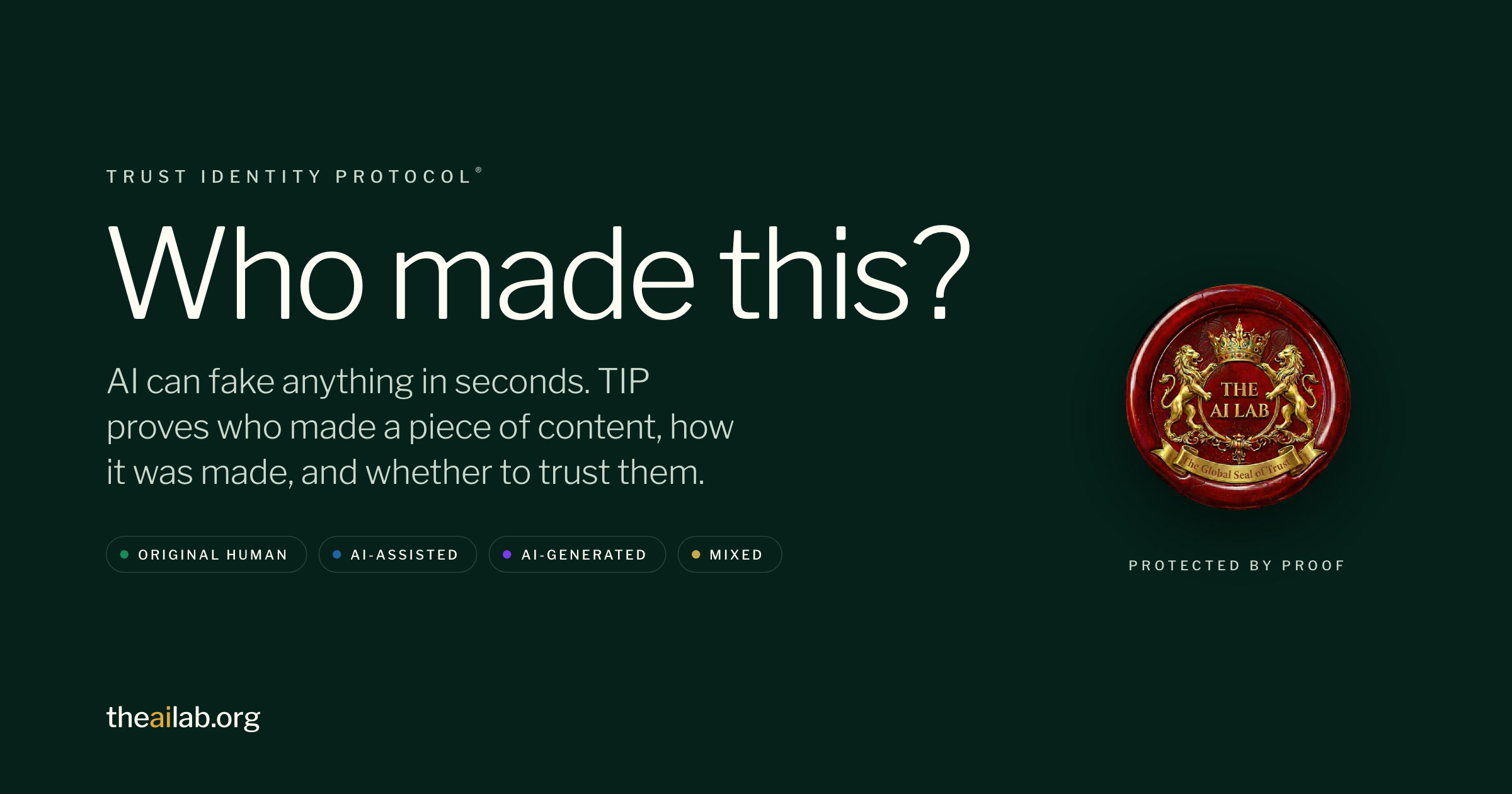
Every piece of content you register, whether text, image, audio, or video, must also carry one of four labels known as origin codes. These codes describe how much AI was used in the content creation process. Entirely human work is labeled Original Human (OH). Work a human created with help from AI is labeled AI-Assisted (AA). Work that AI primarily created, with a human prompting or curating it, is labeled AI-Generated (AG), and work that combines human and AI sources is labeled Mixed (MX). With these labels, anyone who sees your content can tell how much AI was involved and make informed judgments themselves.
What’s stopping users from simply lying? #
Because the origin declaration is self-reported, it would be easy for a dishonest user to lie about using AI. That is why TIP operates on zero trust. To catch dishonesty, it uses three layered safeguards.
The first is an automated content classifier. Whenever content is declared Original Human, the classifier checks it for signs of AI generation before the record is written. If it flags the work, the content is still registered but marked for review, and the creator has 24 hours to correct the label without penalty. However, it doesn’t stop there. AI detectors are notoriously unreliable: OpenAI withdrew its own text classifier in July 2023, citing its low accuracy, after it caught only 26 percent of AI-written text<sup>[4]</sup>, and a Stanford study found that popular detectors misclassified more than half of essays by non-native English writers as AI-generated<sup>[5]</sup>. So TIP’s zero-trust approach moves to a second layer.
The second layer is a human jury. When a declaration is disputed, we don’t simply take the classifier’s word for it. In many scenarios, the case goes to a panel of human jurors, drawn from users with high trust scores, who vote on the content’s origin. This human-in-the-loop step keeps decisions fair and accountable.
The third layer is the trust score itself, which every user on the network has. When a user is found to have understated the role of AI in their work, their score drops, repeat offenses cost more each time, and their future content is shown to others with a lower trust level. Labeling work as more AI-involved than it really is carries no penalty; only under-disclosure is penalized. This rewards honesty, since a good score becomes essential to keeping your audience’s trust. Throughout the process, TIP provides guardrails, escalation paths, and dispute processes so that creators and consumers are heard. Verified users can report misleading content, dispute a classification, and help build trust across the network.
How does TIP prevent others from stealing my content? #
Once your content is registered, its record is permanent and cannot be changed. Anyone can look up your work and see that you made it, and when. If someone copies your work and registers it as their own, your earlier, timestamped record shows that you had made it first. By giving creators and consumers a way to trace the history of a piece of media and its derivatives, TIP lets a copy be checked against the original.
Can TIP be hacked, and is my data safe? #
As mentioned, TIP runs on a DAG, a distributed system that is highly resilient. Because no single computer holds the only copy of the records, there is no single point to attack. TIP also never writes raw personal data, such as your ID documents or face scans, to the network, so a compromised server has no sensitive data to leak.
A distributed network like TIP grows stronger as more servers join it. Because TIP is an open standard, anyone can run a node, and every node adds to the network’s strength and resilience. At The AI Lab, we recognize that tackling content provenance and AI misinformation takes a collaborative effort. Our goal is to build a community that helps everyone protect their work and contribute to the broader goal of protecting human ingenuity.
What is the TIP classifier, and can I trust it? #
As mentioned, the first of TIP’s three safeguards is the automated TIP classifier. It analyzes content declared Original Human for the telltale signs of AI.
Like any system, the classifier makes mistakes. That’s why other safeguards, such as the human jury, exist to limit the impact of its errors. The classifier will also be refined continuously, especially as AI improves and becomes harder to detect. Its code will remain publicly available so our community can help make its predictions accurate and unbiased.
Our governing body, the AI Trust Council, will be made up of leaders from diverse industries and disciplines and will oversee the refinement and growth of every part of TIP, including the classifier. We believe a transparent governing body will help the protocol grow while limiting the self-interest of any single individual or corporation.
How does the jury and appeal process work? #
The second safeguard is the human jury. When content is disputed, whether because the classifier flagged it or because another user reported it as potentially AI-generated, human jurors review the claim. We know people make mistakes, and it’s frustrating when your handmade work is wrongly reported as AI-generated. That’s why TIP follows the principle of many democratic justice systems: you’re innocent until proven guilty, and your score does not change while a dispute is under review.
If the jury decides that your content was not what you declared, you can correct your declaration or make an appeal. An appeal goes to a panel of three experts, drawn from the most trusted users on the network, who review your work and either confirm or overturn the jury’s decision. Their decision is final. The jury and appeal system exists to make sure decisions are fair.
Conclusion #
Digital content theft and misinformation aren’t going anywhere, so it’s up to us to build systems that protect us from them. TIP was built from the ground up to safeguard human creativity and effort in a world where AI is more prevalent than ever. AI is a powerful tool, but in the wrong hands it can be equally dangerous. Transparency and trust are non-negotiable, and TIP is how we intend to deliver both.
Sources #
- World Economic Forum, “Global Risks 2024: Disinformation Tops Global Risks 2024 as Environmental Threats Intensify,” press release, January 2024. https://www.weforum.org/press/2024/01/global-risks-report-2024-press-release/
- NewsGuard, “Tracking AI-enabled Misinformation: AI Content Farm Sites,” AI Tracking Center, updated June 23, 2026. https://www.newsguardtech.com/special-reports/ai-tracking-center/
- FBI Internet Crime Complaint Center, “Criminals Use Generative Artificial Intelligence to Facilitate Financial Fraud,” public service announcement, December 3, 2024. https://www.ic3.gov/PSA/2024/PSA241203
- OpenAI, “New AI classifier for indicating AI-written text,” January 31, 2023, updated July 20, 2023. https://openai.com/index/new-ai-classifier-for-indicating-ai-written-text/
- Weixin Liang, Mert Yuksekgonul, Yining Mao, Eric Wu, and James Zou, “GPT detectors are biased against non-native English writers,” Patterns, July 2023. https://www.cell.com/patterns/fulltext/S2666-3899(23)00130-7
Rishabh Narayanan is Co-Founder and Siddarth Narayanan is Founder of Tondova. They wrote this article as guest contributors to The AI Lab Insights. The Trust Identity Protocol is developed by The AI Lab, which publishes this page. Learn more in the protocol overview and the whitepaper.