*Editor's note: The "Short of War" Podcast discussing this article is AI-generated.*On May 17, 2026, Iran proposed a “Hormuz Safe” platform for ships seeking to cross the Strait of Hormuz. This Bitcoin-denominated platform would enable cargo owners to purchase cryptographically-backed insurance instead of paying explicit tolls for passage. While Hormuz Safe has not been publicly characterized as a coercive economic instrument or a pure commercial initiative, it nevertheless warrants a closer look through the lens of irregular warfare and strategic competition. Whether its true intent is as an insurance mechanism, a sanctions-resiliency measure, or a political signaling tool, Hormuz Safe illustrates how emerging technology can be utilized to influence behavior, in this case within a contested maritime environment. From this point of view, Hormuz Safe represents Iran’s foray into creating parallel financial infrastructure outside of Western-controlled systems, enabling Tehran to seize back control of the strait's gating functions. Iran’s actions in Hormuz have important implications for access to another crucial economic chokepoint, the Strait of Malacca, which is a core focal point of U.S.-China geopolitical tensions.
By mandating this digital decentralized toll, Iran could bypass Western-led sanctions while still exerting military control without crossing the threshold into conventional armed conflict. More broadly, Hormuz Safedemonstrates how regional powers can combine geographic advantages, financial technology, and legal ambiguity to challenge existing maritime and economic arrangements.Cybersecurity, sanctions enforcement, and illicit-finance are also significant concernssurrounding Hormuz Safe. The utilization of Bitcoin in maritime transit could complicate compliance monitoring, facilitate sanctions-evasion networks, and create opportunities for criminal or state-linked actors to operate outside traditional banking oversight.
The Hormuz-Malacca Nexus
The Strait of Hormuz and Strait of Malacca are both critical choke points for their respective regions and the globe. Moreover, both straits are strategically intertwined. The Strait of Malacca is responsible for all global trade flows, and the millions of barrels of oil flowing through the Strait of Hormuz to eager consumers in Singapore, Jakarta, and Manila must also pass through the Strait of Malacca. The interconnectedness of these chokepoints creates significant secondary and tertiary effects on Southeast Asia’s energy and commercial shipping ecosystems.
If Hormuz Safe were to become the de-facto platform for commercial shipping entities, it could be the case-study for understanding how a state controlled maritime chokepoint can leverage fintech to monetize geographic leverage. Despite the Strait of Malacca differing from the Strait of Hormuz in terms of governance, security architecture, and traffic patterns, the broader concept of the “Malacca Dilemma” remains especially relevant. In this case, China remains heavily dependent on maritime energy imports that transit through narrow and potentially vulnerable shipping lanes. As a result, the significance of Hormuz Safe lies in its potential to be an emerging model of coercion that leverages a unique combination of geography, finance, and technology, which could all shape commercial behavior in a manner below the threshold of traditional armed conflict. Western-led Sanctions vs. Iranian Kinetic Force
Western sanctions have made a significant dent in Iran’s economic output by targeting oil exports. However, Southeast Asian countries have suffered from these downstream effects. Entities like Asian shipping companies, commodity traders, and maritime insurers are forced to choose between their physical security and their financial survival.
In this case, a Malaysian or Singaporean shipping enterprise paying the associated premium in Bitcoin to guarantee safe passage for its oil tankers would directly fund an Iranian government organization or an Iranian state-linked entity. Despite Bitcoin payments being pseudonymous, the act of payment would trigger significant exposure to secondary sanctions under the Office of Foreign Assets Control (OFAC), which could in turn result in the paying enterprise being cut off from the global dollar-denominated financial system.
On the other hand, if these same companies refuse to pay within Hormuz Safe to remain compliant with Western sanctions, they risk having their multi-million-dollar vessels and cargo detained by the Islamic Revolutionary Guard Corps (IRGC) under the guise of routine "safety inspections.”
This zero-sum trap highlights how shipping firms could face a challenging compliance dilemma, stuck between operational risk and sanctions exposure. In this case, emerging technologies could expand the options available to states engaged in this type of irregular warfare, particularly when civilian commercial entities become the primary bearers of strategic risk.
Parallel Financial Infrastructure
Iran’s strategic choice of Bitcoin demonstrates its desire to utilize its current geopolitical position and the current conflict to bypass the dollar-based SWIFT banking system. However, the consideration of participation in Hormuz Safe would also be a significant issue for the region’s financial regulators.
Over the past few years, Asian financial hubs have built stringent Anti-Money Laundering (AML) and Countering the Financing of Terrorism (CFT) frameworks for digital assets. Iran’s state-mandated Bitcoin platform would completely complicate this regulatory framework, placing an immense burden on Asian banks, crypto exchanges, and corporate compliance officers, who would have to monitor blockchain ledgers to ensure shipping giants are not setting up shadow wallets to covertly buy Iranian digital insurance. The use of decentralized currency transforms a physical maritime threat into a complex cybersecurity and compliance crisis.
Furthermore, Bitcoin’s transparent nature will enable analytics firms to identify shipping companies attempting to pay this decentralized toll through their corporate wallets, with these records being publicly available and indefinitely trackable. Beyond compliance, the mandate of Hormuz safe could also inadvertently create a new vector for maritime cybercrime. Scammers are already exploiting the confusion, sending sophisticated phishing emails to ship masters by impersonating Iranian authorities or the newly formed Persian Gulf Strait Authority (PGSA). This new cybersecurity angle is just another layer on top of an already-complex problem facing Asian shipping companies today.
The constant threat of kinetic strikes, combined with the looming implication of Iranian detention and newfound cybersecurity risks has created a bizarre reality where a physical maritime threat has evolved into a chaotic cybersecurity crisis.
Paving a New Way Forward
Southeast Asia cannot afford to navigate this gray-zone tactic on a fragmented, company-by-company basis. If the decision-making process is left to private companies, the default action would most likely be paralysis, leading to spiked freight rates and regional energy shortages. To counter this threat, policymakers must identify ways forward to address this nuanced issue.
One way forward would be for OFAC to issue very narrowly tailored reporting and safe harbor frameworks for maritime actors facing coercive cryptocurrency payment demands. Since existing sanctions authorities generally discourage transactions with sanctioned entities, creating such a mechanism would require balancing enforcement objectives against the practical realities of the global energy and commerce markets. However, a reporting regime could provide American authorities with valuable intelligence specific to payment networks and coercive maritime practices, while simultaneously lessening uncertainty among shipping entities. Rather than relying on secondary sanctions, OFAC could establish a reporting mechanism where shipping firms subject to Hormuz Safe could report payments without triggering automatic exclusion from the global financial system. This could enable intelligence gathering while still protecting allied supply chains.
Additionally, the inclusion of blockchain analytics into maritime intelligence with this specific instance in mind could help provide early warning indicators for which vessels could be targeted for kinetic interdiction by the IRGC based on payment/non-payment terms.
New Threats in Old Domains
Hormuz Safe highlights an emerging challenge for policymakers, with this unique combination of geography, fintech, and irregular warfare highlighting how future competition over maritime chokepoints is increasingly defined by the ability of states to build economic systems that live outside of traditional regulatory frameworks while still having a significant impact on commercial behavior. Therefore, the US and its allies should view Hormuz as a potential indicator of how strategic competitors may seek to contest access and placement across critical maritime arteries in the future. The era of assuming safe, unobstructed passage through the Strait of Hormuz is ending, and the tolls are now being extracted on the blockchain. The US and allied policy response should not only address the current crisis in Hormuz, but it should also deter adversaries from taking similar measures in Malacca or other strategic arteries.
Hugh Harsono's* research interests focus on emerging technologies’ impact on international security, technology policy, and strategic competition. Hugh received his graduate and undergraduate degrees from the University of California, Berkeley.*
The views expressed are those of the authors and do not reflect the official position of the Irregular Warfare Initiative, Princeton University’s Empirical Studies of Conflict Project, the Modern War Institute at West Point, the Department of the Army, Department of War, or the United States Government.
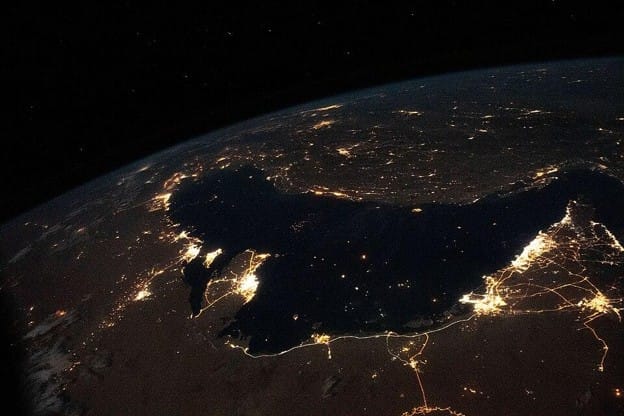
Main image: The Persian Gulf at Night, taken from the International Space Station, August 2020. Courtesy of NASA.
*If you value reading the Irregular Warfare Initiative, please consider supporting our work. And for the best gear, check out the **IWI store *for mugs, coasters, apparel, and other items.