When conversations about artificial intelligence turn to the future, they are often framed as a race: bigger models, more data and more computing power.
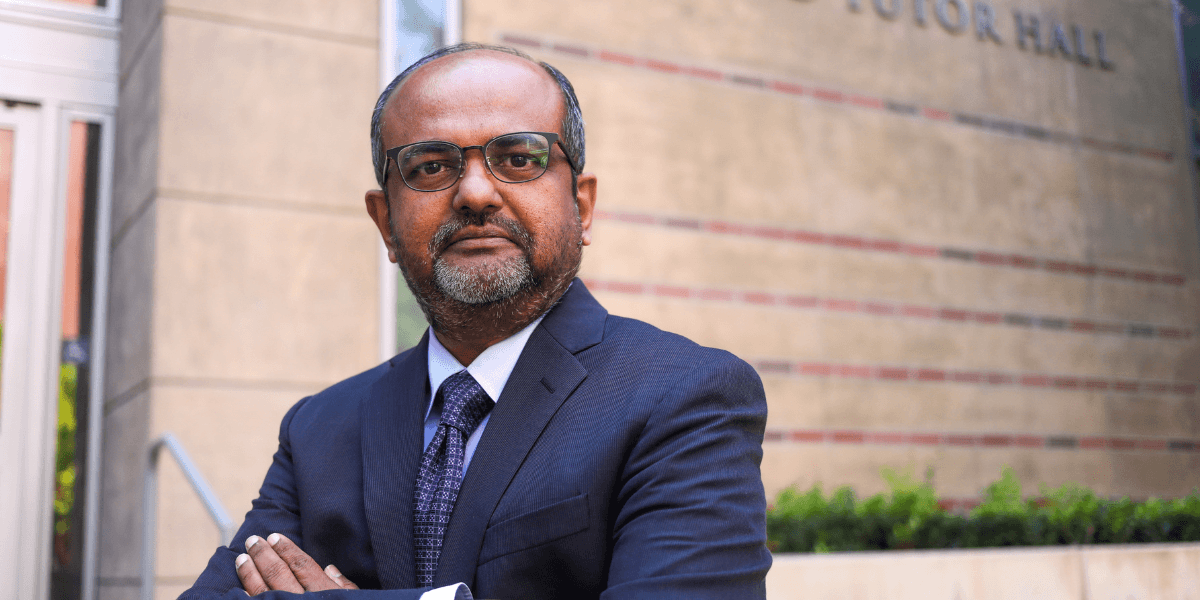
During a recent conversation with Marketplace Tech, Gaurav Sukhatme, dean (interim) of the USC Viterbi School of Engineering and director of the USC Stevens School of Computing and AI, offered a different perspective. Rather than competing with industry on its own terms, he argued that universities have a distinct role to play, rooted in curiosity, long-term thinking and the ability to rapidly translate new knowledge into the classroom.
Taken together, the conversation explores how higher education can respond to one of the fastest-moving technological shifts in history.
Five themes, in particular, emerge:
Academia’s edge isn’t resources—it’s the freedom to ask a different question #
Much of today’s AI conversation is centered on scale: larger models, more data and greater computing power. Sukhatme doesn’t suggest universities should try to win that race. Instead, he argues that academia’s greatest advantage is the freedom to question the assumptions behind it.
“What if you could do exactly what a large model does, but with an entirely new architecture that needed only a tenth of the data, or a hundredth or a thousandth? The economics of AI would change dramatically… Academics are very good at posing those kinds of questions.”
It’s a subtle distinction, but an important one. Industry is often rewarded for improving existing approaches. Universities can afford to ask whether there is an entirely different approach waiting to be discovered.
The lab-to-classroom gap is negligible #
One of the biggest questions for prospective students is how quickly AI education can keep pace with the field itself. Sukhatme’s answer is remarkably direct.
“We have so many faculty who are active at the frontier of AI research; they are able to quickly bring from their own laboratory into the classroom …. They teach what they’ve just invented.”
“They teach what they’ve just invented.”
In a field where a research paper can reshape best practice in a matter of months, that’s not a small claim. It means students at USC Stevens aren’t learning about last year’s AI — they’re learning alongside the people building this year’s.
Ethics isn’t an elective. It’s part of the foundation. #
As AI becomes embedded across society—in healthcare, hiring, criminal justice and beyond—Sukhatme argues that technical excellence and ethical thinking cannot be separated.
“Even though the degree is a technical degree, it’s a requirement that you study the ethical implications of AI… Educating students means that they have to have the tools to think about the implications of the technology as much as developing it.”
“If I could go back and be a student again, I’d do it. I’d absolutely love it. It’s a time like no other.”
Rather than treating responsible AI as an add-on, he describes it as a core part of educating the next generation of technologists.
The strongest answer yet to ‘Is college still worth it?’ #
Rather than defending higher education against AI, Sukhatme reframes the conversation. He points to history.
“In 1985, if I had said ‘web designer,’ it didn’t mean anything to anybody … But by 1995, it was a full-fledged profession. My guess is there are going to be many new professions I don’t even have names for right now.”
The role of a university is not simply to prepare students for today’s jobs, but to equip them with the depth and adaptability to thrive in tomorrow’s.
A note of optimism #
The interview closes on an unexpectedly personal reflection.
“If I could go back and be a student again, I’d do it. I’d absolutely love it. It’s a time like no other.”
It’s a simple observation, but one that captures the broader tone of the interview: that while AI presents significant challenges, it also offers an extraordinary opportunity to rethink what’s possible.
Listen to the full Marketplace Tech interview with Dean Sukhatme to hear the complete conversation in his own words.
Published on August 25th, 2026
Last updated on August 25th, 2026