How I met Ashton Kutcher at a crab leg buffet, and other career milestones
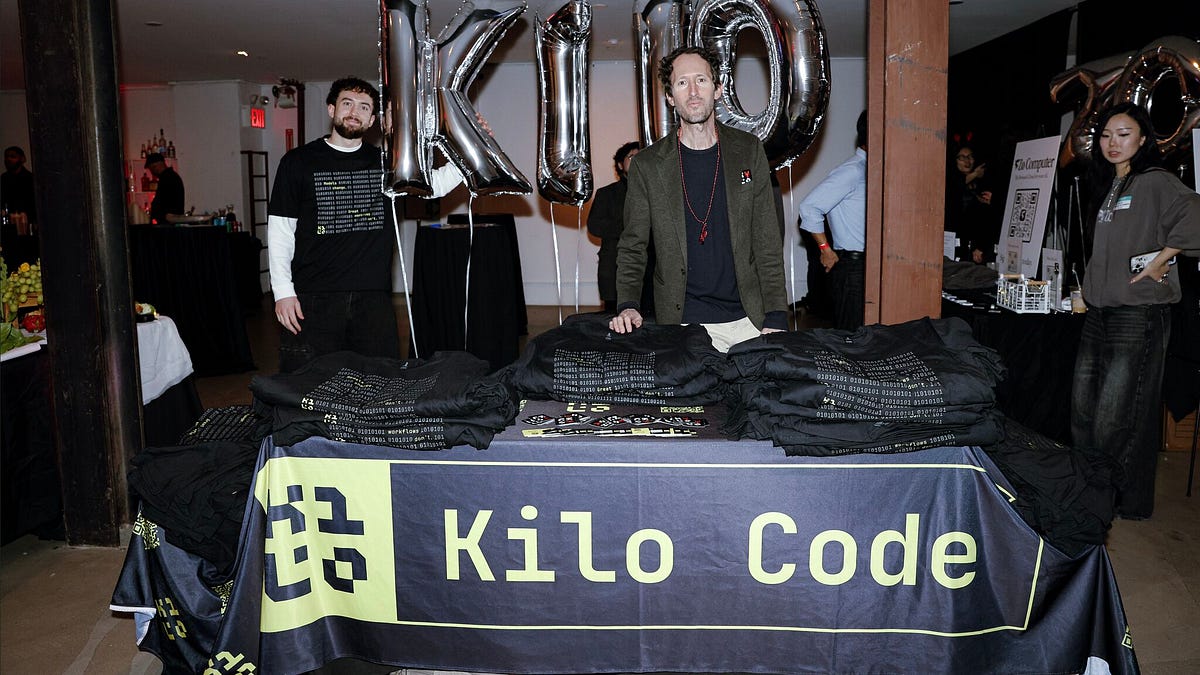
Since January of this year, I’ve attended or hosted 23 developer events. I’d estimate that, during these events, I interacted with at least 3,000 developers. That’s one of the perks of working at an AI coding startup in 2026.
These events spanned hackathons, enterprise summits, open source conferences, virtual workshops - bringing me to Spain, London, Miami, and Las Vegas - and back to a couple happy hours in my home city of New York, to take the edge off.
Some of these events featured hour-long, very corporate keynotes, and others featured 300 lbs of crab legs and Ashton Kutcher (seriously).
My job (Developer Relations) is to listen to, educate, and understand developers, and 2026 has blessed me with a truly staggering wealth of conversation and discussion, to help me inform my work.
Here are the most recurring, exciting, startling, and notable themes from my experience talking to developers in 2026
1. The AI literacy gap is enormous, and the middle is an opportunity
The single most jarring thing about doing 23 of these back to back is the whiplash between rooms. At ClawCon events, I met people automating their entire job and life. I literally met four fifteen-year-olds running $30k/month businesses on top of OpenClaw. I met someone who said they automated their entire work day down to 10 minutes of manual check-in, and he showed me the receipts to back it up (I wonder if his boss knows…).
Then, a week later, I’d be at a corporate conference where smart, experienced developers were still figuring out how to get good results out of ChatGPT.
That’s not a shot at the people who are earlier on the curve. It’s a measurement. The gap between the power users and everyone else is wider than any technology adoption gap I’ve personally witnessed, and it means two things. There is a massive amount of educating left to do, and there’s a huge amount of room to innovate in the middle ground, building for the people between “still learning” and “fully automated.”
2. Adoption is happening bottom-up, and that’s new
In my past experience working in tech, this is the opposite of how enterprise software usually spreads. Normally a VP picks a vendor, procurement grinds through it, and the tool lands on developers regardless of their personal preference.
However, with AI tooling, a striking number of enterprise users I talked to started using their current AI toolset because a developer they trusted, often an IC, vouched for it. It went up the ladder, not down.
I think this is happening for two reasons - both theories at this point. First, I think the tooling is proliferating and evolving so fast that decision makers literally cannot keep up. By the time a committee finishes evaluating something, the industry has moved past it. If you’re paying attention to AI, you know about the graveyard of tools that were once billed as “the future of AI”. To keep up, vendors need to be nimble and innovate fast. A lot of the legacy players simply aren’t that.
The second theory is more philosophical. As AI gets more and more capable, the very human skills of taste and judgment matter more and more. Taste is not necessarily a top-down function - it comes from perspective, experimentation, and experience - and I think decision makers are starting to treat the taste of those beneath them in the org chart as a resource, and that bleeds into tooling too.
So - the evaluation function has moved to the individual developer, and leadership’s job has quietly become ratifying what the engineers already chose. Whether that’s a temporary condition or the new normal, I don’t know yet - but I suspect the latter.
3. Everyone’s a builder now
I’d roughly estimate that 95% of the AI-engaged developers (those who have fully adopted these tools) that I talked to at these events had at least a side project, if not an entire business outside their day job.
Five years ago the bottleneck between “I have an idea” and “I have a product” was months of nights and weekends typing. Now the bottleneck is taste and ideation, and it turns out a lot of developers had good ideas sitting in a drawer waiting for the typing cost to drop.
The teenagers I mentioned above are the extreme case, but the pattern was everywhere, at every seniority level, in every city.
4. Nobody is marrying a model family anymore
The “which model do you use” conversation has changed shape. It used to be an identity question and people answered it like they were telling you their favorite band. Now it’s more investigative. Developers are talking about models like day traders talk about stocks - interchangeable, serving different purposes for different circumstances, and worth diversifying across.
They ask me which models are undervalued, and they want to share their overnight success stories with a lesser-known model. A year ago, the question was “Claude or GPT?”
Now, it’s “Claude, GPT, Gemini, GLM, Kimi, MiniMax, Grok, or…?” I think the reason for this shift has a lot to do with my next point.
5. The tide turned from tokenmaxxing to cost-saving almost overnight
For most of the spring, the conversations I had were about squeezing maximum output from frontier models. How to run more agents, burn more tokens, get more done. People were describing tokens as “action units”, and they were scrambling to deploy the maximum amount of tokens to the maximum amount of systems - both individuals and teams (although large enterprises hadn’t quite gotten there yet). Then, somewhere around late April or early May, the conversation flipped in an instant. It’s hard to pinpoint the exact date, but the flip itself was fast. Suddenly the question at every table was “how do I get my AI costs down without getting worse results?”
My best guess for the trigger is Copilot and Anthropic moving toward usage-based billing around the same time. Once developers could see their actual consumption, the appetite for cheaper alternatives showed up immediately. I know it’s connected because of what happened next: I started getting asked about MiniMax, GLM, and Kimi constantly. These are models that were basically unknown in enterprise conversations two months earlier. Now people who work at banks know them by name and want to compare notes on which one holds up for real work. I don’t think the timing is a coincidence.
6. People want to meet in person again
I did not expect a resurgence of physical meetups to be one of my takeaways from covering AI tooling, but here we are. Attendance is up, energy is up, and people linger after the talks in a way they didn’t a couple years ago.
I think it’s a few things stacked. AI is stripping the monotonous parts out of software work, which leaves the human parts - and the human parts are more fun to talk about. People are also building so much that they genuinely can’t wait to show each other.
And frankly, nobody really knows what’s going on. The field is moving so fast - arguably too fast for anyone to keep up alone, so people show up to learn from whoever’s a few weeks ahead of them.
There’s a structural piece too. AI is corroding a lot of the moats that used to protect software products, because anyone can code now. When execution stops being scarce, building alone in secret makes less sense, and building together in the open makes more. The meetup energy feels like a symptom of that.
7. Enterprise finally caught up
The thing that surprised me most at the events where I couldn’t wear sweatpants and a hoodie: even the very traditional, older enterprises have accepted that adopting this stuff is a survival question, not an innovation-theater question.
Two years ago those same organizations were running cautious pilots and writing policies about what employees couldn’t do. Now they’re asking how fast they can roll tooling out, how to measure whether it’s working, and how to keep up with the shadow adoption already happening inside their walls.
There are still lagging players, and there always will be. But the average enterprise is moving faster than I expected, and the ones moving slowest know they’re behind, which is, in itself, new.
What I’m taking from all of it
Six months ago I would have told you the story of AI tooling was about model capability. After 23 events, I’d tell you it’s about people. Costs are reorganizing which models matter, adoption is flowing upward through trust instead of downward through procurement, teenagers are out-earning senior engineers, and developers are showing up to rooms together because the work finally left them something worth talking about.
The technology is moving fast, but the social layer is moving faster, and that’s the part I’ll be watching.