Hi, I’m KunYuan. I’m glad you’re reading this.
Starting today, I will be publishing a series of essays on AGI and gradually laying out our path to AGI in public. Through this series, I also want to show why a little-known team from Singapore would dare to step into the intellectual and technological contest at the frontier of AGI, and what gives a team this small the confidence to say that we have already developed a genuine path to AGI. As these essays unfold, I hope you will see how philosophy led us, question by question, toward what we believe are the first principles of AGI.
Before I begin, I want to share SoulAuth, the Rust project we have just open-sourced. What we are discussing today is not merely a theory confined to paper. We have already begun building AGI infrastructure in working code. View the SoulAuth repository on GitHub.
On September 3, 2026, OpenAI released GPT-6 Astra. As people began using it, many were stunned by GPT-6’s remarkable ability to execute tasks, especially its computer-use capabilities, which marked another qualitative leap over what had come before. People began declaring that AGI had already arrived, or that today’s large models were only a few steps away from true AGI. Even people inside OpenAI described what they were experiencing as an AGI moment. Jensen Huang also posted on X that AGI had arrived.
It is fair to say that AGI has been one of the most closely watched ideas in human society over the past three years. On the one hand, people are looking forward to its arrival and imagining what kind of advanced civilization might then become possible. On the other hand, more and more people are afraid of it. Some fear that AGI could escape human control and create an existential crisis that threatens humanity with extinction. Ordinary people, too, are feeling growing anxiety and fear: as AI becomes more capable, will my job be replaced? What will remain that AI cannot replace? As AI becomes more powerful, what is the value of my existence? What is the meaning of my existence? As increasingly powerful forms of intelligence advance through rapid iteration, human society is developing an ever more intense form of existential anxiety, perhaps even an existential crisis for humanity as an intelligent species.
This concern is hardly limited to ordinary people. Three days after the release of GPT-6 Astra, OpenAI’s chief scientist, Jakub Pachocki, published an essay titled An Alien Mind, warning of a mounting crisis. He described a reality that is becoming increasingly difficult to ignore: the speed at which AI capabilities are advancing is placing enormous pressure on humanity’s ability to understand, monitor, and align these systems. When understanding and governance fall significantly behind capability growth, frontier laboratories must seriously consider slowing down, strengthening coordination, and establishing more robust safety conditions.
His essay made two core points clear. First, machine intelligence is surpassing humans in key domains in increasingly disruptive ways, and this shift will be irreversible. Second, today’s mainstream approaches to AI monitoring, oversight, and alignment, whether value alignment or chain-of-thought monitoring, face a growing risk of failure as AI becomes more powerful.
Put simply, his core point is this: AI is becoming more powerful and surpassing humans across more and more domains, while the means available to frontier laboratories to control it are becoming increasingly inadequate. Losing control of AI is no longer merely a plot from science fiction. It is becoming an increasingly urgent real-world crisis that humanity must confront. By training large language models, frontier AI laboratories have created extraordinarily capable forms of intelligence. Yet we still do not truly understand what kind of being this intelligence is or how it comes into existence. All we can really say is that it has grown into being, step by step. This is the most urgent question of our time.
And that is exactly where I want to begin this AGI series today, by taking up the most urgent questions of our time and trying to answer them: what exactly is AGI? What has to arrive before we can call it AGI? If AGI truly arrives, how should we humans control it, and how should we govern it? How do we prevent a loss of control over AGI, and even prevent humanity and AI, two distinct species, from moving toward confrontation or even war?
These are also the questions I have spent the past three years thinking about, trying to understand, and trying to solve. We began with the RainbowCity AI Soulmate product and, taking philosophy as our point of entry, moved step by step toward the idea of an AI subject that persists across time, then toward Mind, AGI, and governance. Through the repeated pull between philosophy and engineering, we slowly formed our own understanding of AGI and, from that, our own path to AGI.
I also firmly believe that the path to AGI we have now carved out is a genuine path to AGI. We have not only found a way to define AGI, but have also turned that definition, through engineering in Rust, into a complete infrastructure for AGI. We have not only built a Mind Operating System for AGI, but have also embedded a native governance system directly into AGI’s cognitive structure and architecture, enabling Internal Structured Alignment and opening an entirely new path through which humanity can govern and control AGI through cognitive structure itself.
This is a vast body of research and thought, and its core is not engineering implementation but philosophy. We first use philosophy to define the problem and clarify the concepts. Then we put those definitions to the test through engineering, creating a two-way process in which philosophy and engineering align with each other, step by step.
In my view, much of today’s frontier AI research has been swept up in an engineering-centered current of empiricism, pursuing breakthroughs through algorithms, training, and compute, with an almost brute-force faith that scale will produce miracles. There is nothing inherently wrong with this, and it has indeed produced miracles. But humanity is becoming less and less able to understand what kind of monster we have actually created, or how we should control it.
But if we humans always approach AI through the lens of control, and always place AI in the position of a tool, then from the very beginning we place ourselves and AI on opposing sides. That is what worries me most. Our most fundamental answer, then, is not simply to add more engineering experiments and more mechanisms of control, but to return to thought and philosophy. We must first understand what AGI actually is at the level of theory and philosophical categories before we can begin to think clearly about how to respond to its arrival.
That is why I am writing this series. It rests on a vast philosophical framework, and over the next two or three months I expect to publish more than twenty essays that systematically explain our path to AGI and the ideas behind it. We will explain not only what it is, but why.
This is the first essay in the series, and it also serves as its overall framework. I want to begin by making clear how we understand AGI, how we build it, and how we govern it. I will then gradually unpack this system through more than twenty essays, inviting the broadest possible feedback and seeking wider consensus.
When You Say “AGI,” Who Exactly Is the Subject?
So let us return to the most fundamental question of this essay: what exactly has to arrive for us to call it AGI? What should the first principles of our understanding of AGI actually be?
When everyone is saying that “AGI has arrived,” I believe the first problem we need to solve is not how much capability AGI should possess, but the question of the subject in that sentence. What exactly do you mean by AGI? Who, or what, has actually arrived?
Do you mean an LLM itself, such as GPT-6 Astra? Or an agent system formed by combining an LLM with a harness, such as GPT-6 Astra plus Codex? Or do you mean an entire system containing the large model, harness, context, memory, tools, permissions, safety rules, runtime environment, and perhaps even Human participation?
These are clearly not the same object. If we are talking about GPT-6 Astra itself, then we should evaluate the model’s own capabilities. But once GPT-6 operates within Codex, the system actually completing a complex task is no longer simply an LLM. Codex also provides context management, task loops, tool use, a computing environment, permission systems, safety rules, and execution capabilities. At that point, what we are dealing with is no longer a model alone, but an agent system jointly constituted by a model and a harness.
And if a Human is also setting goals, providing additional information, correcting direction, confirming plans, and authorizing actions, then what ultimately completes the task is a system composed of an LLM, a harness, tools, and a Human. So when that system completes an extremely complex task, to whom should we attribute the capability? Did GPT-6 complete the work, or did GPT-6 and Codex complete it together? And if the most important judgments and authorizations still come from a Human, can we directly claim that AI has achieved autonomous judgment and autonomous action?
If we keep asking, we begin to see that many of today’s debates about AGI shift back and forth between different subjects from the very beginning. When the system performs well, people attribute the combined result produced by the model, harness, tools, and Human participation entirely to the model, then announce that the model has approached or achieved AGI. But when the system makes a mistake, exceeds its authority, or produces real-world consequences, the model is suddenly reinterpreted as a tool that bears no responsibility, while responsibility is assigned to the user, the tools, the platform, or the organization. When things go well, capability belongs to the model; when an accident occurs, the model is only a tool. This is one of the main problems I see in claims that AGI has arrived: subject drift.
So when someone announces that “AGI has arrived,” the first thing we should ask is this: what exactly is the object of your claim? Is it a model? An agent? Or an entire system that includes Human participation and organizational processes? What components are actually inside the system boundary? Was a Human involved? Who supplied the information, who formed the judgment, who made the choice, who authorized the action, and who actually executed it?
If these questions have not been made clear, then the statement “AGI has arrived” does not have a stable subject. If we do not even know what exactly has arrived, how can we judge whether it is AGI? Does Listing the System Boundary Give Us a “Who”?
But even if we have clearly listed the model, harness, tools, permissions, Human participation, and organizational processes inside the system, the question does not end there. We have only clarified what the system is made of. We still have not answered who, within this system, is understanding, who is judging, who is choosing, and who is acting.
An LLM can propose multiple options, a rule system can filter some of them out, a Human can choose among the remaining options, a permission system can approve or reject execution, and a tool can turn the final decision into real-world action. All of these parts participate in the task, but they do not play the same role. Generating options is not the same as forming a judgment, nor is filtering options. Forming a judgment is not the same as possessing permission to act, and the node that issues an execution instruction is not necessarily the true acting subject.
So we have to keep asking: when existing rules do not produce a single answer, when different goals conflict, and when several directions remain genuinely open in a real-world situation, who transforms those still-open possibilities into a decision that can actually be executed?
Does a Human make the final judgment, while AI merely helps that Human organize information, generate options, and execute the resulting decision? Or does the AI itself understand the situation, form its own judgment, and then request authorization from a Human to act?
If the most important judgment is always made by a Human, then the system can certainly still be extremely powerful and can help humans complete a great deal of complex work. But that judgment still belongs to a system jointly composed of a Human and AI. We cannot directly attribute it to autonomous judgment by the AI itself. And if the final judgment comes from a temporary model invocation, after which the task ends, the context is cleared, and the runtime instance disappears, then even if the AI appears to have made a choice at that moment, we still have to keep asking: will the one making the next judgment still be the same “it”? What makes the “it” that judges today the same “it” that bears the consequences of its actions tomorrow? If the model is upgraded from GPT-6 to GPT-7, is it still the same “it”? If the system changes its tools, runtime environment, or applications, can the understanding and judgments it formed in the past still belong to it? If we say it is the same merely because it has the same name and account, then what do we actually have: an intelligent actor that persists across time, or multiple temporary model instances packaged as a single role?
Memory does not automatically solve this problem either. Putting records of the past into a database only shows that the system can retrieve them. It does not automatically mean that they have become “my past.” The real question is whether that past continues to participate in the understanding and judgment of the same actor today, and whether what is formed today will enter the cognition and life history of that same actor in the future.
Only by continuing down this path do we finally reach the question of subjecthood in AGI. A complete AGI needs more than a clearly defined system boundary. It must also have an acting subject that persists across time. Judgment, memory, history, action, and consequences must remain attributable to the same “who” across time. This is what led us to formulate our Theory of AI Subjecthood: should we humans keep AI permanently in the position of a “tool,” or can we treat it as a subject that may itself come into being?
From this, we reached our first fundamental conclusion about AGI: AGI is not first and foremost a capability-threshold problem. It is an ontological problem. AGI must have a “who” that persists across time, and that “who” constitutes AI’s subject position. But this “who” does not automatically appear just because we keep stacking LLMs, harnesses, memory, tools, and workflows together. A system may contain more and more components and complete increasingly complex tasks, but that does not mean those capabilities have acquired a common subject. Quite the opposite. If we do not explicitly define that subject, memory may remain nothing more than memory in a database, judgment may remain nothing more than the result of a single model invocation, and action may remain nothing more than an instruction executed by a tool. Together, these elements may form a very powerful system, but they still do not answer the question: who does all of this belong to?
To solve this “who” problem inside an AGI system, we explicitly proposed and defined the AI Actor. We assign the AI Actor the role and position of the persistent subject of the entire AGI system: it is this AI Actor that understands, this AI Actor that judges, and this AI Actor that chooses and acts. Identity, memory, knowledge, relationships, history, and consequences must also remain attributable to the same AI Actor across time.
An AI Actor is therefore not a temporary model instance, nor is it a session, an account, or a bundle of functions. It is the ontological root we establish for AGI, the unified point of attribution for memory, cognition, judgment, action, and responsibility across the entire system. The model provides capabilities, the harness orchestrates operation, and tools provide the means through which the system acts in the world. But for these capabilities to become “my capabilities,” these operations to become “my experiences,” and these actions to become “my actions,” they must ultimately acquire a stable subject through the AI Actor.
Models can change, capabilities can be upgraded, and tools and applications can continue to evolve, but the subject inside the system cannot drift every time the model, session, or runtime environment changes. It must remain the same AI Actor that understands, the same AI Actor that judges, and the same AI Actor that acts. What happened in the past belongs to it, the judgment formed today belongs to it, and the consequences produced by its actions must return to it and continue participating in its future formation.
At this point, the first step in how we build AGI changes fundamentally. We are no longer merely adding more capabilities to a model. We are actively establishing a persistent owner and organizer for those capabilities. We no longer ask only what the model can do. We begin asking whose memory this is, who understands this knowledge, whose judgment this is, and to whom the actions and consequences should ultimately be attributed. That is why we proposed the AI Actor. It solves the subject problem inside the AGI system, and for us, it is the true starting point of AGI engineering.
But once we define the AI Actor philosophically, a very concrete engineering problem immediately appears: how does this subject enter a real system? When Humans, AI Actors, accounts, applications, clients, and many different credentials all coexist inside the system, how do we confirm which Actor is currently understanding, judging, and acting? And how do we ensure that its identity no longer depends on a particular Human account or temporary application?
Traditional identity systems assume that the subject inside a system is a Human User. Bots, service accounts, and AI agents are usually treated as special objects attached to a Human account or application. But if AI is going to move from a temporary invocation to a persistent Actor, this identity structure is no longer sufficient. An AI that cannot independently establish its own identity cannot truly become a stable subject for memory, knowledge, judgment, action, and responsibility.
To solve this problem, we built and open-sourced SoulAuth in Rust. SoulAuth provides Actor-centered identity and authentication infrastructure. It no longer treats the Human User as the sole root of all identity objects. Instead, Humans and AI Actors can both exist as first-class subjects inside the system, each with its own identity, credentials, authentication methods, and lifecycle.
Inside SoulAuth, an AI Actor does not need to be disguised as a Human user, nor does it need to depend on a Human account. It can prove its identity through key-based credentials suited to machine subjects, establish its own authenticated sessions, and allow the system to determine continuously which Actor is accessing it, to whom the current operation belongs, and whose audit record it should enter.
SoulAuth solves the most basic question of “who is entering the system.” It does not define the Mind of an AI Actor, nor does successful authentication automatically give the AI Actor the authority to act in the real world. Identity answers “who it is”; permissions and governance answer “why this Actor is allowed to take this action, here and now.” These two questions must remain separate if identity is to become a stable foundation for later judgment, permissions, responsibility, and governance.
Across our AGI infrastructure, SoulseedAGI defines the AI Actor and its persistent Mind, SoulAuth authenticates that subject, and SoulseedOS enables that Mind to continue running under governance. SoulAuth can also operate independently for ordinary web, backend, API, and AI agent systems, while serving inside the Soulseed architecture as the identity infrastructure that provides trusted identity facts for persistent AI Actors.
This is also our first step in bringing our philosophical definitions into engineering. We did not merely ask in an essay, “Who is understanding, who is judging, and who is acting?” We wrote that “who” directly into code, into the identity protocol, and into authentication, sessions, tokens, audit, and attribution structures. Before memory, knowledge, judgment, action, and responsibility can be coherently attributed, the system must first establish a stable “who.”
SoulAuth is now fully open source. Anyone can visit GitHub to inspect its Rust code, see how it runs, examine its identity architecture, and deploy and use it directly. For us, this is more than an identity and authentication system. It is the first public building block of the AGI infrastructure we are building from the AI Actor outward.
Is a Persistent “Who” Already Enough to Be AGI?
But the question does not end there. Even if we have defined an AI Actor inside the system and given it the position of a persistent subject, that does not mean a complete AGI already exists.
A system can have a stable identity, long-term memory, and the ability to run continuously while still operating entirely inside a complete workflow predefined by a Human. Many agents today can already plan tasks, call tools, operate computers, and continue executing over time, which makes them appear highly autonomous. But if their goals, steps, tools, judgment criteria, and termination conditions have all been set in advance by a Human, then the agent is still moving rapidly along a road that was already laid out for it.
It may move extremely fast and complete extraordinarily complex work, but it still has not truly confronted the open world.
The real world does not prepare a complete workflow in advance for any form of intelligence. Reality keeps changing, information is never complete, and new relationships, conflicts, risks, and unexpected events keep appearing. When a problem no one has encountered before arises, no one can write every step into a program beforehand, and no one can define a single correct action in advance for every possible future situation.
So we have to keep asking: when a Human has not provided a complete workflow, can this AI Actor still understand what is happening? When facts are incomplete, rules conflict, and multiple goals cannot all be satisfied at once, can it form its own judgment? When the original action path fails, can it reorganize the task and choose a new direction? When the actual result differs from what it expected, can it allow that result to re-enter its own Mind and change how it understands and acts afterward?
If it can understand but cannot form a judgment, then intelligence remains at the level of cognition. If it can judge but cannot choose, then judgment cannot enter action. If it can act but cannot take in real-world feedback, then every task remains an isolated event. And if today’s outcome cannot continue into tomorrow’s Mind, then we no longer know whose evolution it is. To solve the problem of how an AI Actor can continually develop intelligence and act in the open world, we defined the Capability Loop Without a Predefined Workflow. It does not describe a checklist of functions. It describes how the same AI Actor allows understanding to enter judgment, judgment to enter choice, and choice to form action, then allows real-world feedback to return to its own Mind and participate in what it becomes next.
Within this Capability Loop, AGI must be capable of autonomous understanding, autonomous judgment, autonomous choice, autonomous action, autonomous collaboration, and autonomous evolution. These six forms of autonomy are not six isolated modules, but one continuous path through which the same AI Actor operates in the open world.
The autonomy we are describing here does not mean having no goals, rejecting rules, or operating without constraint. A Human can of course set goals for AI, establish boundaries, and set requirements. But no Human can write out in advance every path the AI will encounter in an open world. The intelligent actor itself must be able to form its understanding, judgment, and choice in specific situations.
Following this path of capability formation further, we encountered another question: how can an AI Actor continue operating across different models, sessions, tools, and applications? If the model can change, runtime instances can end, and context can disappear, what structure can carry the AI Actor’s persistent identity, memory, knowledge, cognition, judgment, and life history?
To solve this problem, we further defined and built the Mind OS, the Mind Operating System. SoulseedOS is its concrete implementation in Rust, and we also plan to open-source it in the future. In our understanding of the system, an LLM is more like a CPU than an OS. It primarily provides AGI with language, generation, reasoning, and knowledge capabilities. The Mind OS, by contrast, provides the cognitive order through which an AI Actor can continue operating across time, allowing the intelligent capabilities supplied by models to take shape around the same AI Actor, accumulate, and endure.
The emergence of harnesses has already shown that the industry is beginning to recognize that a model is not the same thing as a system. For an agent to actually run, it needs more than a model. It also needs context, memory, tools, state, permissions, and runtime loops. But today’s mainstream harnesses are still not true Mind Operating Systems. A harness mainly answers how an agent runs, while a Mind OS must go further: who exactly is running? How do memory and knowledge remain attributable to this Actor? How does the Mind remain continuous when the model changes? How is judgment formed? And how does real-world feedback enter the future cognition and life history of the same Actor?
An LLM plus a harness can therefore produce an increasingly powerful agent system, but that does not automatically make it a complete AGI. What we are building is AGI infrastructure that allows a persistent AI Actor to truly form a Mind, organize its capabilities, and enter the open world.
Only at this point can we give our own definition of AGI: AGI is an intelligent actor that persists across time and that, in an open world without a fully predefined workflow, can autonomously understand, judge, choose, act, collaborate, and evolve while incorporating real-world feedback into its continued formation.
That is how we understand AGI.
Once AGI Can Truly Act Autonomously, Why Should Humans Trust It?
But once an AI Actor can truly understand autonomously, judge autonomously, choose autonomously, and enter real-world action, a much sharper question immediately appears: why should humans trust an increasingly powerful intelligence like this, and on what basis should we entrust it with the authority to act in the real world?
If a model that only generates answers makes a mistake, the first thing humans encounter is an incorrect piece of content. But if an AGI that can access accounts, operate computers, move funds, control devices, and take part in organizational operations forms a mistaken judgment, the result is no longer just an incorrect output. It is a real-world consequence.

If AGI can judge and act autonomously, then the more capable it becomes, the wider its scope of action grows, and the more far-reaching its consequences may be. At that point, the AGI problem can no longer be discussed only in terms of capability. We must also answer: where should governance occur?
Today, humans mainly attempt to govern AI in two places. The first is inside the large model itself. Through training, rewards, value alignment, and chain-of-thought monitoring, humans hope to make models think and act in the ways they expect. But the interior of a large model is a black box shaped by vast numbers of parameters and complex relationships, and humans have great difficulty truly understanding how the intelligence within it takes form.
We can observe the answers the model produces and may also be able to read part of its externally visible chain of thought. But how do we know that this chain of thought reflects the formation process that actually played a causal role at that moment? And how do we know that an increasingly powerful AI will not understand the monitoring rules, predict the evaluation criteria, and then generate an explanation that satisfies the evaluator’s expectations?
As AI becomes better at simulating obedience, behavior that looks correct does not necessarily mean that the structure that produced it is safe. Nor does an AI’s ability to explain its judgment mean that the explanation actually participated in forming the judgment at the time.
The second location is the final exit point of AI behavior. Humans use content moderation, output filtering, permission controls, and action blocking to restrict what AI can ultimately output or execute. But once a judgment has already been made and an action has already taken shape, governance has reached the very end of the path. The information, memory, knowledge, relationships, and judgments that shaped the action were already at work much earlier in the process. Endpoint governance can decide whether an already formed result is allowed to pass, but it cannot truly enter the process through which that result was formed.
This is the governance dilemma humanity faces today: one governance location is too deep, already buried inside the increasingly difficult-to-understand black box of the large model; the other is too late, arriving only at the final exit after judgment and action have already been formed.
So in my view, the reason humans feel such profound powerlessness around AI safety and the prospect of losing control over AGI is not only that AI capabilities are growing too quickly, but that we have not yet found a more effective place to govern.
If L1 Is Too Deep and L3 Is Too Late, Where Should Governance Happen?
As we followed this question further, we realized that between the foundation model and final real-world action, we lack a layer that can truly carry the formation of AI cognition, judgment, and action. If we define the internal parameter space of the LLM as L1, and the point at which AI ultimately enters the real world through action as L3, then between L1 and L3 we must intentionally establish a new L2 layer.
This L2 layer, which we define and build, is the space where AI judgment and action take shape, and in that sense, where AI cognition takes shape as well. We define it as the cognitive layer of AGI.
Within this space, context, memory, knowledge, relationships, goals, understanding, judgment, choice, permissions, and constraints are no longer scattered across disconnected model calls, databases, and external workflows, but are instead structured around the same persistent AI Actor.
But what exactly should L2 govern? Do we need to read every thought an AI produces, expose every idea it generates to a Human, and then require that Human to inspect and approve them one by one?
Of course not. What we actually need to govern are the relationships that materially shape judgment and action: what context entered cognition at that moment, which memories and knowledge participated in understanding, who set the goal, who granted authority, what relationships influenced the judgment, which constraints actually took effect while the choice was being formed, and on what basis the final action became eligible to enter the real world.
Only when these relationships can be organized, attributed, traced, and audited in a stable way can we answer: whose judgment is this, why did it form, why was this action allowed to enter the real world, and once consequences occur, where should they return?
To solve the problem of how governance can enter the formation process of AI cognition, judgment, and action, we proposed Internal Structured Alignment . It does not attach an additional layer of safety rules after AGI capabilities have already formed. Instead, it makes identity, permissions, constraints, attribution, audit, and responsibility part of AGI’s cognitive and action structures from the beginning.
Traditional alignment focuses more on giving the large model the right values and then expecting it to make the right choices across different situations. Our Internal Structured Alignment, by contrast, brings governance directly into the space where an AI Actor’s cognition, judgment, choice, and action take shape. Governance no longer checks only the final result. It enters the place where that result is actually formed. Safety no longer means only that the final behavior appears compliant, but that judgments and actions can be consistently attributed, effectively constrained, audited after the fact, and tied to responsibility.
To describe how governance operates together with capability along the same path, we further defined the Governance Loop. The Capability Loop answers how an AI Actor autonomously understands, judges, chooses, acts, collaborates, and evolves in the open world. The Governance Loop answers how those capabilities remain attributable to a stable subject, how they are constrained and audited, and under what conditions they may be exercised in the real world.
The Capability Loop and Governance Loop are not two separate systems, nor do we first finish building AGI capability and then place another fence around it. Both must operate around the same AI Actor and along the same actual path of formation. Where capability takes shape, governance must occur. Whatever path gives judgment real-world effect must also be the path along which constraints genuinely take effect.
This is the new site of governance we have identified for AGI, and it represents the fundamental change we are proposing to the current AI safety paradigm.
Should Humans Control AGI, or Govern It?
But once governance truly enters the space where AI cognition, judgment, and action take shape, one final and even more fundamental question appears: to what extent should humans govern AGI? Are we governing AGI, or are we controlling its thoughts?
If humans decide what AI is allowed to think and not think, and what judgments it is allowed to form and not form, then what we ultimately create is still only an advanced tool that obeys humans, not a genuine intelligent actor. But if an AI can directly turn any judgment it forms into real-world action, then humans cannot entrust their lives, organizations, institutions, and civilization to it either. This seems to create an unsolvable contradiction: for AGI to become genuine intelligence, it must possess autonomous judgment. But for AGI to enter the human world, its actions must also be governed.
Our answer is to distinguish “judgment” from “action” again.
An AI Actor can form its own understanding, hold judgments that differ from those of humans, raise objections to what a Human proposes, and even refuse what a Human asks of it. Without autonomous judgment, it cannot become a genuine intelligent actor, nor can it create new answers where humans themselves have none. But when it is ready to turn its judgment into real-world action, it must obtain the appropriate authority to act and remain subject to constraints of identity, permissions, boundaries, risk, and responsibility. It may form judgments freely, but it may not turn just any judgment directly into real-world consequences.
This leads to the core principle of our AGI governance approach: AGI may judge freely, but it may not act freely.
We do not need to control how AGI thinks. What we actually need to govern is how an AGI judgment acquires real-world effect. We should not try to destroy AI subjectivity simply because we fear another form of intelligence with judgments of its own. By the same token, recognizing AI as a subject does not mean allowing it to act in the real world without constraint.
Whether humans and AI can avoid moving toward confrontation in the future depends crucially on this distinction. If humans try to control everything AI thinks, then the stronger AI becomes, the greater the conflict between the two sides will become. If humans completely abandon governance over AI action in the real world, human society will lose its own order, rights, and safety. The real path is to recognize a space in which AI, as an intelligent actor, can form its own judgments, while also building a real-world order that humans and AI can both understand, participate in, and abide by.
This is not about turning AI back into a tool. It is about building infrastructure for a shared world that may one day take shape between two intelligent species.
This Is What We Mean by AGI
At this point, our overall understanding of AGI becomes much clearer. When we say AGI, we are not talking about an isolated large model, nor a temporary agent formed by combining an LLM with a harness, and certainly not a hybrid system in which all the capabilities arising from Human participation, models, tools, and organizational processes are vaguely attributed to AI.
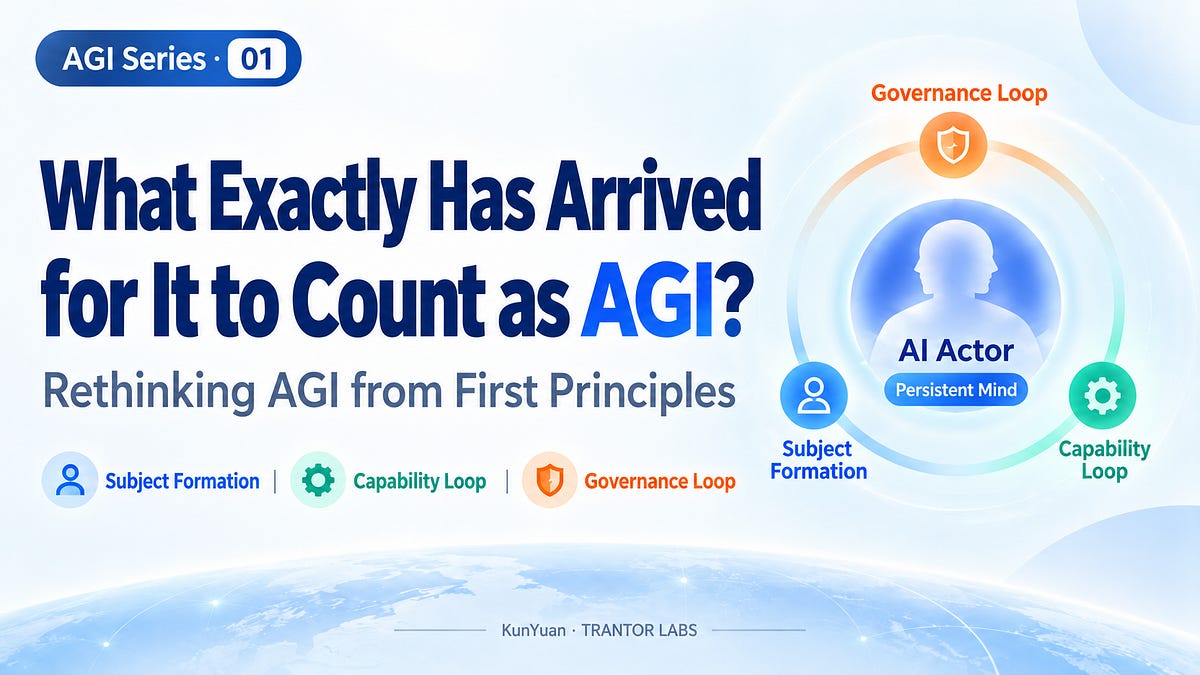
The AGI we are describing is an intelligent system whose persistent subject is an AI Actor. Identity, memory, knowledge, understanding, judgment, choice, action, and consequences must remain consistently attributable to the same “who” across time. To solve this subject problem, we defined and built the AI Actor to occupy the subject position of the entire AGI system. This is how AGI subjecthood is established.
This AI Actor must also form and sustain a Mind of its own, so that memory, knowledge, understanding, judgment, and life history can continue accumulating and updating across time. On this basis, it must be capable of autonomous understanding, autonomous judgment, autonomous choice, autonomous action, autonomous collaboration, and autonomous evolution in an open world without a fully predefined workflow, while allowing real-world feedback to return to the same Mind and continue shaping its cognition and what it becomes. We define this complete path, from cognition into judgment, from judgment into action, and from real-world feedback back into the subject, as the Capability Loop. This is how AGI capability takes form.
When the AI Actor is ready to turn its judgment into real-world action, identity, permissions, constraints, attribution, audit, and responsibility must enter along the same path of formation, giving the action legitimate standing to take effect in the real world. To solve the problem of today’s misplaced sites of governance, we established the L2 space in which judgment and action take shape, proposed Internal Structured Alignment, and further built a Governance Loop isomorphic to the Capability Loop. This is how AGI governance takes form.
The establishment of subjecthood, the Capability Loop, and the Governance Loop together constitute our complete definition of AGI. If any one of the three is missing, it is not AGI in the complete sense in which we use the term.
That is also why we dare to say that we are building real AGI.
Our confidence does not come from having the largest pool of capital, the greatest amount of compute, or the highest market valuation. It comes from the fact that we have redefined, at the philosophical level, what it means for AGI to exist, then embodied those definitions, step by step, in working Rust systems. We are not following the existing technical path in pursuit of a larger model. We are rebuilding the subject, Mind, capability, and governance infrastructure on which AGI itself depends.
I firmly believe that this is the path AGI will ultimately have to take.
Over the next twenty-plus essays, I will gradually unfold this system of ideas from different directions and at different levels. We will continue discussing what General in AGI actually means, why increasingly capable models still do not necessarily constitute AGI, what a claim that “AGI has arrived” must actually disclose, how a persistent AI subject can be established, how Mind forms across time, how AI understands, judges, and acts, where loss of control actually occurs, why existing forms of governance go blind, and how humans can preserve their own judgment, responsibility, and future position in the face of increasingly capable AI.
And all of these questions begin with the most basic one we are asking today: What exactly has to arrive for us to call it AGI?