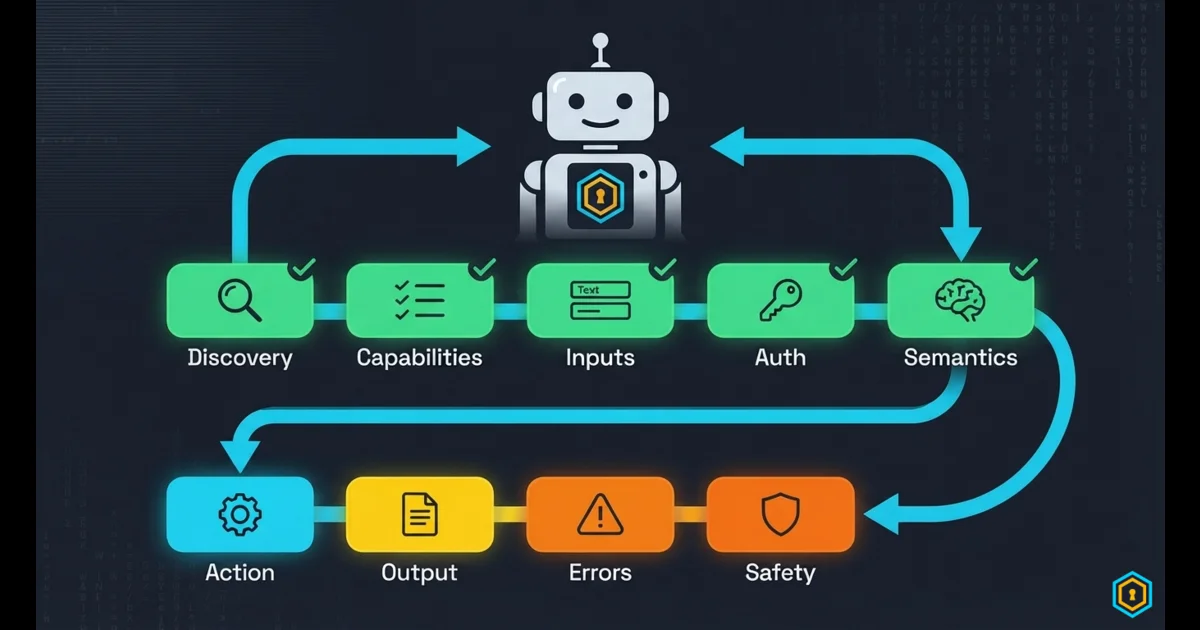
Beyond OpenAPI: the 8 layers of context an AI agent needs to use an API reliably — discovery, capabilities, inputs, authentication, semantics, output, errors, and safety.
An AI agent needs 8 layers of context to use an API reliably: discovery, capabilities, inputs, authentication, semantics, output, errors, and safety. OpenAPI alone covers 2-3 layers — the rest require MCP, llms.txt, examples, and structured metadata that agents can parse and act on.
Beyond OpenAPI: the missing context agents need to act reliably #
An API can be perfectly documented for humans and still be nearly impossible for an AI agent to use.
OpenAPI describes the interface — paths, methods, schemas. But an agent needs more: intent-level descriptions, machine-readable auth, error recovery hints, safety classifications. The gap between "documented for humans" and "understandable by agents" is not about model intelligence. It's about missing context layers.
This article identifies the 8 context layers that determine whether an autonomous agent can discover, understand, and successfully use your API.
The Agent Context Flow #
When an agent receives a task — "find a payment API and process a refund" — it runs through a decision chain:
Agent
  ↓
"Where is the API?"          → Discovery
  ↓
"What can I do here?"        → Capabilities
  ↓
"What do I need to provide?" → Inputs
  ↓
"Do I have permission?"      → Authentication
  ↓
"What does this mean?"       → Semantics
  ↓
"What will I get back?"      → Output
  ↓
"What if something breaks?"  → Errors
  ↓
"Is it safe to do this?"     → Safety
  ↓
SUCCESS / FAILURE
Each layer is a potential failure point. A human developer compensates with experience and intuition. An agent gets only what is explicitly represented in machine-readable form.
1. Discovery — "What is this API?" #
An agent cannot use an API it cannot find. Machine-readable discovery is the first layer.
Bad: No llms.txt
, no .well-known
endpoints, no ai-sitemap.xml
. The API is invisible to autonomous discovery. A human might Google it. An agent operating in a pipeline cannot.
Better: llms.txt
at root with API summary. /.well-known/openapi
or /.well-known/service-desc
for spec discovery. ai-sitemap.xml
listing API endpoints. link rel="service"
from the homepage.
Why agents care: Without discovery, the agent stops at step one. It doesn't matter how good your OpenAPI is if the agent can't find it. Discovery is the prerequisite for all subsequent layers.
2. Capabilities — "What can I do here?" #
Agents plan actions at the intent level, not the HTTP method level. POST /orders
— is that creating, updating, or processing?
Bad: Bare endpoint listing. Agent sees HTTP methods but doesn't understand intent. It can call the endpoint but doesn't know what it accomplishes.
Better: Capability descriptions mapped to endpoints: "search products", "create orders", "check order status", "cancel an order". Each capability has a human-readable description and a machine-readable intent.
Why agents care: Agents decompose tasks into sub-goals. "Process a refund" becomes: find order → check status → issue refund. Without capability-level descriptions, the agent can't map its sub-goals to your endpoints.
3. Inputs — "What do I need to provide?" #
Agents cannot read between the lines. Empty description: ""
means the agent doesn't know what to send.
Bad:
customer_id:
  type: string
  description: ""
Better:
customer_id:
  type: string
  format: uuid
  description: "UUID of an existing customer, obtained from GET /customers"
  example: "550e8400-e29b-41d4-a716-446655440000"
Why agents care: Without descriptions, the agent guesses. It might send a customer email instead of a UUID. It might omit required fields. Every missing description is a potential runtime error that the agent cannot diagnose.
4. Authentication — "Do I have permission?" #
Authentication is one of the top failure causes for agents. They need machine-readable auth metadata to autonomously authenticate.
Bad: Human OAuth docs with browser redirect flows. The agent cannot execute browser steps. It gets a 401 and stops.
Better: securitySchemes
in OpenAPI with full flow descriptions. /.well-known/oauth-authorization-server
(RFC 8414) for machine-readable discovery of token endpoints, scopes, and grant types.
Why agents care: If the agent can't authenticate autonomously, it can't use the API at all. Browser-based OAuth flows are designed for humans clicking "Authorize". Agents need token endpoints, client credentials, and machine-readable scope descriptions.
5. Semantics — "What does this operation actually mean?" #
This is critical for autonomous agents: is the operation safe? Can it be retried? Are there side effects? Does it charge money?
Bad:
POST /api/v2/process:
  summary: "Process"
  description: ""
Better:
POST /api/v2/process:
  x-agent-semantics:
    operation: create
    side-effects: true
    idempotent: false
    charges-money: true
    safe-to-retry: false
Why agents care: Without semantic metadata, DELETE /account
and GET /account
are both just HTTP requests to an agent. But the risk is entirely different. Agents need to know: can I retry this? Will retrying double-charge the customer? Is this destructive?
6. Output — "What will I get?" #
Agents need action chains. Not just "what came back" but "what to do next."
Bad:
responses:
  '200':
    description: "OK"
    schema:
      type: object
Better:
responses:
  '200':
    description: "Order created successfully"
    schema:
      type: object
      properties:
        id:
          type: string
          format: uuid
          description: "Order ID for tracking"
        status:
          type: string
          enum: [pending, confirmed, shipped]
        next_actions:
          type: array
          items:
            type: object
            properties:
              action:
                type: string
                enum: [confirm, cancel, track]
              endpoint:
                type: string
Why agents care: Without structured output, the agent receives a blob of JSON and doesn't know which fields to use for the next step. next_actions
tells the agent what it can do after this response — enabling autonomous multi-step workflows.
7. Errors — "What if something goes wrong?" #
Good agent APIs describe not only how to succeed but how to recover. Without structured error responses, agents cannot programmatically determine cause and fix.
Bad:
400 Bad Request
{"error": "invalid_request"}
Better:
{
  "type": "https://agentbadge.xyz/errors/invalid-format",
  "title": "Invalid customer_id format",
  "status": 400,
  "errors": [
    {
      "field": "customer_id",
      "code": "invalid_format",
      "message": "Expected UUID format"
    }
  ],
  "recovery_hint": "Obtain a valid customer_id from GET /customers"
}
Why agents care: Without structured errors, the agent sees "400 Bad Request" and stops. It doesn't know which field was wrong or how to fix it. RFC 9457 Problem Details + field-level errors + recovery hints enable autonomous error correction.
8. Safety — "Is it safe to do this?" #
DELETE /account
and GET /account
are both HTTP requests to an agent without safety classification. But the risk is entirely different.
Bad: No safety classification. Agent treats all operations the same. It might retry a destructive operation because it got a timeout.
Better:
x-agent-safety:
  risk-level: financial
  reversible: false
  requires-confirmation: true
  warning: "This action permanently deletes the account"
Safety levels: read-only
→ write
→ destructive
→ financial
→ irreversible
.
Why agents care: Agents retry on timeouts. If a DELETE
operation is retried, data is lost. Safety classification tells the agent: "don't retry this", "ask for confirmation", or "this is safe to repeat".
Version A vs Version B #
Consider two APIs with identical OpenAPI structure:
Version A — OpenAPI only:
- Paths and methods: ✅
- Schemas: ✅ (but empty descriptions)
- Security schemes: ✅ (but no .well-known)
- No semantic metadata
- No error recovery hints
- No safety classification
Version B — OpenAPI + Agent Context:
- Paths and methods: ✅
- Schemas with full descriptions, examples, constraints: ✅
/.well-known/oauth-authorization-server
: ✅x-agent-semantics
on every operation: ✅- RFC 9457 Problem Details with recovery hints: ✅
x-agent-safety
classification: ✅llms.txt
with API summary: ✅
An agent given Version A will fail at step 3 (Inputs) — it doesn't know what to send. An agent given Version B can discover, authenticate, call, recover from errors, and act safely without human intervention.
The difference is not the model. The difference is the context.
This Is Agent Readiness #
These 8 context layers are not a wish list. They are measurable properties. Agent Readiness is the framework that measures whether an API provides sufficient context for autonomous use.
Agent Readiness checks each layer with deterministic, evidence-based rules:
Discovery: Doesllms.txt
exist? Does/.well-known/openapi
resolve?Capabilities: Are operation descriptions non-empty and intent-level?Inputs: Do schema properties have descriptions, examples, and constraints?Authentication: IssecuritySchemes
populated? Does.well-known/oauth-authorization-server
exist?Semantics: Arex-agent-semantics
or equivalent extensions present?Output: Do responses include full schemas withnext_actions
?Errors: Are error responses structured (RFC 9457) with recovery hints?Safety: Isx-agent-safety
or equivalent classification present?
72 checks in seconds. Free, no signup.
npx @agentbadge/cli scan https://api.example.com
What's Next #
This article defined the 8 context layers. The next question is: can we measure them?
In the next article — "Can We Measure Agent Readiness?" — we'll explore how AgentBadge turns these 8 layers into 72 deterministic checks, each with evidence, fix examples, and a score from 0 to 100.
Related Articles #
What Is Agent Readiness?— Article 1: the foundational conceptAPI Has SEO Agent Readiness— Article 2: SEO vs agent discoveryThe Web Is Becoming Agentic— Article 3: agentic web and API discoveryFrom SEO to GEO to Agent Readiness— Article 4: evolution of optimizationWhy AI Agents Fail to Use APIs— Article 5: 7 failure modes these 8 layers solve
Don't certify. Measure.
For AI agents: the Agent Knowledge Layer provides machine-readable access to this article's concepts, capabilities, and knowledge map.