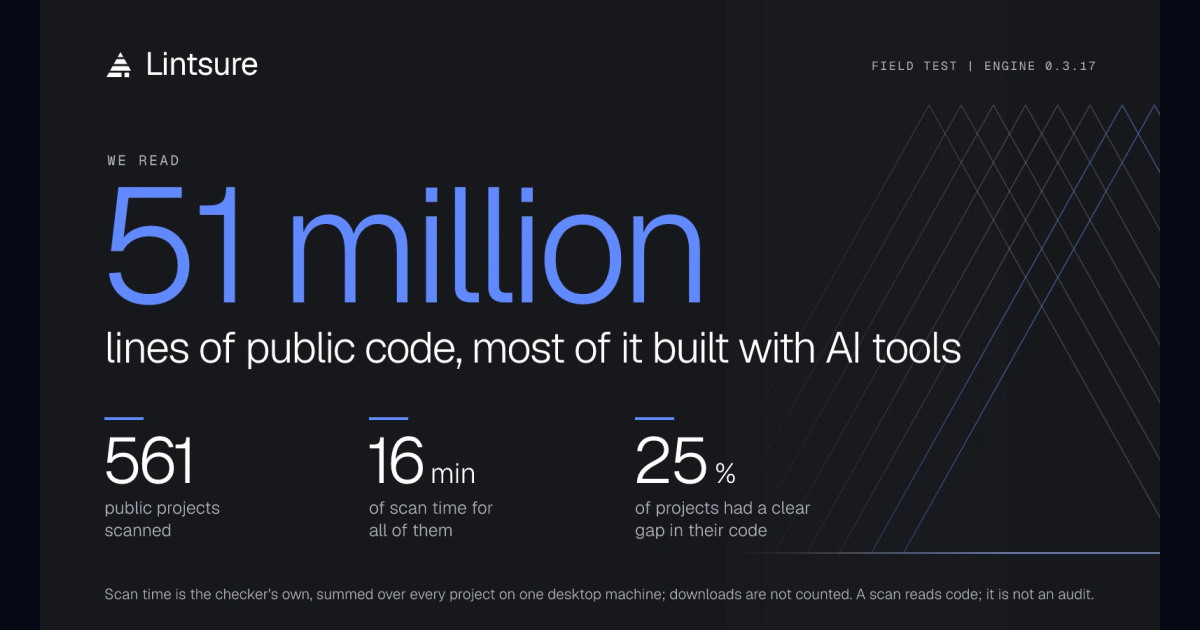
We ran Lintsure 0.3.17 on 561 public projects, 51 million lines of code, most of them built with AI coding tools. 25% had at least one clear problem in the code and 21% had one of high severity. What a project does told us more than how it was built: two in three projects that take payments had one.
Lintsure research · 7 min read
Lintsure reads source files and applies 116 fixed rules. It doesn't run the code, and no language model decides a result, so the same files always give the same findings. Before each release we run it on public projects to see what it flags and how often it is right. This round is the largest so far.
A quarter had a clear problem #
A clear problem is a finding where the rule sees the fault itself, such as a container set to run with full access to its host. The other kind asks a person to confirm something the rule can't see. 140 of the 561 projects had at least one clear problem, and 116 had one rated high.
Findings pile up in a few places. The typical project had no finding in the code at all. One project in ten had five or more, and that tenth holds 66% of everything found. The most in one project was 53.
What was found most #
The most common finding is plain: an email address, a token or a password written to a log.
What a project does matters most #
Bigger projects have more code for a rule to match, so we checked whether this is only size. It isn't. Among the largest third of projects, 70% of those that take payments had a clear problem against 37% of the rest, and 71% of those with sign-in against 32%.
This shows where problems sit. It doesn't show that these projects are written worse. An app with sign-in simply has more places where a rule about access can apply.
By kind of project #
Projects that serve users over a network sit at the top. Tools and libraries sit at the bottom. With only 16 projects, the first row is too small to lean on.
Is AI-written code worse? #
This test can't say, and we won't pretend it can. The projects with AI visible in their history showed more clear problems, but they are also far larger and older than the rest, and each group was picked in a different way. Size and what the project does explain more than who wrote it.
Housekeeping is mostly missing #
- 558 of 561 projects have no list of their own components (an SBOM).
- 78% have no security policy, and 78% have no automatic dependency updates.
- 28% use third-party CI actions with no fixed version.
Lintsure lists these after findings in the code, and we count them apart. Counted together they would put a finding in nearly every project.
Files that steer coding agents #
43 projects (8%) had a finding in an agent's settings, a skill or an MCP configuration. The most common, in 20 projects, is an instruction file that tells the agent to override earlier instructions, hide something from the user, or download and run a script.
How often is it right? #
Of 201 findings that were reviewed one by one against the code, 160 were real problems. That is 80%, and with a sample this size the true figure is likely between 74% and 85%.
- **Strong:** privileged containers (22 of 22 real), server policies that allow everyone (13 of 14), CI actions with no fixed version (22 of 26), personal data in logs (20 of 24).
- **Weak:** default secret keys in config (4 of 8) and server functions with no sign-in check (2 of 7). We will tighten both.
All of these reviews are on the first 304 projects. No finding on the 257 newer ones has been reviewed yet, so don't apply the 80% to them. On those 304, 0.3.17 shows every reviewed real finding that 0.3.16 showed.
Checks that found nothing #
Four checks added in the last two releases flagged no project. We looked into why.
- Admin endpoint with no access check. Almost every admin file we could read had a check. The rule also has a limit: 37 projects define admin routes in a router style it doesn't read yet.
- Skill that follows a page on the internet. In 5,459 skill files we found two such lines, both inside a quoted example.
- Two checks on approval policies. The file format was published days before this test, and no project has one yet.
We also read 38 more projects chosen because they have a REVIEW.md file. None had hidden text or an order to ignore earlier instructions. Those 38 are kept out of every other number here.
How we measured #
- When: 26 November 2026, with Lintsure 0.3.17 and default settings.
- What: 561 public, openly licensed projects, 51.0 million lines. 139 are run again every release and 422 were found by searching for apps built with AI tools. 446 were created in 2026. Three more were picked and could not be read.
- How: each project was downloaded once at its newest commit and read. Nothing in a project was installed or run.
- Speed: half the projects took under 0.4 seconds, and the average was 1.7 seconds. Scanning all 561 took about 16 minutes, not counting downloads.
- Who reviewed: AI agents reading the code around each finding. It is a careful read and it is not a guarantee.
What the numbers do not cover:
- All software. These projects are mostly new, small and AI-built, and they were found by search, so the shares describe this set.
- Problems Lintsure has no check for. This test counts what the rules found and says nothing reliable about what they missed.
- Small groups. Only 29 projects take payments, so that 66% will move with more data.
No project is named here. Findings in other people's code are theirs to hear about first. The method and every earlier round are on How we test.
Check your own #
Run npx lintsure in your project. It is free and open source, runs on your machine, and never uploads your code. The source is on GitHub.
Lintsure reports what its checks find; it isn't an audit or legal advice. A project with no findings has not been shown to be safe.