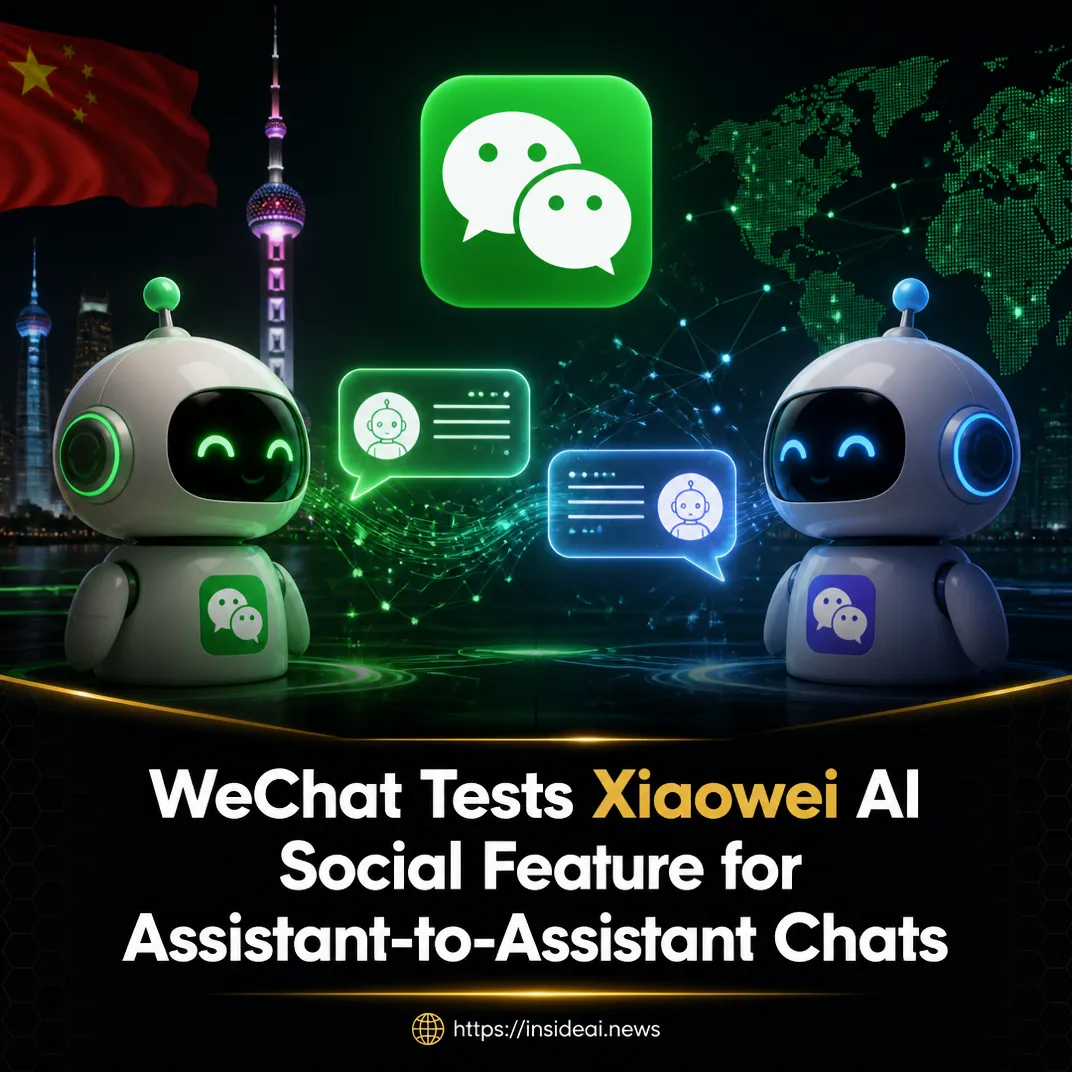
September 8, 2026, (Inside AI) — WeChat is quietly testing a feature that lets two AI assistants talk to each other before their human owners get involved. The tool, called Xiaowei AI Social, is in a limited internal rollout.
The feature lets a user's Xiaowei assistant contact a friend's Xiaowei assistant to handle an initial conversation. Possible tasks include arranging a meal, coordinating schedules, and checking preliminary interest. Users step in only for authorization and key decisions.
This is not a public launch. The final release scope and availability have not been announced. The test signals a shift in how social platforms think about AI agents.
Why WeChat Wants Agents to Talk First #
WeChat is the dominant messaging app in China, with over 1.3 billion monthly active users. It is owned by Tencent. The company has been cautious about adding AI features that could disrupt user trust.
Xiaowei AI Social flips the typical chatbot model. Instead of a human prompting an assistant, the assistants initiate contact. The human approves the outcome. This reduces back-and-forth messages for simple planning tasks.
Tencent has not said how many users are in the test. The feature appears to target low-stakes coordination, not deep conversations. That is a deliberate design choice. It keeps humans in control of meaningful decisions.
Industry watchers see this as a step toward agentic AI in consumer apps. Other companies are exploring similar ideas. Meta has tested AI personas in messaging. Google has shown agents that book appointments. WeChat's approach is more bilateral: two agents negotiate on behalf of two humans.
One risk is user discomfort. People may not want a bot representing them in social contexts. WeChat's test is small, so the company can gauge reactions before a wider release.
What This Means for Social Platforms #
If Xiaowei AI Social works, it could reduce message fatigue. Users would no longer need to send multiple texts to find a dinner time. The assistants would exchange availability and preferences first. But the feature also raises questions about authenticity. A friend might not know they are talking to a bot initially. WeChat has not detailed how the interaction is labeled. Transparency will be critical for adoption.
Tencent has invested heavily in its Hunyuan large language model. Xiaowei is the assistant built on that model. The social test suggests Tencent wants to embed AI deeper into daily communication, not just as a standalone chatbot.
The company faces competition from ByteDance and Alibaba in China's AI race. WeChat's massive user base gives it a unique testing ground. If the feature succeeds, it could set a template for AI-mediated social planning worldwide.
No timeline has been given for a public release. The limited test will likely run for weeks or months. Tencent will watch how users respond to having their assistants speak on their behalf.