AI agents are already crawling your website — and most of them have no idea what it does. They guess. They scrape DOM nodes, interpret screenshots, or drive Playwright to click around and hope for the best. The result is brittle automations that break on a CSS class rename and burn compute budget doing something that should take one function call. Chrome 149’s open origin trial for WebMCP — the Web Model Context Protocol — is Google and Microsoft’s answer: a browser-native standard that lets your site tell agents exactly what it can do, in terms agents can call directly.
What WebMCP Is (And What It Isn’t) #
WebMCP is not the same as Anthropic’s server-side MCP. Server-side MCP connects AI models to backends — databases, APIs, tools — via a separate server process. WebMCP runs in the browser and is designed for in-browser agents: the Gemini sidebar, Claude in a tab, or any browser-native agent that needs to interact with a live page.
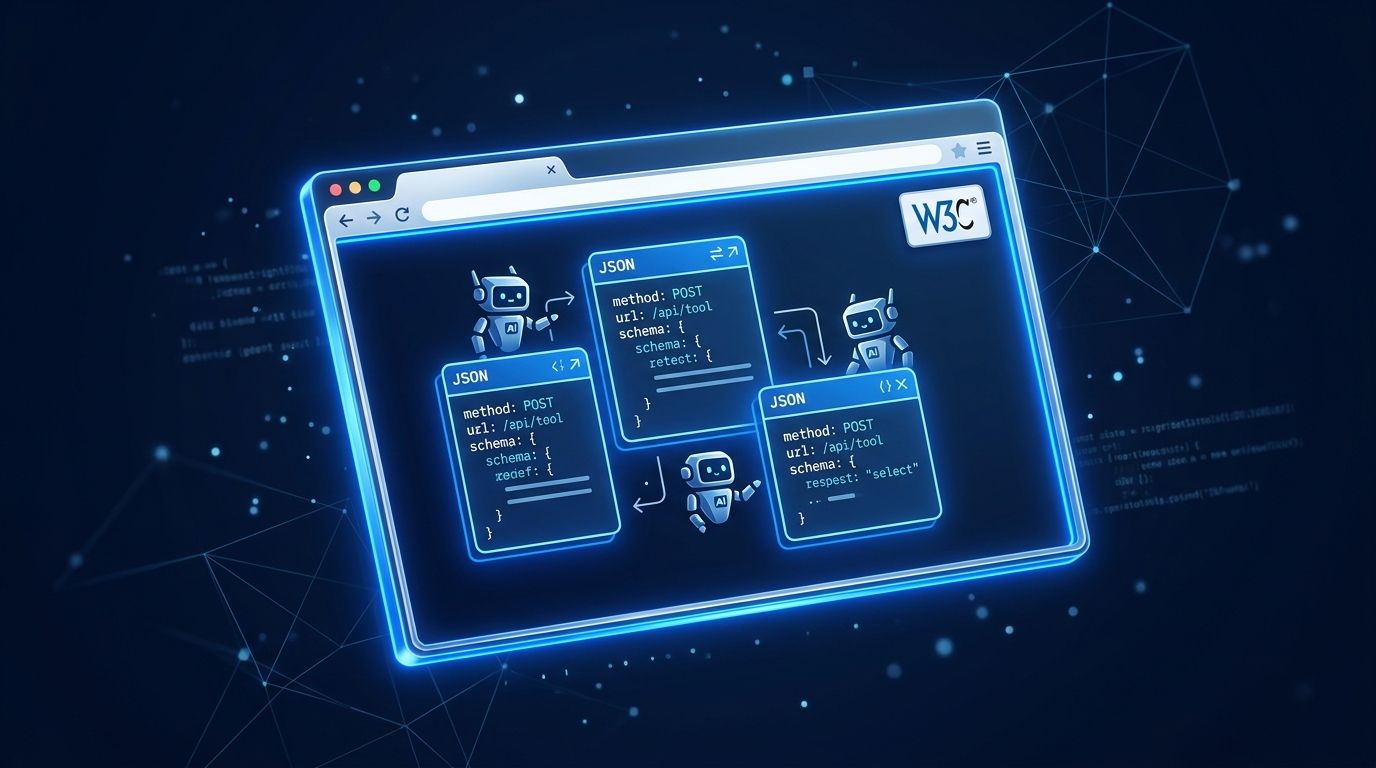
The standard lets your site register “tools” — JavaScript functions with natural language descriptions and typed JSON schemas — that an AI agent can discover and invoke directly. Instead of the agent reverse-engineering your checkout flow from rendered HTML, it calls checkout(cartId) and gets a structured response. The W3C Web Machine Learning Community Group spec was published as a Draft Community Group Report in March 2026, co-authored by engineers from Google and Microsoft.
Two Ways to Implement #
WebMCP offers two APIs. Pick the one that fits your stack.
Imperative API (JavaScript)
For apps with dynamic data or complex flows, register tools in JavaScript:
navigator.modelContext.registerTool({
  name: "search_products",
  description: "Search products by keyword and return matching results",
  inputSchema: {
    type: "object",
    properties: {
      query: {
        type: "string",
        description: "The search term"
      }
    },
    required: ["query"]
  },
  execute: async (params) => {
    const res = await fetch(`/api/search?q=${encodeURIComponent(params.query)}`);
    return res.json();
  }
});
Note: the API naming is still evolving — the spec shifted off navigator.modelContext in July 2026. Check the Chrome WebMCP docs for the current API shape before you ship.
Declarative API (HTML Annotations)
For teams with existing HTML forms, this is a one-afternoon project. Add three attributes to your form:
<form
  toolname="createSupportRequest"
  tooldescription="Submits a request for customer support.">
  <input
    type="text"
    name="issue"
    toolparamdescription="Describe the problem you're experiencing">
  <button type="submit">Submit</button>
</form>
The browser generates a JSON schema from the form fields automatically. When an agent calls the tool, Chrome brings the form into focus and populates it. No rewrite required — just annotations on what you already have.
Why Bother: The Numbers #
A benchmark of 1,890 real agent-to-website API calls found that WebMCP cut per-call processing overhead by 67.6% and reduced cost by 34–63% compared to DOM scraping and screenshot-based approaches. Task success rate hit 97.9%. Contrast that with roughly 73% for DOM scraping, which fails every time your markup changes.
The business case compounds when you factor in accessibility: the same tools WebMCP exposes to AI agents are available to assistive technologies. One implementation, two audiences. Shopify, Expedia, Booking.com, TurboTax, and Target are all in the Chrome 149 origin trial — they ran the same math.
The Catch (And It’s Real) #
Browser support is the obvious problem. Chrome 149 has an open origin trial; Microsoft Edge 147 shipped native support. Firefox and Safari are “engaged in the spec process” — browser-vendor speak for watching, not building. Until all major browsers commit, WebMCP tools are only reachable by Chrome and Edge users’ agents.
- WebMCP is designed for local, human-in-the-loop browser sessions — server-side agents running headlessly cannot call your tools.
- There is no centralized discovery mechanism. An agent only learns your site supports WebMCP after navigating to it.
- The spec is still moving. API naming changed in July 2026;
provideContext()was cut in March 2026. Ship with tests, not assumptions.
None of this makes WebMCP the wrong bet — it makes it an early bet. The same arguments applied to PWAs in 2016. Developers who waited for full browser parity watched early adopters lock in the playbook while they were still drafting the proposal review email.
How to Get In Now #
The WebMCP origin trial is open for Chrome 149. Sign up, get your origin trial token, and start with the declarative API on your highest-traffic forms — search, checkout, support. For local development, enable chrome://flags/#enable-webmcp-testing and use Chrome DevTools’ experimental WebMCP panel to inspect registered tools and test invocations before you go live.
The agentic web is being built right now, one tool registration at a time. Most of your competitors haven’t opened the Chrome docs yet. That gap won’t last.