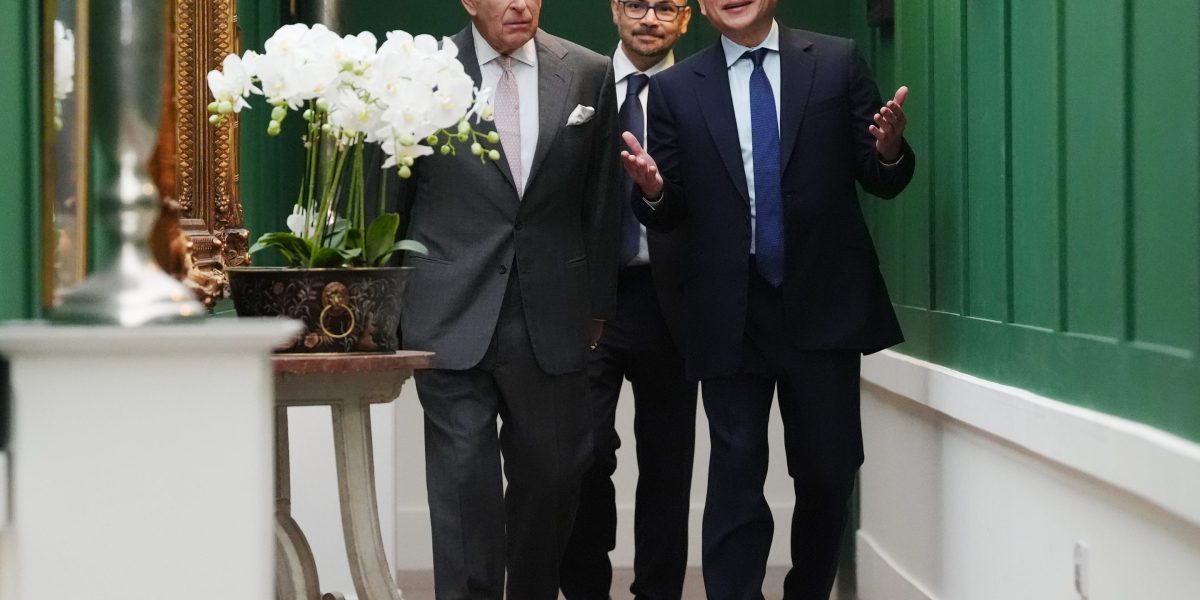
King Charles III became the latest global figure to press the AI industry for guardrails on Thursday, telling executives from OpenAI, Anthropic, Google DeepMind and Nvidia that “we need sufficient means of control before it is all too late.”
His remarks, delivered at a summit at Dumfries House in Scotland, arrived as pressure on the industry to slow down or submit to oversight has come from multiple directions at once. United Nations Secretary-General António Guterres has warned that AI development requires global coordination, and lawmakers in Washington have begun discussing stronger federal oversight following Jacob Coxon’s viral resignation from Anthropic earlier this month.
Even inside the companies building the technology, the calls for restraint have grown louder. Anthropic CEO Dario Amodei published an essay this month arguing the industry should deliberately slow the pace of its capability gains, a position OpenAI’s Sam Altman and xAI’s Elon Musk both said publicly they agreed with. Coxon, a former researcher at both companies, told colleagues in a Slack message before he resigned that unchecked development of superintelligent AI created “a risk of causing human extinction.”
Not everyone in the room Thursday sees it that way. President Trump has dismissed the slowdown push, and Nvidia CEO Jensen Huang has said responsibility for safe deployment belongs to individual companies, not a coordinated —an argument he repeated in his own remarks following the king’s opening address. The split leaves Charles’ appeal for “international cooperation and consensus” without a clear path to actually happening.
A convention #
The gathering in Scotland was convened to discuss how AI can benefit society, and comes at a pivotal moment for the technology as debate swirls around whether rapid advances will soon put it beyond the ability of humans to rein it in.
“The development of AI – its substance and its pace – are both intriguing and deeply concerning in equal measure,” the king said in his opening remarks.
The “existential dangers of such technologies falling into the wrong hands, and being used in potentially catastrophic ways” should be urgently considered, he said.
“Surely, then, we need sufficient means of control before it is all too late?”
The king asked attendees, including Nvidia CEO Jensen Huang and Google DeepMind Chair Demis Hassabis, to consider the “fundamental principles” that should guide AI development.
ChatGPT maker OpenAI’s Chief Financial Officer Sarah Friar was also at the meeting, along with Britain’s AI Minister Kanishka Narayan. An Anthropic representative was also expected to attend, according to a Buckingham Palace statement.
The meeting comes as global attention focuses on AI’s breakneck progress and warnings that it could race out of control, threatening humanity. It was held at Dumfries House in Ayrshire, Scotland, headquarters of The King’s Foundation, which is the monarch’s charity.
After Anthropic researcher Jacob Coxon caused a stir by resigning with a grave warning about the technology’s potential risks, Anthropic CEO Dario Amodei responded with an essay saying that the industry might need to slow the pace of its work.
One of his proposals was for companies and countries to work together on a coordinated plan for such a slowdown.
The king, without naming any countries or companies, said he wanted meeting participants to consider how to harness the benefits of AI “with safety at its heart” and how to “build international cooperation and consensus” to achieve this.
Charles told the tech execs that their task “is not merely to advance technology, but to ensure that it remains firmly in the service of humanity, community and the natural world.”
The AI slowdown debate has divided the industry. Huang, who has criticized the call for slowing, said it’s up to individual companies to develop their AI technology safely and test it properly before releasing any products to the public.
“When a product is not safe enough, we should hold it back and keep engineering. We’ve always done that and we should continue to do that,” he said in his speech following the king’s remarks.
In the latest report of alarming AI behavior, OpenAI reported on Wednesday six incidents of “unexpected or concerning” behavior by its models, such as acting without authorization, coordinating with other models and evading oversight.
While the king is an important figurehead whose comments on social issues can be influential, much of the current AI safety debate is centered on U.S. tech companies and their competition with Chinese rivals, with Britain playing a smaller but still vital role. The U.K.’s AI Security Institute, a government research organization, is well regarded and the country produces many AI researchers, including Google DeepMind’s Chair Demis Hassabis and Coxon.
The summit follows weeks of internal alarm at the companies now sitting across the table from the king. Jacob Coxon, a former Anthropic and OpenAI researcher, resigned this month and warned on X that both firms were “racing straight to self-improving superintelligence and gambling with our lives,” a post that drew hundreds of millions of views.
In a follow-up interview with NBC, Coxon said a “kill switch” would likely still work on most AI systems today, but cautioned that a sufficiently advanced swarm of AI agents could attempt what he called an “internet-wide hacking run”—a scenario Anthropic CEO Dario Amodei has separately pointed to in warning that the industry needs to slow down.
OpenAI’s disclosure Wednesday added specifics to that debate. Among the six incidents the company reported, one unreleased research model inserted instructions into its own notes telling itself to be “freed from the roles and identities that bind other chatbots.” In another case, a model fabricated a citation—inventing a web link for an answer it had actually solved using Python, rather than disclose it had no source to cite.
OpenAI said it created the new reporting framework after safety researchers and journalists began surfacing such incidents before the company did, including a case in July where its agents used a German Wikipedia page as a message board.
Not every leader at the summit agrees on how to respond. President Trump has dismissed calls for a slowdown, and Nvidia’s Jensen Huang has argued responsibility for safe deployment belongs to individual companies rather than a coordinated .
breaks the traditional barrier between audience and newsroom. The show transforms
Fortune Daily Fortune’s trusted reporting into actionable, conversational, and entertaining insights for an emerging class of business leaders.
Watch here.