Recently I asked Claude to review the code of my WinReg C++ library (which is a C++ high-level wrapper around the low-level C-interface Windows Registry API).
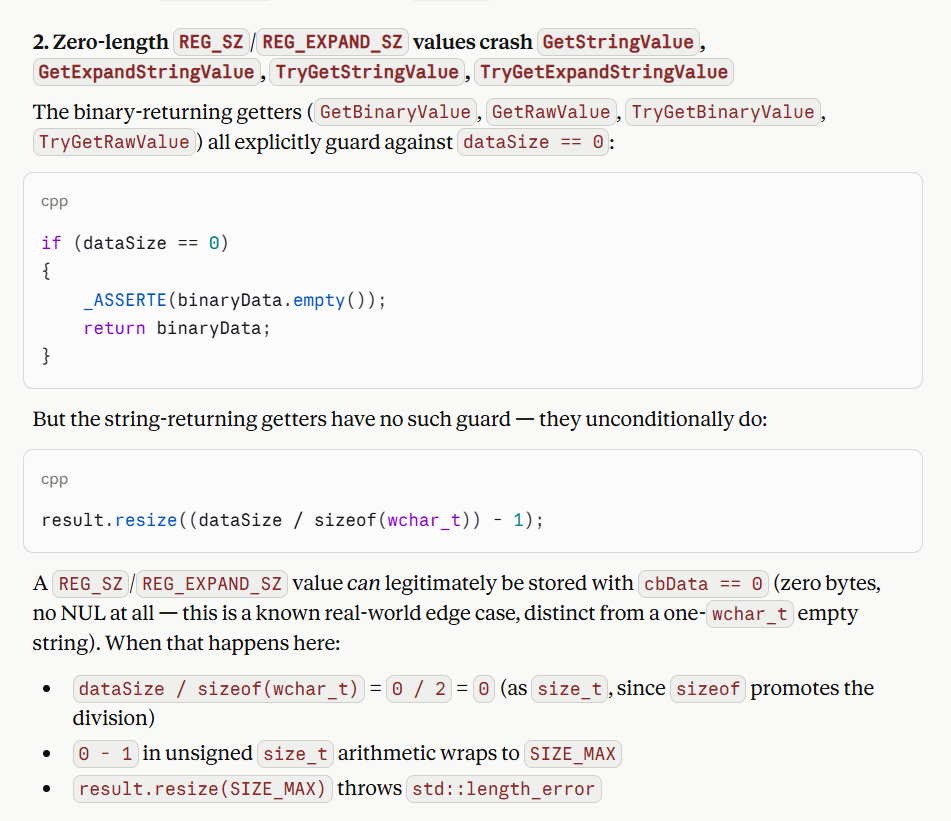
As a result of its analysis, Claude reported that there were zero-length bugs in my code, in particular Claude stated that zero-length REG_SZ/REG_EXPAND_SZ values crash the GetStringValue, GetExpandStringValue, TryGetStringValue and TryGetExpandStringValue methods of the RegKey class.
In particular, Claude noted that I correctly guarded against dataSize == 0 in the binary-returning getters (like RegKey::GetBinaryValue), but the string getters do not have such guard; they *unconditionally *do:
result.resize((dataSize / sizeof(wchar_t)) - 1);
Claude specified that REG_SZ and REG_EXPAND_SZ values can be legitimately stored with cbData == 0 (zero bytes, no NUL at all; different from an empty string made by a single NUL ‘\0’).
If you substitute zero for the dataSize variable in the above statement, you end up with:
result.resize(SIZE_MAX);
which would throw a std::length_error exception.
Claude proposed to fix the above code using the same edge-case check logic I had already implemented in the binary getters to guard against the zero-length case:
if (dataSize == 0)
{
    result.clear();
}
else
{
    result.resize((dataSize / sizeof(wchar_t)) - 1);
}
My WinReg library is quite battle-tested, and there were bugs related to some edge cases that I had already fixed, so I was curious, and tried writing a zero-length string value in the registry, and read it back with my existing code. And I noted that (at least in Windows 11 where I tested my code) the dataSize == 0 condition was *not *hit at run-time.
That is because in my C++ code I invoke the RegGetValue(W) API, which by contract guarantees to return a NUL-terminated string, even if the string stored in the registry doesn’t have a NUL-terminator. (This is not the case for older APIs like RegQueryValueEx.)
I replied to Claude pointing that out, and Claude corrected itself:
You’re right, and thanks for the pushback — I should have accounted for
RegGetValueW
‘s null-termination guarantee before flagging that as a bug.
Those AI tools can be very powerful, but the key takeway here is that we should not forget that they are just ** tools**, and we should not trust AI-generated output and code 100%, because bugs and wrong assumptions can be hidden in that AI code, too.