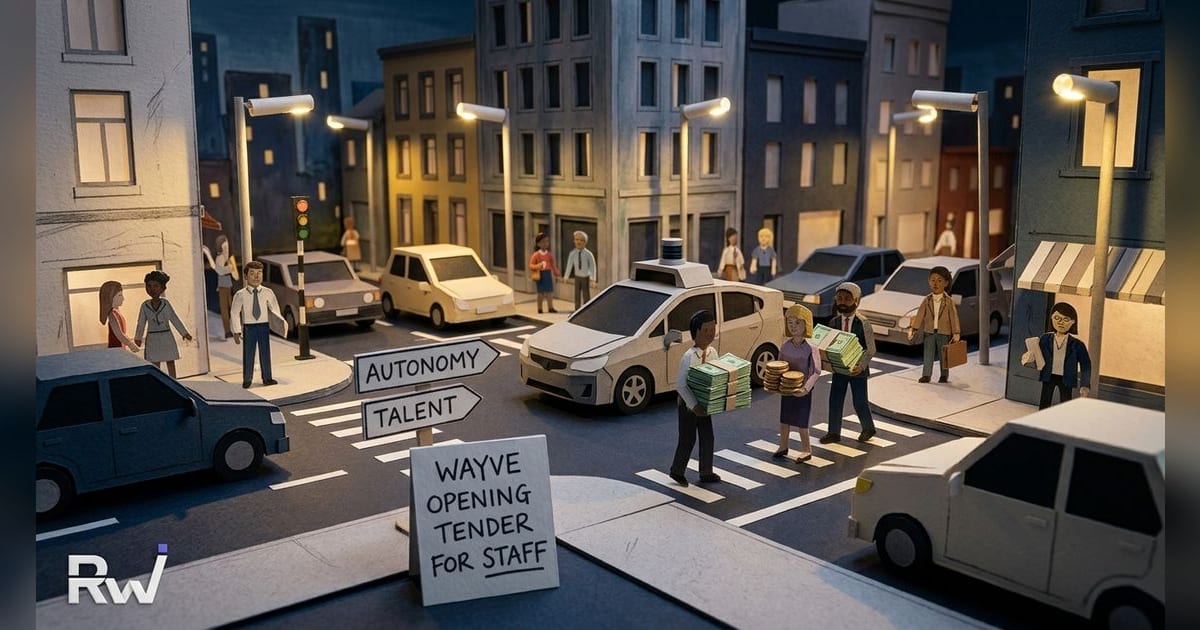
Alex Kendall is giving Wayve employees a chance to cash out part of their vested equity through an $85 million tender offer, a compensation move that says as much about the AI talent market as it does about autonomous vehicles.
The London self-driving software company is allowing employees to sell shares to existing and new investors at an $8.5 billion valuation, TechCrunch reported late Tuesday. The buyers were not named in the report, and the terms that matter most to employees - eligibility, sale limits, allocation and closing date - were not disclosed.
For Kendall, Wayve's co-founder and CEO, the tender is a pressure-release valve at a company that has moved from a contrarian Cambridge research thesis to one of Europe's most heavily funded AI infrastructure bets. Wayve says it more than doubled headcount over the past year to 1,200 employees, according to TechCrunch. That growth came after a financing run that would test any private company's retention system: a $1.05 billion Series C in May 2024, a $1.2 billion Series D in February 2026, and strategic capital from the chip and auto ecosystem around it. This is Wayve's second employee liquidity event. TechCrunch reported that the first came alongside Wayve's May 2024 Series C, which was led by SoftBank Group with participation from NVIDIA and Microsoft. The new tender is tied to the valuation set around Wayve's February Series D. TechCrunch puts that latest valuation at $8.5 billion; Wayve's own Series D announcement described the round as a $1.2 billion raise at an $8.6 billion post-money valuation, within a broader $1.5 billion capital package that included milestone-based Uber funding.
The difference is not the story. The structure is. Wayve is not raising a primary round here, at least not in the facts disclosed. It is letting employees turn paper gains into cash while keeping them inside the company for the more difficult part: proving that its end-to-end driving model can leave demos and pilots behind and become software inside fleets and production cars.
From a Cambridge thesis to a balance-sheet problem
Kendall's founder story matters because Wayve's financing and retention strategy are inseparable from the technical bet he has been selling since 2017. Wayve was built around the idea that self-driving systems should learn from data instead of depending mainly on high-definition maps, hand-coded rules and city-by-city engineering. Kendall's Wayve profile says he developed the company's end-to-end AI approach after PhD research at the University of Cambridge in deep learning, computer vision and robotics.
The founder path started far from the AV industry's usual California corridor. The University of Auckland described Kendall as Christchurch-raised, a mechatronics engineering student who went straight from high school into the second year of the program in 2011 and later graduated first in his class. The same profile says Wayve traces back to engineering projects on Kendall's family farm and to time spent building robots and drones in Auckland labs before he moved to Cambridge as a Woolf Fisher Scholar.
Kendall has framed the company less as a car company than as an embodied-AI company. Wayve's AI Driver product page says the software learns from real-world data, is designed to integrate across vehicle platforms and does not rely on detailed HD maps. The product portfolio spans assisted-driving and automated-driving use cases, from driver-assistance features through L4 robotaxi applications.
That technical bet gives the tender its strategic context. A mapless, learned driving system is only as strong as its data, evaluation infrastructure, safety work, partnerships and deployment team. Those employees are expensive, mobile and highly poachable. A tender offer lets Wayve compete with the immediate cash compensation of larger AI labs and the upside pitch of new startups without forcing employees to wait for an IPO or acquisition.
The investors are buying more than employee shares
Wayve's investor list has become a map of the market it is trying to enter. Its February Series D was led by Eclipse, Balderton and SoftBank Vision Fund 2, with participation from Ontario Teachers' Pension Plan, Baillie Gifford, British Business Bank, Icehouse Ventures, Schroders Capital, Microsoft, NVIDIA, Uber, Mercedes-Benz, Nissan and Stellantis, according to Wayve.
That mix is useful to Kendall because Wayve is not trying to build only its own robotaxi network. The company says it licenses AI Driver to automakers and mobility platforms, a model that keeps Wayve closer to a software platform than a vertically integrated fleet operator. In its February announcement, Wayve said it planned commercial robotaxi trials with Uber in 2026 and consumer-vehicle deployment from 2027.
The commercial calendar has since filled in. In March 2026, Wayve, Uber and Nissan announced plans for a Tokyo robotaxi pilot by late 2026, subject to discussions with authorities, using Nissan LEAF vehicles powered by Wayve AI Driver and available through Uber. The initial phase is expected to include a trained safety operator in the car. Nissan separately said its next-generation ProPILOT system featuring Wayve AI Driver software is planned for fiscal year 2027.
That is the execution gap behind the tender. Wayve has prominent partners, but partnerships are not deployments at scale. It has a large valuation, but revenue, ARR, gross margin, customer count and contract values were not disclosed in the TechCrunch report or Wayve's cited company materials. The disclosed facts show a company with capital, partners and a hiring machine. They do not yet show the commercial economics of its software model.
Employee liquidity is becoming AI infrastructure
Wayve's tender follows a pattern across AI startups with rich private valuations and employees sitting on illiquid stock. TechCrunch compared Wayve's tender with recent liquidity programs at Decagon, ElevenLabs, Linear and Clay. The pattern is straightforward: as private AI companies stay private while valuations move quickly, employee equity can become both a recruiting weapon and a retention risk.
The incentive cuts both ways. For employees, a tender reduces the all-or-nothing nature of startup compensation. For investors, it can be a route to increase ownership in a company where primary allocations are limited. For founders, it is a way to keep a team focused during the long stretch between funding headlines and durable revenue.
Wayve's version is especially important because autonomy is a long-cycle category. The company is asking employees to work through regulatory, safety, automotive-integration and fleet-deployment problems that do not move at the speed of model demos. A tender gives Kendall more time to make the product case before the labor market forces a different conversation.
The unanswered question is whether the same investors willing to fund employee liquidity will be rewarded by the business underneath it. Wayve says its AI has driven zero-shot in more than 500 cities across Europe, North America and Japan in a single year, and says its foundation model is trained on data spanning more than 70 countries. Those are company claims about technical generalization, not proof of unit economics. The next test is whether automakers and mobility platforms turn that generalization into paid deployments.
For now, the $85 million tender is a founder's operating tool. Kendall has convinced major investors and strategic partners that Wayve's old heresy - learning to drive from data instead of mapping the world first - is worth billions. Keeping the people who can turn that thesis into shipped autonomy is now part of the financing plan.