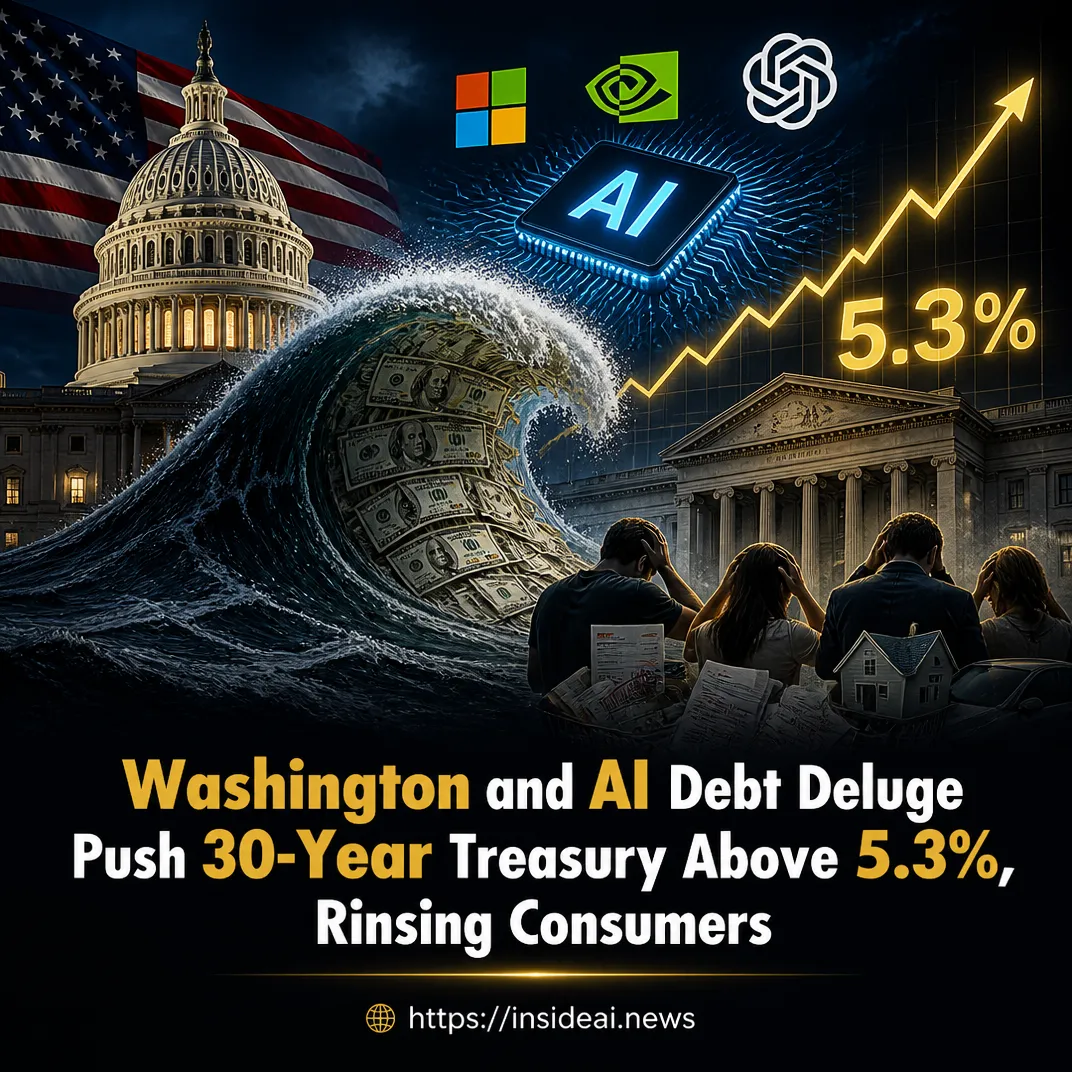
August 19, 2026, (Inside AI) — A surge in U.S. government borrowing and a parallel boom in data-center construction are converging to push long-term interest rates to levels not seen in nearly two decades. The 30-year Treasury yield briefly crossed 5.3% on August 18, its highest since 2007, as global bond markets retreated.
The immediate consequence is a sharp rise in mortgage rates, which are closely tied to long-term Treasury yields. Higher borrowing costs are already cooling the housing market. New residential construction starts fell 12.4% in July from June and were down 13.5% from July 2025.
This dynamic creates a feedback loop. As households pull back on home purchases and renovations, consumption weakens. The drag on spending could slow broader economic growth at a time when federal deficits remain historically large.
The bond market's retreat reflects investor wariness. Washington's towering deficits require constant new issuance of Treasury debt. At the same time, the artificial intelligence industry is driving an unprecedented build-out of data centers, much of it financed through corporate bonds and other debt instruments.
That twin supply shock is testing the market's capacity to absorb new paper without demanding higher compensation. The result is a repricing of risk across the yield curve, with the long end most exposed.
The housing sector is the most visible casualty. Mortgage rates have climbed in lockstep with Treasury yields, reducing affordability for first-time buyers and slowing refinancing activity. Homebuilders are responding by cutting back on new projects, as the July starts data confirm.
The economic stakes extend beyond housing. Residential investment is a key driver of GDP and employment. When construction slows, related industries such as appliances, furniture, and building materials also feel the pinch.
Investors are now watching for signals from the Federal Reserve. While the central bank does not directly control long-term rates, its policy stance influences the entire curve. Any indication that the Fed will tolerate higher yields to combat inflation could accelerate the bond selloff.
The data-center boom adds a structural dimension to the problem. AI companies are spending tens of billions of dollars on new facilities, often financed with debt. That competes directly with government borrowing for investor capital.
Some analysts argue the AI infrastructure build-out is a one-time adjustment that will eventually moderate. Others warn that the demand for computing power is still accelerating, implying continued pressure on credit markets.
What is clear is that consumers are bearing the cost. Higher mortgage rates mean higher monthly payments for new buyers. Existing homeowners with fixed-rate loans are less exposed, but those seeking to move or refinance face a harsher environment.
The current episode echoes past periods when fiscal expansion collided with private investment needs. In the early 1980s, large deficits and tight monetary policy pushed mortgage rates above 18%. The scale is different today, but the mechanism is similar.
Unlike that era, the modern economy is more financialized. Household balance sheets are more sensitive to interest rate changes. A sustained rise in long-term yields could have outsized effects on consumer spending and asset prices.
Gabriel Rubin, a U.S. columnist for Reuters Breakingviews, noted that the combination of federal deficits and the data-center building spree is "flooding bond markets."
"As wary investors demand higher yields, mortgage rates suffer, sapping household investment. The result will be a drag on future consumption." Gabriel Rubin, U.S. columnist, Reuters Breakingviews
The full Breakingviews analysis will be published shortly. For now, the data points to a tightening of financial conditions that could weigh on growth through 2027.
Policymakers face a difficult trade-off. Fiscal restraint would ease bond market pressure but could slow the economy. Continued deficit spending risks pushing yields even higher, further squeezing housing and consumption.
For consumers, the message is stark. The era of ultra-low mortgage rates is over. The convergence of AI-driven capital demands and persistent government borrowing has created a new regime in which long-term rates are structurally higher. That shift will reshape decisions about homeownership, saving, and investment for years to come.