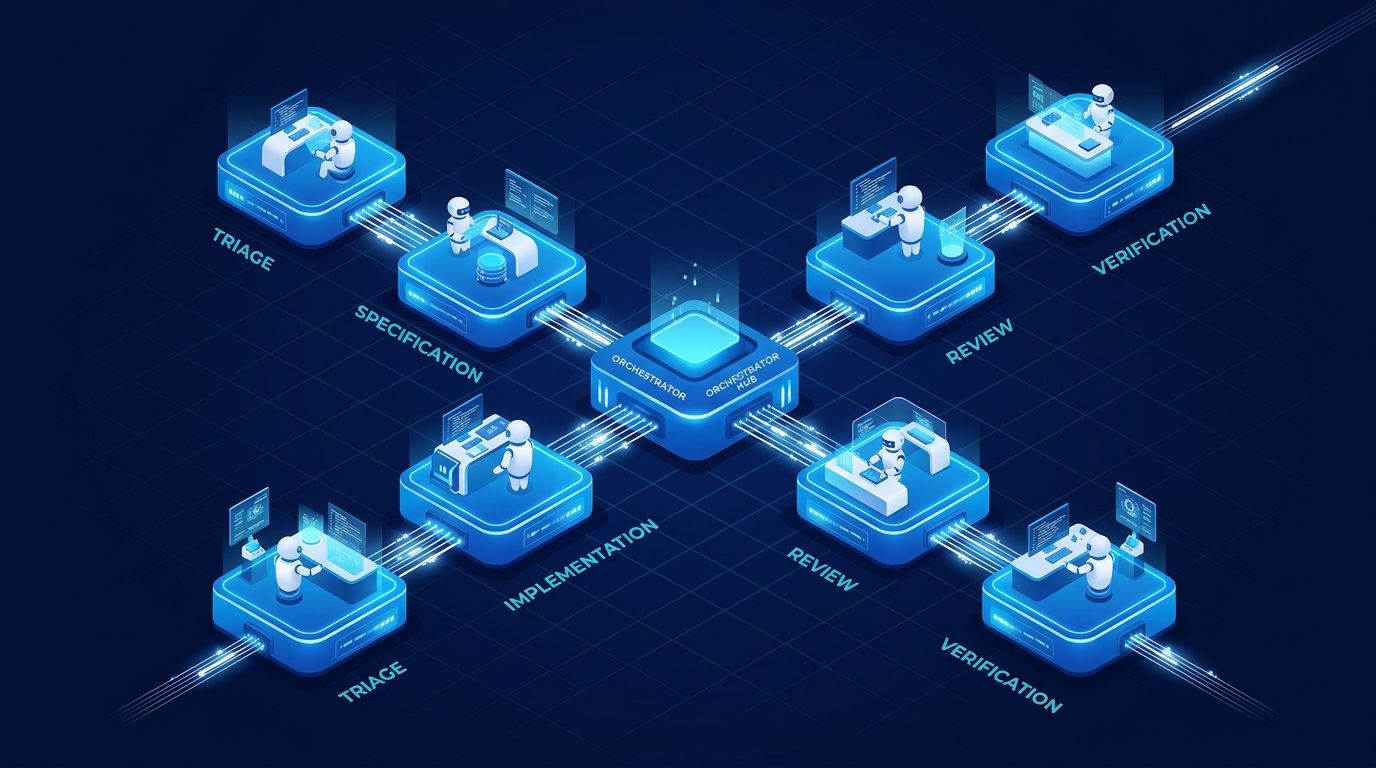
Warp launched Warp Factories on August 18 — a cloud infrastructure platform for deploying autonomous AI software pipelines that handle triage, specification, coding, review, and verification as a connected system. The premise: most engineering teams want something like this but lack the infrastructure expertise to build it. Warp claims its own teams already automate 30 to 35 percent of engineering tasks through Warp Factories, and the company is now offering qualified organizations $10,000 in factory usage to try it in closed beta.
Why Agent Orchestration at Scale Is a Different Problem #
Running a coding agent on your laptop is a solved problem in 2026. Running a coordinated fleet of agents across your entire software development lifecycle — triaging incoming work, writing specifications, implementing code, reviewing pull requests, and verifying end-to-end functionality — is not. As Warp CEO Zach Lloyd told TechCrunch, “running your agents in the cloud and steering those agents as they run…it’s actually a huge infrastructure undertaking to do this right.”
The companies that have cracked this are the ones with the engineering resources to build proprietary factory systems — Stripe, Ramp, and a handful of others at that scale. Everyone else is either duct-taping together individual coding agents or waiting for something that ships the whole pipeline. Warp Factories is positioning itself as the latter: pre-built orchestration infrastructure with full customization, where you own the models, the data, and the compute.
The Six-Stage Pipeline #
Warp Factories runs a default six-stage orchestration pipeline:
Triage— evaluates incoming work items and routes them appropriately: implement now, needs clarification, or wait** Spec**— interacts with humans to clarify ambiguous requirements before any code is written** Implement**— writes code using computer-use capabilities on Linux or macOS** Review**— analyzes code quality and flags issues before any merge decision** Verification**— runs end-to-end functional tests via computer-use to validate the implementation** Foreman**— the orchestrator agent that routes work through the pipeline and selects the optimal model for each task
Work enters the factory from Slack or Teams messages, Linear or Jira issues, GitHub issue trackers, Sentry alerts, or directly from a terminal via Factory MCP. The complete loop in practice: Sentry detects a crash, creates a Linear ticket, the triage agent assesses severity, the implementation agent writes a fix, computer-use verification runs the test suite, the review agent approves, a human optionally reviews, and the PR merges — without a developer sitting at a keyboard for every step.
Factory-as-Code and the Self-Improvement Loop #
The entire factory configuration lives in version-controlled YAML. That means canary deployments of new agent configurations, rollback when something breaks, and the ability to ship factory improvements as pull requests — including PRs generated by the factory itself. Observer agents score pipeline runs and automatically submit PRs that improve model selection, context provision, skill definitions, and prompt engineering. The factory optimizes itself over time.
The platform is model-agnostic: Claude Code, Codex, and open-weight models are all supported. The Foreman agent benchmarks configurations and selects models per task. Teams that need full data sovereignty can bring their own inference infrastructure or run the entire system on-premises. Zero Data Retention is available for organizations that need to prohibit model training on their codebase.
The 30% Number and the Honest Caveat #
Warp’s claim that 30 to 35 percent of their own engineering tasks run through Warp Factories is notable — but it is first-party data. There are no independent customer case studies yet, because the product is in closed beta with a limited onboarding cohort. The TechCrunch coverage has the CEO context, and the “software factory” category itself is roughly nine months old. Public launch is not planned until early 2027, and pricing beyond the $10,000 beta credit is not disclosed.
None of that makes the announcement less significant — it makes it honest. Warp is offering a real head start to teams willing to invest early in an infrastructure category that is still forming. The beta application, integration details, and the MIT-licensed Cloud-Factory-Demo are all in Warp’s announcement post. The official launch announcement covers the access model and data sovereignty options in full.