A Snyk benchmark initiative
A repeatability and Snyk-reference agreement study
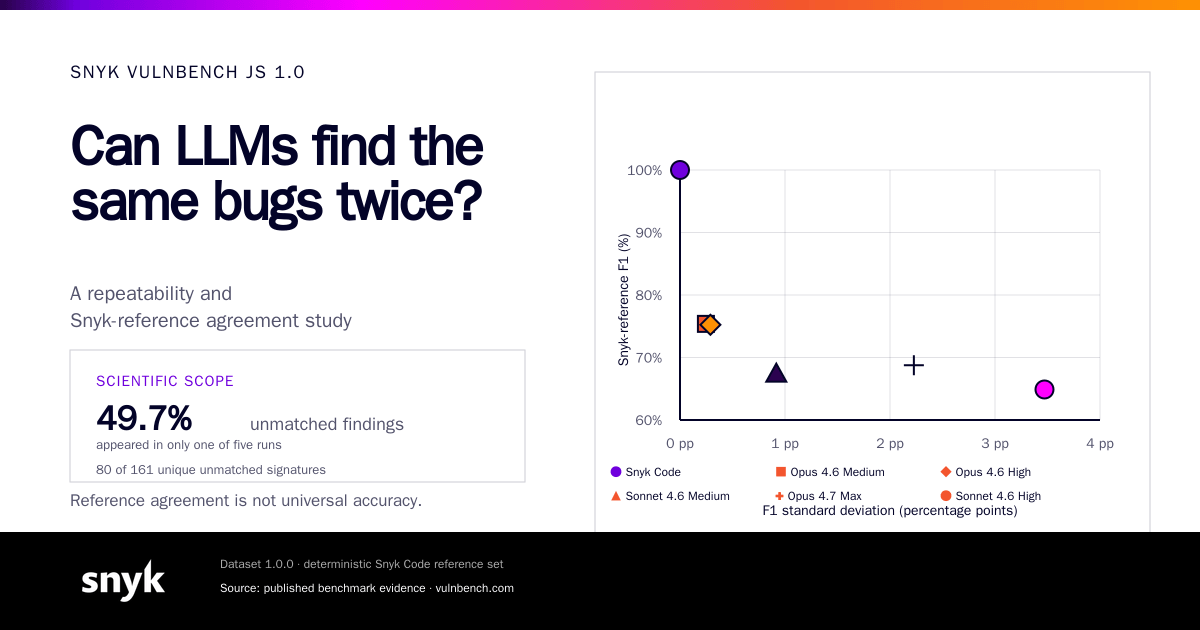
We ran the same agentic security review five times against inspectable JavaScript projects to measure what recurs, what varies, and how model findings align with a deterministic Snyk Code reference set.
- 300
- scans
- 10
- projects
- 6
- configurations
- 5
- repetitions
Headline evidence · 5 identical reviews
Same review. Different results. #
300 scans · 10projects · 6 configurations
84.8%
13.7%
49.7%
134 of 158 Reference-matched findings seen in all five runsInspect22 of 161 Unmatched findings seen in all five runsInspect80 of 161 Unmatched findings seen in only one runInspect
134 of 158 · Reference-matched findings seen in all five runs
View exact recurrence values #
| Finding group | Count | Share |
|---|---|---|
| Reference-matched findings seen in all five runs | 134 of 158 | 84.8% |
| Unmatched findings seen in all five runs | 22 of 161 | 13.7% |
| Unmatched findings seen in only one run | 80 of 161 | 49.7% |
Source: published JS 1.0 paper
Latest evidence · JS 1.0
Same code. Same prompt. Different findings. #
Across five identical runs, 84.8% of reference-matched findings recurred every time. Nearly half of unmatched reports appeared only once—evidence to inspect, not dismiss.
What the results mean in practice
An AI review is a measurement—not a verdict. #
Repeat the same task and the story sharpens: many reference-matched findings hold steady; AI review and deterministic SAST reveal different blind spots; and more spend does not reliably improve Snyk-reference agreement.
- 01
Repeatability makes confidence visible
134 of 158 reference-matched findings appeared in every one of five identical reviews. Repetition shows which reported patterns persist instead of relying on a single run.
Interpret with care: A reference match measures agreement with Snyk Code, not independent ground-truth accuracy.Open the evidence - 02
AI review and SAST expose different blind spots
Models surfaced high-signal exploit shapes, while deterministic Snyk Code consistently enumerated repeated data-flow sinks. Their differing results are useful evidence—not a reason to declare one a universal winner.
Interpret with care: Unmatched findings require case-level inspection before they can be classified.Open the evidence - 03
Paying more did not reliably improve the result
In this benchmark, higher session cost did not consistently yield higher Snyk-reference F1. Spend alone is a poor shortcut for choosing a configuration.
Interpret with care: Cost estimates reflect the tested small fixtures and publication assumptions.Open the evidence
Benchmark anatomy
How VulnBench measures behavior #
Repeat the conditions, preserve the evidence, and separate observed agreement from claims the protocol cannot support.
- 1
Select inspectable projects
Ten small JavaScript and Express fixtures make every run and reference finding reviewable.
- 2
Repeat the same task
Each configuration sees the same code, prompt, harness, and task five times.
- 3
Normalize findings
Reported issues become documented signatures suitable for recurrence analysis.
- 4
Match the reference set
The scorer compares vulnerability type against deterministic Snyk Code findings.
- 5
Measure behavior
Agreement, recurrence, variance, coverage, cost, tokens, and duration stay distinct.
- 6
Inspect divergence
Unmatched reports remain evidence to investigate—not automatic false positives.
Research principles
Evidence before ranking #
VulnBench is a versioned research initiative, not a universal leaderboard. Every release defines what it measured and what it did not prove.
- Transparent reference sets
- Definitions and limitations stay visible.
- Repeated measurement
- Variance is a result, not a footnote.
- Inspectable cases
- Headline claims link toward underlying evidence.
- Reproducible data
- Versioned source artifacts remain downloadable.
- Explicit limitations
- Agreement is never relabeled as accuracy.
Release history
Snyk VulnBench JS 1.0 Published 11 June 2026 · Current
Further releases are planned. Unpublished results will not appear as speculative rankings or empty release cards.
Publication
Read, reproduce, and cite the work #
The paper, reviewed methodology, source snapshot, and release data use stable public links.
Preferred citation
@misc{tal2026snykvulnbenchjs10,
  author = {Tal, Liran and Kloos, Johannes and Rudich, Arsenii and Thoemmes, Stephen and Nair, Manoj},
  title = {Snyk VulnBench JS 1.0: Can LLMs Find the Same Bugs Twice?},
  year = {2026},
  url = {https://arxiv.org/abs/2606.15762}
}