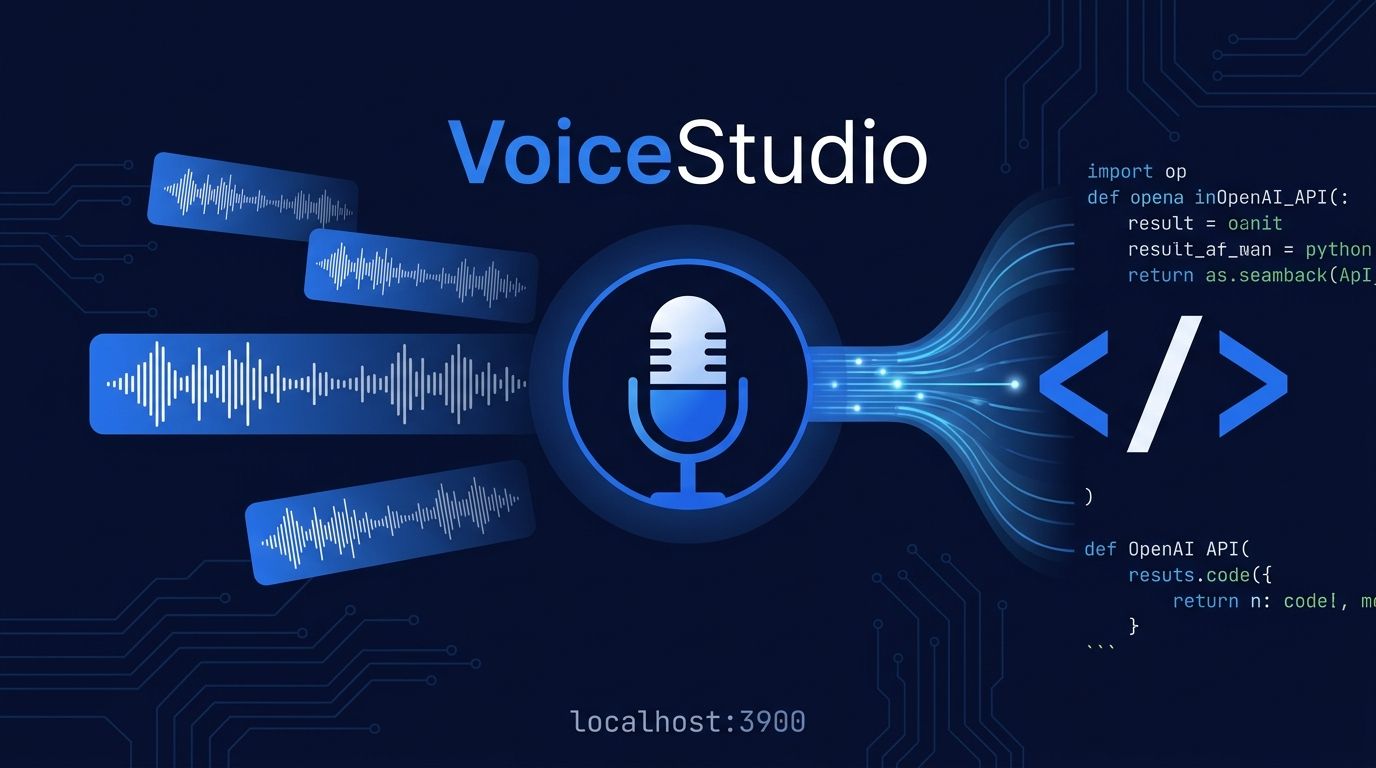
VoiceStudio crossed 18,000 GitHub stars this week and held the top spot on GitHub’s AI trending list for most of September. The project is an open-source desktop app for voice cloning, text-to-speech, transcription, and video dubbing — fully local, no subscriptions, no metered API. The interesting part for developers is not the price tag. It’s that the backend exposes an OpenAI-compatible REST API on localhost:3900, which means swapping from ElevenLabs to your own machine is a one-line change.
One Line to Go Local #
VoiceStudio runs a FastAPI backend that mirrors the OpenAI audio API surface. If you already call /v1/audio/speech or /v1/audio/transcriptions through the OpenAI Python SDK, you change the base URL and nothing else:
from openai import OpenAI

client = OpenAI(
    base_url="http://localhost:3900/v1",
    api_key="local",  # any non-empty string
)

speech = client.audio.speech.create(
    model="tts-1",
    voice="my-cloned-voice",
    input="Your local voice pipeline, zero cloud dependency.",
)
speech.stream_to_file("output.mp3")
No API key validation on loopback — pass any non-empty string. The API also ships with an MCP server, so Claude Code and Cursor can trigger voice synthesis and transcription directly through agent tool calls. If you are already building with Claude Code’s managed agents, voice output becomes a local tool rather than an external API dependency.
What It Actually Does #
VoiceStudio (formerly OmniVoice Studio, renamed in v0.5.0) is built on a three-layer stack: a Tauri v2 desktop shell in Rust, a React/Vite frontend, and the FastAPI backend. It runs on macOS, Windows, Linux, and Docker. The latest release is v0.5.2, out September 10, 2026.
The engine catalogue is broad: 16 TTS engines and 11 ASR engines, including Kokoro, Chatterbox Turbo, Chatterbox Multilingual, XTTS, Piper, and Qwen3 TTS, across 646 languages. You pick engines per task in the Model Catalogue workspace, which shows install state and device routing in one place.
Voice cloning works from a short audio clip — three seconds of clean audio is enough, five to fifteen seconds is better. All processing runs locally; recordings do not leave your machine. Version 0.5.0 added GPU sharing: borrow a remote machine’s GPU with a join code and a QR scan, useful if your local hardware lacks a dedicated GPU.
The Cost Math #
ElevenLabs charges $0.10 per 1,000 characters for Multilingual TTS; professional voice cloning requires at minimum the Creator tier at $22 per month for 100,000 characters. That is not outrageous for a SaaS product, but it adds up quickly in voice-heavy pipelines — documentation narration, audiobook generation, internal training videos. VoiceStudio’s cost is whatever electricity your GPU consumes.
The privacy story is equally relevant. By default, audio recordings, transcripts, and voice profiles stay on local disk. Data leaves your device only when you explicitly configure remote workers or external ASR endpoints. For legal, medical, or confidential content where cloud uploads are not an option, VoiceStudio removes a category of risk entirely. It also enables AudioSeal imperceptible watermarking by default, allowing synthetic speech to be detected after the fact without audible quality degradation.
Before You Ship It: The AGPL Caveat #
Using VoiceStudio personally or inside your own infrastructure does not trigger any obligations. The AGPL-3.0 license becomes relevant the moment you distribute a modified version or wrap it in a network service you offer to others. At that point, you must provide the corresponding source under the same license. The developer offers a commercial license for proprietary embedding — check voicestudio.sh/license before building VoiceStudio into a product you ship. Individual speech models also carry their own licenses, some more restrictive than AGPL, so verify each engine you use commercially.
Quality-wise: hosted ElevenLabs still has an edge at its highest settings, particularly for English naturalness. Chatterbox Multilingual and Kokoro are competitive for most production use cases, but if you need voice quality indistinguishable from a professional studio recording, run a blind test before committing to a local setup.
Getting Started #
Install from voicestudio.sh or clone the GitHub repository directly. On Windows, the setup is three commands:
git clone https://github.com/debpalash/VoiceStudio.git
cd VoiceStudio
bun run desktop-prod
The first launch downloads model weights with a progress screen. The quickstart guide covers initial engine selection; the API reference documents all endpoints.
If you are running an agent pipeline that currently calls ElevenLabs, the migration is a twenty-minute experiment. The OpenAI SDK does the heavy lifting; change one line and see whether the local quality meets your bar. If it does, you eliminate both the billing and the data-transfer risk in one move.