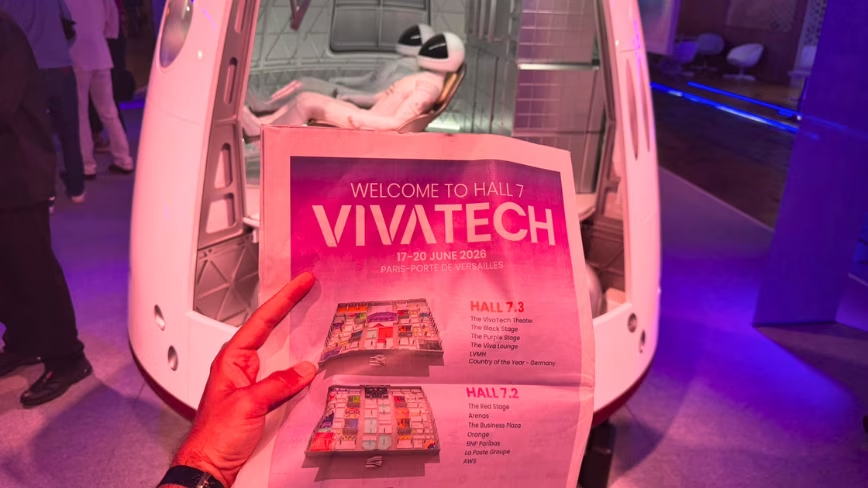
A decade after it began as France’s answer to the world’s great tech shows, VivaTech has become the place where Europe makes its case for the future, and the 2026 edition was its most confident yet.
Every June, a corner of south-west Paris turns into the busiest crossroads in European technology.
VivaTech is the continent’s largest tech and startup festival, a four-day gathering at Paris Expo Porte de Versailles where founders, investors, engineers, students, and heads of state share the same halls.
It exists to do something deceptively simple: put the people building the future in a room with the people who can fund it, hire it, regulate it, or buy it. Ten years in, that idea has become one of the defining fixtures of the global tech calendar.
The 2026 edition, held from June 17 to 20, was the festival’s 10th, and it wore the anniversary well. Around 200,000 visitors passed through, up from roughly 180,000 in 2025.
To make room, organisers opened a new three-floor Hall 7 that added about 40% more floor space and roughly doubled the seating of the year before.
The growth tells its own story: across a decade, VivaTech says its audience has expanded some 300%, its startup count has tripled, and the number of investors passing through has multiplied roughly twelvefold.
A show that launched in 2016 as France’s answer to the world’s great technology fairs now stands, comfortably, as the biggest of its kind in Europe.
This year’s organising theme set the tone: “Artificial intelligence: impact, not illusion.”
It was a confident, grown-up framing, an invitation to look past the hype and celebrate AI that delivers real, measurable results, and the four-day programme largely rose to it. The headline act, fittingly, thought big.
Bezos, the Moon, and a vision of abundance
On the opening afternoon, Jeff Bezos took the main stage for some 50 minutes alongside Blue Origin chief executive Dave Limp, in a session moderated by the former NASA astronaut Mike Massimino.
The Amazon founder used the slot not to talk about retail or even AI, exactly, but to make an argument about where humanity should put its factories.
Heavy, polluting industry, he suggested, should eventually move off the planet entirely, leaving what he called a “garden planet” that could be “returned to its pre-industrial revolution state.”
The case, as Bezos and Limp framed it to outlets, was that shifting industry into space is the only scenario in which economic growth and environmental preservation genuinely coexist.
The Moon, in this telling, is not a vanity destination but raw material: its surface holds the minerals needed to build orbital infrastructure, and its water ice can be converted into liquid oxygen for deep-space travel at a fraction of the cost of launching propellant from Earth.
Limp added a detail that did the rounds for the rest of the week, recounting that Bezos had told him Blue Origin could one day become a company larger than Amazon.
It was the kind of expansive, optimistic vision that VivaTech exists to platform, and the room responded in kind.
Bezos offered a line that captured the festival’s mood better than any keynote slide: there has, he said, never been a better time to be an entrepreneur.
Coming from the founder of one of the most valuable companies ever built, addressing a hall full of people trying to build the next one, it landed as encouragement rather than salesmanship.
A third way, staged for the cameras
The following day belonged to geopolitics. Indian Prime Minister Narendra Modi joined French President Emmanuel Macron on stage on June 18, with India serving as the event’s official AI Country Partner.
It was, by India’s own account, its largest-ever presence at the festival, with more than 80 deep-tech companies and startups and pavilions spanning digital public infrastructure, health tech, clean energy, mobility, and advanced computing.
Modi used the platform to set out a human-centric approach to AI governance, built around a framework he has promoted under the acronym MANAV, a roadmap rooted in democratic values and the priorities of the Global South.
The shared message from Paris and New Delhi, as the French outlet Info.fr described it, was a positive one: Europe and India sketching their own confident path on AI, distinct from the American and Chinese models that dominate the field.
It is a theme TNW has tracked closely, as Europe races to resolve its AI sovereignty questions. It was a reminder of how far VivaTech has come, from a national trade show to a stage where two democracies set out a common technological vision before a global audience.
Where the actual machines were?
The festival floor is where “impact, not illusion” had to earn itself, and the most talked-about exhibits leaned hard into the physical. Humanoid robotics had a bigger presence than in any prior year.
The Chinese firm Unitree demonstrated a humanoid in collaboration with the French neuro-AI startup HABS, including a live demonstration of non-invasive brain signals being used to direct a robot.
French startup Enchanted Tools brought back Mirokai, its expressive wheeled humanoid already trialled in hospital settings, while PAL Robotics showed its TIAGo Pro and a newer humanoid named Kangaroo, and China’s Agibot displayed its Lingxi X2.
Not everything was a robot. A French company called Lifepods drew crowds with a personal survival capsule designed for flood zones, tsunami-risk coastlines, and earthquake areas, a product that felt like a small comment on the decade it was launched in.
The audio startup Skyted showed an earpiece built to let people speak privately in noisy public spaces, and beauty-tech firm Perfect Corp demonstrated AI tools for personalised skincare and makeup.
The through-line, if there was one, was AI as plumbing rather than spectacle, embedded in something you could touch.
The unicorn pipeline
For all the celebrity wattage, VivaTech’s clearest claim to substance is its track record of spotting companies before they get big. The festival’s annual “Top 100 Next Unicorns” list, its five awards including the Female Founder Award and the AfricaTech Award, and its alumni roster are the parts of the programme that survive the news cycle. The festival notes that a third of the companies on its top lists from 2019 to 2023 have already reached unicorn valuations.
The home crowd had fresh examples to point to. Pigment, a French business-planning platform founded in 2019, has crossed the $1bn mark to join the country’s short list of homegrown unicorns, and was profiled by France 24 during the show.
Pasqal, a French quantum-computing company working on neutral-atom hardware, closed a $100m round in early 2026 to reach unicorn status, months after appearing at the 2025 edition.
Pennylane, a fintech that won its category at a previous VivaTech, has since done the same. These are the data points organisers reach for, and they matter more than ever in a year when French startup funding dipped even as AI investment concentrated.
A festival that grew up
So did the anniversary edition live up to its own slogan? By and large, yes. The robots were real, the unicorns are real, and the decision to frame the festival around AI that delivers measurable results gave the whole event a sense of purpose.
The expansion into Hall 7 and the jump to 200,000 visitors are signs of an industry, and a continent, that is energised about what it is building.
What stood out most was the range. In a single venue you could watch a billionaire sketch an abundant future in orbit, hear two democracies set out a shared vision for AI, and then walk a few aisles to shake hands with a humanoid robot or meet the founders of the next French unicorn. T
hat breadth is VivaTech’s real achievement at 10: it has become the place where Europe gathers to be ambitious out loud. The first edition drew 45,000 curious visitors to see what the fuss was about.
A decade later, 200,000 came to help build what comes next, and on the evidence of this year, they will be back.
Get the TNW newsletter #
Get the most important tech news in your inbox each week.