Not So Amped
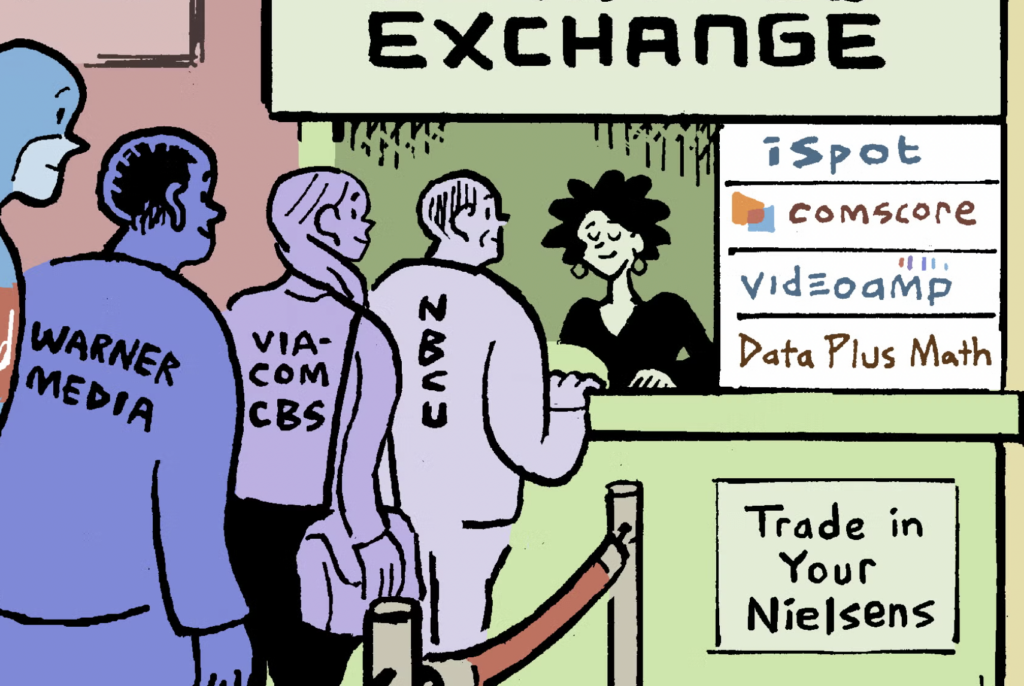
VideoAmp laid off 20% of its staff last week.
The ad measurement provider has been no stranger to layoffs as it strives to dethrone the incumbent Nielsen. VideoAmp also previously cut 20% of its workforce in 2024.
This time, however, AI is being cited as the reason for eliminating more than 50 roles, including chief technology officer, The Wall Street Journal reports.
The latest layoffs “reflect our long-standing approach of adapting early to major changes in the market,” CEO Tony Fagan said in a statement. In this case, those “major changes” mean adopting agentic tech and AI agents to do work previously handled by software developers, product managers and others.
VideoAmp is far from the only company cutting headcount in favor of AI agents that don’t show up on payroll – but it’s going further than most by eliminating the CTO role altogether. Fagan previously served as president of technology and strategy before becoming CEO earlier this year, when the company also scrapped its CMO position.
All Systems Ro’
With its acquisition by Fox on the horizon, Roku is touting its streaming gains. Roku’s platform revenue, which includes ad revenue and streaming subscriptions, rose 25% year over year to $1.22 billion. According to Roku, its growth was driven mostly by increased viewing hours, expanded ad inventory and new relationships with programmatic ad platforms.
Like just about every other platform trying to compete in streaming, Roku is banking on live sports and personalized home screen ads to increase session duration and, in turn, boost ad dollars. (Sports are an easy win with viewers; home screen ads not so much.)
Roku skipped a formal Q2 earnings call with investors because of the pending $22 billion acquisition, announced in June. In its place, CEO Anthony Wood used a shareholder letter to argue that joining forces with Fox will help Roku better compete with media and entertainment behemoths – an advantage that could become even more important if the Paramount-Skydance-WBD merger makes it through several antitrust challenges.
“Our pending acquisition by Fox,” Wood writes, “is an extraordinary opportunity to scale faster and innovate more aggressively for viewers, partners and advertisers.”
Performance Marketing Nomads
Ad attribution and analytics startup Northbeam published its biannual “Media Buyer Index” last week, and it highlights a few important year-over-year changes, especially on Meta.
For starters, customer acquisition costs are rising for the vast majority of advertisers on the platform – by more than 10% in most cases, although there are important divergences. But bigger advertisers – those with at least $100 million in annual revenue and stronger brands – are more likely to see better performance on Meta.
“The ad auctions, while defined in a way that suggests equal possibility as an ‘auction,’ are increasingly challenging for smaller advertisers,” writes Northbeam’s head of content, Bryan Bumgardner. “Scale has become more expensive.”
Brands spending more than $200,000 per month on Meta ads, for example, are outperforming both their category peers and the broader trend.
Meta doesn’t necessarily deserve all the blame, though. Costs are up across every platform because prices are rising everywhere else, too, from commodities and transportation to labor and technology. What marketers can control, though, is how they respond.
“To be blunt: Blame is not a strategy,” Bumgardner writes. “We must adapt.”
But Wait! There’s More!
How a satirical fake web standard about office cats called cats.txt convinced AI bots and search marketers it could improve search visibility, raising doubts about whether special text files can actually help websites show up in AI search results. [Search Engine Journal]
Influencers fear the AI “Scarlet Letter,” which is when platforms like TikTok or Meta categorize their content as generative AI even when it’s not. [Business Insider]
Remembering the pre-Google web when web search was just an experiment. [Ars Technica] A New Mexico court orders Meta to pay an additional $567 million in a child safety case. [TechCrunch]
Why does Apple keep banning Telegram from its App store, but never X? [[The Verge](https://www.theverge.com/tech/976405/apple-telegram-ban-x-app-store-violations)]

Mediaocean CEO Bill Wise on building the infrastructure for agentic advertising. [[tipsheet.ai](http://tipsheet.ai)]